
Quercus rubra browning out

rfwoodvt

New member
Hi There!

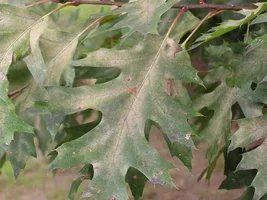
We've got a number of Quercus rubra that, at a distance, look like they are covered with brown dust. Upon further examination, they exhibit signs of progressive browing of the leaves from the veins outward.


If you turn the leaves over, the backs look fine.

This is appearing on many oaks throughout my county and there appears to be no real pattern as to which trees are affected.

Attached is a photo to show what's up.

I see no evidence of any unusual insects. Of those insects found there were the usual leaf galls, webs and what not. But nothing not normally seen.

Any help would be greatly appreciated.

Regards!
 

Attachments

  • 30250-oakleaves.webp
    30250-oakleaves.webp
    47.5 KB · Views: 282
SPIDER MITE - Oligonychus spp. - The dull green color to oak leaves may also be the result of spider mite feeding. They feed on the underside of the leaf and are not easily seen because of their small size. If you do not see the black specks and adult lacebugs, then the discoloration is probably from spider mites. Spider mites like the hotter part of the summer. They commonly attack spruce trees producing a reddish brown or purplish red color to the inner needles. One way to recognize their presence is the morning dew on the silk threads between the needles or the needle hanging in "mid air" by the silk thread. Besides the oaks and spruce, spider mites will feed on other trees such as scotch pine Christmas trees which were heavily damaged in recent years.

http://www.fnr.purdue.edu/inwood/summer.htm#SPIDER%20MITE

The only reason I even thought of this is that we say mites for the first time ever on azalea here this year! If we had unusual mite problems, then why can't y'all?
 
Hi Mark,

That was my first thought, though water has been fairly consistent throughout the summer as opposed to prior years.

If it were drought stress, wouldn't/shouldn't there be an associated wilting or drooping of the leaves prior to the browning out? Most confusing of all is that if you look on the back of the leaves, they appear perfectly normal..color, shine and otherwise.

This one is giving me fits as I cannot find anything else with a picture that looks like it.

It does not affect all trees in a group, though several may show the same symptoms. It also appears to be common, but not frequent...not like it is moving through from one to another in any progressive fashion.

Any suggestions as to examples of drought stress I can compare to?
 
I too was thinking a water problem. You say water's been good compared to previous years, what about LAST year,dry?
Also b eware of Bacterial Leaf Scorch. I'm not too familiar with it but I've been warned to watch my Oaks for unusual browning.
 
Hi,

Bacterial wilt apparently goes from the margins inward...so I don't think it is.

But, speaking of water, we've had several years of unbalanced rainfall...either all in the beginning or all at the end. This year, from my monitoring, has been fairly consistent.

It also just occurred to me that we have had an abundance of sunshine this year. some farmers/gardeners have called it the best growing season they have seen in years.

Supposedly NW Vermont receives less annual sunshine than any other part of the country except Seattle.

If we have had an abundance of sunshine, is it possible that we have had chlorophyll degredation or migration due to too much sunshine?

Would this also explain the normal coloration on the bottoms of the leaves?

HMMMM something to think about....apparently shade loving plants will brown out if they get too much sun...could be our oaks have adapted to less light and are compensating.

I'll have to see if I notice a pattern of browning among edge and open trees as opposed to those grown close in with others. I seem to recall this being the case.....

Anyhow, thanx for the help and I would definitely appreciate more!
 
That looks like damage from a sucking insect to me. It is described as stippling of the leaf. I'd guess it to be mite or lace bug damage. It also could be damage from an eriophyid mite.

Joe
 
After a five hour drive to scope the size of areas affected by browning we've concluded that we're in need of searching the climate databanks for changes not referred to much in daily news reporting.

Here we're in an three week long inversion whereby the both the light spectrum is filtered and particulate - specifically ozone related - has changed the O2 levels significantly. For the first time ever, we're able to test the pH of air by taking filter disks to solution.

Not familiar with a base-line understanding of normal ranges, things seem alarmingly extreme. Basically by looking at Mt. Pinatubo's data, we're in the middle of fallout yet there's been no significant feature event to point-source the culprit. Something is happening and we're associating the leaf response to the air's quality.

Working on it - but when we have time. In the interim I'm trying to prune some trees for money so I can feed my family and buy some drugs. I have been able to modify some nutrients for individual oaks delaying the chlorophyll loss but am not certain of the causitive issues in the first place. The research arm of our land grant school isn't interested, unless we write them a check for a couple hundred thousand.

One thing you can discover in relation to area are the weather reports on location of high presssure cells and for how long they remain stable. High's over a week dictate which componants of dirty air remain prevalent long enough to inflict some noticable damage. WE used to associate highs with clean air, but we ain't in Kansas anymore.
 
On the bright side though - tourist agencies can tout the "pre-season" changes in the forests...more bed and breakfast reservations. Short term riches, that's the American way.
 
Wilt we had a similar weather pattern here and similar symptoms in red oak leaves. I'd like to hear more about this nutrient modification.

Not in Kansas, no, and far from Oz. the chemical soup in our air is way too tangy for my taste.
 

New threads New posts

Back
Top Bottom