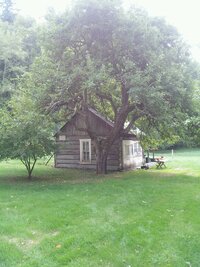
I suggest not doing what is shown in that video.
The absolute first thing is to decide on the form. Open center or central leader. On anything in the ground more than 3-5 years this has already been decided.
For the first cycle make your larger cuts first and keep those cuts in proportion to the tree. How many chainsaw cuts would you make on a 20’-30’ Japanese maple? No different with a fruit tree
Many of the old varieties get quite large, gravistein wants to be 40’+ and it’s a pipe dream to make the tree short. We have all heard of folks who want their tree dwarfed by pruning, and apples/fruit trees are no different. If they want a small tree then tell them to plant a dwarf/semi dwarf
MAINTAIN a full canopy, each pruning cycle ignore the little stuff and focus on thinning, make your big cuts first. Avoid making large cuts near old large cuts that haven’t sealed and are decayed. As these likely are feeding wound/callus wood.
I work many trees that are well beyond hollow as a drum where you can put your hard hat inside cavities. The balance is taking enough load off, but keeping enough green for the tree to put more wood on than what is decayed.
Don’t be afraid of heading cuts on wood that is about 1” diameter.
Reduce large water sprouts vs removal. It’s an ebb flow thing, apples are a different animal where they send sprouts up, takes a couple of years then they flower and fruit. The weigh then pulls them down that then sends up new sprouts as the cycle repeats. Encourage this. Also long whip stouts can be cut in half to stimulate branching. The following year thin the hydra, and pick one that assumes vertical to retain.
Many varieties are bi-annual bearing, so don’t expect heavy fruit every year
I tell my clients if they want production apples, it will take about 4 visits per year and that they have to thin the fruit to about 1 apple per 6” with a minimum of 6 leaves per apple. Never has anyone bitten that fruit! I do though have a couple of real production orchards at ciderys
Reading your post was like “wow!”. I’m glad I read it, otherwise I would have spouted all the same things!
Rather coincidentally, we just got a call to reign in some trees that were neglected for a few years. Mostly pear, plum, peach and cherry varieties since apples would be very susceptible to rust issues with all the Eastern Red Cedars on surrounding land.
The client had just bought the property and had several concerns, but also some misconceptions. The best part is that she and her husband want to be deeply involved in their own trees, and plan to do as much of the pruning and spraying as they can. They were not sure about how to restore the trees to a more manageable size. They also own a copy of ‘The Holistic Orchard’ by Michael Phillips. We were already off to a great start!
The things we had to establish were:
- How high are they willing to work for maintenance and harvesting? We settled on 8’ to 12’.
- How often are they willing to prune? They agreed to perform as many cycles as required based on growing conditions.
- Are they willing to accept mostly, but not all, perfect fruit. Yes! This just keeps getting better!
There are, however, different schools of thought on restorative measures. Some say reduce them slowly over time (low dosage, medium frequency). Some say hit them hard (high dosage, choose your own frequency). I recommended we do no more than 20% bud loss for the first visit. That took some explaining, and found the simplest lesson was for them to leave all material directly beneath the tree it came from and imagine gathering it up and holding like a bouquet. The bouquet should be n more than 20% the sizes of what remains in the tree.
Remember that this is all a game of light. When a tree is trained a particular way for many years and then let go, it will naturally form numerous, vigorous sprouts. Their height before and laterals form is in part due to stem density, and reduced light in the areas a lateral would be preferred. By thinning the number of stems, and also reducing the height of the remaining ones, you can encourage lateral growth through phototropism and hormone response (spreading out auxin). Any laterals that form will be more prone to horizontal growth if they are below other foliage. These new laterals can eventually become your highest structural branches. Once they harden off in your desired form and location, you can remove the parent stems above their points of attachment. If your client can stand having a taller tree, you can form other tiers above by training other laterals oriented in other directions.
Be aware of pruning with specific goals during specific times of the year. A common misconception is that one prunes in Winter for a reason, while that reason may actually be that it was when the farmer had the time to do it. There should really be 4 or 5 doses per year!
Eventually, once the desired structure has been established, your pruning targets may include, but may not be limited to:
- Unwanted vegetation.
- Unwanted or unproductive structure.
- Unwanted vegetation.
- Overly dense buds on spurs.
- Overly dense fruit on spurs.
- Unwanted vegetation.
- Entire spurs.
- Oh, and don’t forget unwanted vegetation!
With all this said, your client has to understand that this is basically impossible with a single visit. Even one visit annually is inadequate. Also, one arborist may have a multi-step plan that another arborist might not be able to pick up and run with.
Cool thread. Hope it gives you a good dose of useful information. Good luck and have fun!