Possible Petzl Ascenders Design Flaw

entirely the reason i will not use the Petzl ascenders (with plastic parts). I first saw the Petzl ascenders in a climbing shop and i could'nt believe all the plastic crap clogging up the design. They seemed prone to jumping the rope when i tried them on the test wall. NO THANKS

I have never had an issue with my all metal JUMARS. Just my 2 cents.
 
If they had clipped the top holes it wouldn't have come off the rope. Sloping ground can cause any ascender to slip if not connected to the top holes. Tree work has many twigs/branch rubs etc that can temporarily disengage a cam if the climber isn't observant.

The system didn't fail - its why you have two ascenders.

Scare mongering in my view. Petzl would've recalled them if there was an issue. If I was in that situation, I would make sure the cams were facing me, not the rock.
 
Handled ascenders by their design easy on easy off are inherently dangerous. I have used Petzl ascenders exclusively for over 10 years on rock and in trees with no real problems. Personally in my SRT setup there is a backup to the handled ascender and that is a Microcender. Good luck getting that off the rope. Rock climbers use a trick called "tying in short" which involves every 10 feet or so tying a figure 8 on a bight and clipping it to your harness. Then if both ascenders somehow popped off the line you would still stay off the deck.

The only time I ever slipped because of an ascender it was because I was ascending through a vine maple and a leaf got sucked in between the rope and the cam. That would have happened no matter what brand of handled ascender I was using.
 
Hard to see the incident as evidence of a desinn flaw. The design has upper holes to allow clipping in a 'biner so that the rope cannot come out and the climber who didn't use that feature was never in any danger of falling since his weight was "automatically" already on the other ascender.
 
I use a Petzl ascender on top, with a pantin on my foot. BUT - I also tie a friction hitch at waist level in case the top ascender should come off. I don't consider the pantin to be a point of attachment.
Stumper - The climber was in danger of falling. He was only connected by his top ascender and one foot strap. When the top ascender came off, if he wasn't balancing himself by holding onto the rope with his other hand (which the article doesn't say, but I am guessing he was) he would have either fallen, or been hung upside down by his foot.
I do, however, agree that the Petzl ascender was designed to be used by clipping into the top holes, as opposed to the bottom one.
 
From my hazy recolection of the intructions that come with the Petzl ascenders, i'm sure there is a cleas picture and instruction advising/insisting that the ascender should never come into contact with the rock face or in our applied case, the tree and it's branches. When ever I use such an ascender and the branches come anywhere near an obstruction such as the trunk or branch, I am sure to pay absolute attention to it and guide it away from anything which may foul it. I guess I sort of figured out there is so much potential for foreign bodies to change a piece of equipments' safety parameters should it/they interfere with it that it may be in my interest to not allow it to happen!!!!!
 
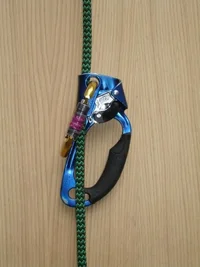
As others have said, put the biner in the upper hole so that the 'biner captures the climbing line. This will capture the rope so that it cannot come out of the carabiner. See attachment.
 

Attachments

  • 59737-dsc02032_resized_19%_rotated_for_TBZ.webp
    59737-dsc02032_resized_19%_rotated_for_TBZ.webp
    29.9 KB · Views: 144
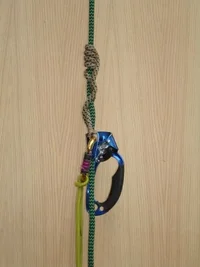
Use a split tail (brown) to tie a friction hitch on the climbing line (red) above the 'biner and attach the split tail to the same carabiner that is in the upper holes of the ascender. This will back up the ascender. Make sure that the hitch has enough friction on the rope that it always grab if the cam does not.

Attach a tether (yellow) to the bottom of the same 'biner and secure yourself to this tether.
 

Attachments

  • 59738-dsc02047_resized_19%_rotated_for_TBz.webp
    59738-dsc02047_resized_19%_rotated_for_TBz.webp
    26.8 KB · Views: 139
Mahk -
While I agree that the backup and connecting lanyard are essential, I don't put my hitch on top of the ascender for the simple reason that it's out of my reach. I set up my system so that the lanyard that connects my saddle to my ascender is just long enough for me to fully extend my arm. If I had the friction hitch above the ascender, I wouldn't be able to access it should I need to.
 
It's easy to reach the friction hitch--after you step up with the foot ascender simply reach above the handled ascender to access the friction hitch instead of pushing up on the handled ascender.

If you have the friction hitch at your waist, and the cam of the ascender fails and slides down the your rope, the ascender could hit the friction hitch and cause the hitch to release and slide down the rope.
 
It was climber error. I don't want to spend 1 hour typing my arguement either.

His friend may be well intended with putting this liturature out, but he is 100% wrong.

Those cams don't just magically open. The guy allowed his cam to move upward along the rock. What person would allow that to happen? He gets a "Darwin Award" award.
jpshakehead.gif
 
^ if there WAS'NT a huge hunk of plastic on the cam to CATCH the rocks or treelimbs, this woudl not be an issue!!! and that is PRECISELY what the author was trying to convey.
 
Agree with notahacker, climber error. He was using his right hand to operate a left-handed ascender, and pushing it against rock. I would never lend gear to this guy.

The key thing for me is that the ascender did not come off the rope while loaded, the climber removed the ascender pushing it wrong side against rock. As others have mentioned, it is very important to protect any ascender from obstacles during ascent, it is not a battering ram.

The plastic thumb release on the cam is just enough to get a grip on but not too much. For instance, try doing a switchover (lanyard in and take the ascender off the rope) on an ice cold day when your fingers will hardly move. You might have trouble thumbing the cam open, but it will work. The design seems intended to cover a wide range of working conditions. As far as plastic construction goes, it's not an issue, it's a convenience to release the cam, it is as strong as it needs to be. The cam itself is steel of course.

I did notice that if my second hand was in contact with the the cam release on the top ascender while standing up on the bottom ascender, it prevented the top ascender from grabbing when I loaded it. Taking hand pressure off the cam allowed it to grab. It surprised me for a second but didn't put me in any danger. Since that happened I keep my fingers away from the cam release when grabbing the top ascender and standing up.
-moss

 
[ QUOTE ]
^ if there WAS'NT a huge hunk of plastic on the cam to CATCH the rocks or treelimbs, this woudl not be an issue!!! and that is PRECISELY what the author was trying to convey.

[/ QUOTE ]

That Moderately sized hunk of plastic makes the ascender easier to use and doesn't affect its security if it is used properly. I own an older Petzl without the plastic and can say A. the stud release system isn't immune from unintentional manipulation. B. The Plastic lever is easier to use intentionally. C. both work just fine if you use them properly.
 
i like the 2 handed design of the Kong. It places a balanced pull on the device; to then grab the rope with balanced. Single handled ascendors have all your weight (as initiating force) off to 1 side of the rope inviting different mechanics that are not as stable IMLHO. The chin-up bar position, and half your weight on each hand at most is nice too.

i use it on a single line; and a French Prussik on top of it. This gives the Fail Safe backup; and easy to change over to friction hitch for DdRT (preferring a moddified Sailor's Gripping Hitch in Tenex). If not Climbing up to my TIP and have SRT anchored by running DBY; i'll clip my rigging line to the DBY. Then when i get as far up as i'm going, lock in with lanyard and pull running bowline open with rigging line and then tie in DdRT.
 
[ QUOTE ]
- The climber was in danger of falling. He was only connected by his top ascender and one foot strap.

[/ QUOTE ]

The climber had two ascenders on rope: a CROLL and a left-hand ASCENSION, which was being used with the right hand. The incident was due in part to this left-right switch b/c the trigger/catch was facing the rock. When the top ascender came off, the climber was resting on the CROLL, so there was minimal risk of a fall.
 
[ QUOTE ]
Those cams don't just magically open. The guy allowed his cam to move upward along the rock. What person would allow that to happen?

[/ QUOTE ]

The climber was a novice being instructed in vertical caving basics by the person who posted the article. Understandable that she might feel "freaked out" by the incident as she was the instructor. However, there was very little danger to the climber (it would be nice to say "no danger" but the possibility must always be allowed). As others have pointed out, this is a perfect illustration of the reason a minimum of 2 ascenders must always be used in a climbing system.
 
[ QUOTE ]
^ if there WAS'NT a huge hunk of plastic on the cam to CATCH the rocks or treelimbs, this woudl not be an issue!!! and that is PRECISELY what the author was trying to convey.

[/ QUOTE ]

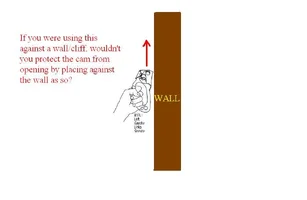
Yes, it is possible for the plastic part to get caught on something, but the person operating the ascender has the ability to prevent that from happening.--Don't you think?
parry.gif
 

Attachments

  • 60264-Ascenderslidingagainstawall.webp
    60264-Ascenderslidingagainstawall.webp
    22 KB · Views: 72
[ QUOTE ]
[ QUOTE ]
^ if there WAS'NT a huge hunk of plastic on the cam to CATCH the rocks or treelimbs, this woudl not be an issue!!! and that is PRECISELY what the author was trying to convey.

[/ QUOTE ]

Yes, it is possible for the plastic part to get caught on something, but the person operating the ascender has the ability to prevent that from happening.--Don't you think?
parry.gif


[/ QUOTE ]

yes AND no. A very experienced rope technician might be skilled enough to recognize that, but your average weekend Joe and Jane sixpack might not ever consider it. They are too busy de-stressing from the week, bagging climbs etc. Whereas you or I spend thousands of hours studying equipment weak points and dangerous operation scenarios. No way the weekend yuppies will ever clue into to stuff like that.

and that is where the danger lies.......
 

New threads New posts

Back
Top Bottom