
- Location
- Ontario, Canada
I use 1/2 inch stable braid.

Follow along with the video below to see how to install our site as a web app on your home screen.
Note: This feature may not be available in some browsers.

Havent winched for a while, but we also used to use an old arbor master or even natural fibre trash rope which we use to use as a winch line extension to pull over any surface that was muddy or rocky to save the dyneema. Worked pretty well except for tying bowline on a night each time you had to reset the winch pull...
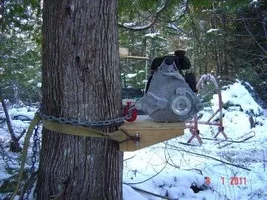
A skidding Cone? Go learn how to set kickers, rolls, ect. from a good choker setter. There are all kinds of tricks to be learned which make your life much easier when skidding logs..I have skidded alot of logs with one of those. Usually just use ratty old climb lines or work lines because that winch and the terrain I was working in will tear up ropes fast. Im thinking about ordering some of that dyneema this spring and trying it out. The big thing for me is make sure you use a skidding cone. Not hanging up on boulders and stumps and other trees will make life easier and the winch wont glaze your rope when it hangs up.View attachment 30569

Don’t forget the endo’sA skidding Cone? Go learn how to set kickers, rolls, ect. from a good choker setter. There are all kinds of tricks to be learned which make your life much easier when skidding logs..
A skidding Cone? Go learn how to set kickers, rolls, ect. from a good choker setter. There are all kinds of tricks to be learned which make your life much easier when skidding logs..

Have you used one of these winches? Not a skidder, not a pto skidding winch, they can get bogged down with just a stack of brush. We've ended up cutting the end of the log into a cone so it twitches better. If one person is using it I bet the cone is a super time saver so one doesn't have to keep re-setting the choker etc. This ain't high-lining...A skidding Cone? Go learn how to set kickers, rolls, ect. from a good choker setter. There are all kinds of tricks to be learned which make your life much easier when skidding logs..
Have you used one of these winches? Not a skidder, not a pto skidding winch, they can get bogged down with just a stack of brush. We've ended up cutting the end of the log into a cone so it twitches better. If one person is using it I bet the cone is a super time saver so one doesn't have to keep re-setting the choker etc. This ain't high-lining...
A kicker is used to make a log go backwards if you need to get it to come around from the wrong side of a stump, tree, or other immovable obstruction. Works like champ. Couldn't live without it.@
Kickers?
I can imagine rolls might be from wrapping the log with the choker to rotate the log. Yes, no?
Any home-made skidding cone/ sled building secrets?
For residential use, I've wondered about just using a piece of plywood as a sled, with some sorta rounded nose. Like a 5" log with a plywood-thick kerf cut half-way in, so about 2" below and 2" above.
A redirect to a snatchblock? Pic?A k
A kicker is used to make a log go backwards if you need to get it to come around from the wrong side of a stump, tree, or other immovable obstruction. Works like champ. Couldn't live without it.
No blocks, No redirects. Just using your choker and skidding line to make things do what you need them to do. Hard to explain so I will draw a diagram and upload it later.A redirect to a snatchblock? Pic?
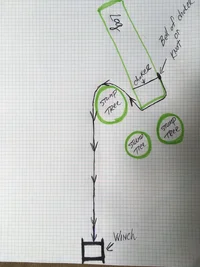
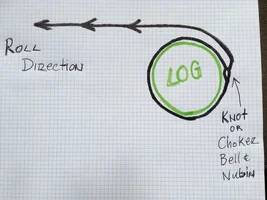
I’ve only set chokers on a skidder a few times.Excuse to childish drawing, but this is your standard good old fashioned kicker. You must set your choker bell or knot on the backside of log and make sure that you do not set up a roll. Make sure your choker/skidding line goes around the butt of the log and around the far side of the tree/stump, and be sure it stays that way until your log clears the obstruction. When you begin yarding on your log its first movement will be backwards or away from your intended skidding direction. It will then begin to swing to the left until the butt ends up clear of the obstruction, and you now have a clear shot to your winch/skidder/truck.
I spent many years working on select cuts in very steep where you really have to know how to manipulate logs around trees and stumps.
View attachment 59501
Yes, but in the typical Arboricultural setting you don't have the volume of stumps to pull out many of the tricks. Granted a good logging outfit will take some effort protecting the leave trees, in a residential setting yarding just one (or a few trees) there is little to no tolerance for collateral damage.These tricks work whether your pulling with a D8, a skidder, a portable winch, or a truck, and as long as you have the power to move the log you can make that log your bitch!
@
I can imagine rolls might be from wrapping the log with the choker to rotate the log. Yes, no?
I do this shit all the time around trees that cannot be damaged. Thoughtfully placing some short beams vertically on the backside of a tree you are protecting will keep your skidding line or choker from ever touching a tree you don't want to damage. I actually have a tool which is 4 foot beams that are attached together with webbing which we use to wrap around trees that need protecting when we are skidding logs near them. Creates a veritable suit of armor and works like a champ. Similar to the wraps you see construction outfits use when using equipment around trees that cannot be damagedYes, but in the typical Arboricultural setting you don't have the volume of stumps to pull out many of the tricks. Granted a good logging outfit will take some effort protecting the leave trees, in a residential setting yarding just one (or a few trees) there is little to no tolerance for collateral damage.
We (arborists) are more inclined to hang directional blocks, high points, or pull out other tricks. Yarding in a logging setup, these options are too time consuming (often, but not always), and you can burn into stumps or low value trees.
@
Kickers?
I can imagine rolls might be from wrapping the log with the choker to rotate the log. Yes, no?
Any home-made skidding cone/ sled building secrets?
For residential use, I've wondered about just using a piece of plywood as a sled, with some sorta rounded nose. Like a 5" log with a plywood-thick kerf cut half-way in, so about 2" below and 2" above.


