Poplar-Rigging-Removal

Reg

Branched out member
Location
Victoria, BC
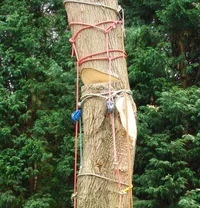
This single tree removal extended 4 of us for 4 days….what with travel, preparation, clean-up, resulting in about 6 hours climbing per day. Thankfully a high Rigging-point enabled us to bring the majority of the tree to the favourable side of the back garden, although it was still a fair hike out to the front to the truck and chipper. We had the roofs boarded out down below and set up some planks so to wheel-barrow out the wood. The weather was ok but patience and concentration from everyone was a must for the duration. About 20 minutes to watch both. Thanks

Part 1: http://www.youtube.com/watch?v=0wb1Xbr-V-U

Part 2: http://www.youtube.com/watch?v=jaGo69VxZJg
 
As usual Reg you guys did an outstanding job. Very tight area to work in, but an excellent rigging plan.

I personally hate working in Poplar trees. Around the New England area they are considered a very weak hardwood, more like a conifer. For years they were a staple tree for the big Berlin New Hampshire paper mill. You could smell that mill for miles around. Mill closed down now.

Thanks for sharing with us. Keep up the great work and keep the videos coming!
 
Thanks Chris. One of the main considerations of this particular job was avoiding collisions and snags, which I why I had to spend some time cleaning out with the handsaw before starting on the main branches. The stuff is so brittle that it would have been easy to cause a piece to break off and spear down through one of the roofs otherwise.
 
[ QUOTE ]
That was a good vid, Reg. Easy to watch. You could easily spend as much time editing that vid as it took to take the tree down, Hey?

[/ QUOTE ]

Took up the whole of yesterday Jerry, about 80+ files worth to choose from, which indicates roughly how many cuts to get the tree to where the video ended....I had enough footage left over to make a part 3 but it was too much the same. Thanks
 
Amazing rigging, Reg.

Put the video on full screen, and enjoyed the show. Your LD looks super heavy duty, and I loved the double rigging lines for the big trunk wood.

Thanks for taking the time to document your craft!


SZ
 
I agree with the double blocks, especially with short rounds. Well worth the time for the safety it affords.

edit. And what a way to control the lines that with a double drum bollard! Perfect!
 
[ QUOTE ]
I agree with the double blocks, especially with short rounds. Well worth the time for the safety it affords.

edit. And what a way to control the lines that with a double drum bollard! Perfect!

[/ QUOTE ]

Its ideal for heavier stuff low down Jerry, especially if you're having to slow them up quite abruptly....heavier sections yet easier on the rigging. The set-up obviously takes longer but is worth it, all things considered. Thanks again.
195761-Handforthpoplar003.jpg
 

Attachments

  • 195761-Handforthpoplar003.webp
    195761-Handforthpoplar003.webp
    77.8 KB · Views: 62
WOW.

Reg's vids are tree removal porn. They are just that good.

Was the 2 to 1 on the tag line just to make it easier to pull the pcs over to the lz?? It would have been too difficult with just a straight tag line?
 
Ya know it is crazy,all these years and never really thought of doubling up on a spar like that.I have double rigged big stuff for sure but never double barrell like that .I will use that fo sho!!! hope ya dont dont mind!
Well done Reg!! loved it!!
 
There's no doubt about it, Reg is a top notch, excellent rigger and his videos are very well made too, just like Gerry B's.

Reg is always thinking and coming up with new ways to make the strenuous job of tree work a little more manageable. A true inventor.
 
rigging has been in use for thousands of years but it's only been in the last ten to fifteen that tree workers have benefited from the knowledge passed on by a few. The old days of wrapping a rope around the trunk of the tree to brake a load is only one example where brakes and bollards have made such a huge difference in how we do our work. And the tools are but a small part really. The intrinsic knowledge of the forces encountered with rigging has been well described and presented, and it's that understanding of rigging forces which really makes a good, safe and efficient rigger.
 
Ya know Ger,you are correct!!I spent the first 8 to 10 years of my career as a foreman doing all jobs with no blocks and no friction devices.I would once in a while use huge and cumbersome bull rope or an old block and tackle, that's it! What a giant leap we have made in so many ways!!
I have always thought that certain aspects can definitely be taught ,but most who excel have an innate sense of forces,physics ,etc. You are dead on !!
 
Thanks again

[ QUOTE ]


Was the 2 to 1 on the tag line just to make it easier to pull the pcs over to the lz?? It would have been too difficult with just a straight tag line?

[/ QUOTE ]

Cory, the 2:1 was needed on the branches but only due the fact that I tied both the lowering and tag lines at the same (butt) ends for the best part of the job. Had I tied them at opposite ends it would have been an easier pull but requiring a lot more climbing on my part.
 
That was really great!

One observation: It looked like the ENTIRE tree was big watersprouts from old topping cuts (?). I'd have been terrified tying off and rigging on those! I saw that the lowering line was spread out to widen the angle up top but still...
 
Reg,

I'm just learning from the best here, and perhaps this is obvious to everyone else, but...

It appeared that your rigging line was on a different tree/leader than you were on. It also looks to me like the TIP for the rigging was a good way from you. How'd you keep getting the rigging rope back to you?
 
Robinia you are correct that the tree had been topped some years earlier. The rigging point had a support line running across to another spar. Regardless, I think its not until you climb up there, take a look around, and most importantly get a feel for it , that you can decide what the limitations should be….not something that can be pre-determined by a formula or equation that’s for sure. It also makes a bid difference who's working the ropes....Steve did good but not great. As you can see though, I kept the loads pretty conservative. Thanks

Ron, when I was lower down the guys’ flicked the ropes to me….higher up they attached them to the end of my climbing line. Thanks again
 
Great Job as always ,, I had my new guys look at video for out tailgate meeting this morning ..

Killer take down my freind..

Later from SO-CAL
 
That Poplar looks a lot like the Hybrid Poplar/Cottonwoods I'm taking down.

There was a lot of work there. I know. You guys always do well planned/executed work.

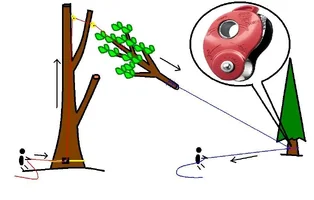
I'm wondering if you have ever considered using a Petzl Mini Traxion (or Pro Traxion) for the control of the drift line. If we need to use a drift line, for long periods of time and long distances, I look for a tree to anchor a Mini Traxion. This gives the groundsman the chance to take a break between pulls, if necessary, and it eliminates the possibility of a groundie accidentally letting go of the load.

Sure, it may take a little bit of time to put the drift line into the Traxion, but the 2 points I brought up are worth it.

Just curious.

(See Attachment)
 

Attachments

  • 196679-ControledDriftLine.webp
    196679-ControledDriftLine.webp
    47.5 KB · Views: 111

New threads New posts

Back
Top Bottom