Physics Question: Basal vs Canopy Anchor Forces

For those who are still tempted to think that the rope going down from the natural crotch to the basal tie on the tree is contributing to the perpendicular pulling force, thus aiding the falling of the tree, try out this thought experiment for size ...

Let's reverse the forces. Instead of pulling 150# on the pulling rope, which happens to also place a load of maybe 80# down to the base of the tree, let's set the whole thing up backwards.

Tie the rope at an anchor a sufficient distance from the tree.
Instead of having the rope go over a natural crotch, run it through a port-a-wrap up in the tree where the crotch should be.
Then place a GRCS at the base of the tree (above the felling cut of course, which no one would ever do, since the fall would probably ruin the GRCS, but it's a thought experiment, so give me a break!).
The GRCS is pulling a rope that is running through a Porta-Wrap then from the portawrap outward to the anchor.
The goal is to put 150# of pressure on the rope between the porty and the anchor.
Assume that the 1 and 1/2 wraps on the porty steal all but 10% of the pull to friction.
The GRCS would need to pull 1500# on the rope to produce 150# of tension on the rope going to the anchor.

Here's the point --- there is still only 150# of pull on the tree toward the anchor, regardless how much pull is on the rope going down parallel to the tree.
My reverse thought experiment broke down when I considered how much friction there would be at the crotch (unless there's a pulley up there)? Or . . .
 
Dan, reasonable guess tension ratio 5 or 10 to 1 on 1 1/2 wraps in a porty, 10 to 20% out the other side.

Still waiting for someone to calibrate a porty for tension ratio vs wraps. Its exponential.

Back in the early SRT days I proposed a thought experiment to Mark of taking a rubber band up over a stick crotch to illustrate tip friction and rope elasticity for basal ties when he videoed using a pulley as a base tie tip. Same principles different coefficients - elastic, crotch,rope.

Ghostice, for an ultimate friction case cinch the pull rope at the pull crotch and then do what you like with the tail down to a basal anchor, any where from limp to taut, but keep the same tension on the pull line to winch.

Or to go full Dr. Seuss, have pulleys anchored symmetrically around the trunk at both the pull tip and the base and route the rope multiple times up and down the trunk, compressing the bejezuz out of it, while still having the same tension on the rope segment from the pull tip to the winch. Will adding more and more pulleys change the pull-over torque? no
 
Last edited:

Dan, reasonable guess tension ratio 5 or 10 to 1 on 1 1/2 wraps in a porty, 10 to 20% out the other side.

Still waiting for someone to calibrate a porty for tension ratio vs wraps. Its exponential.

Back in the early SRT days I proposed a thought experiment to Mark of taking a rubber band up over a stick crotch to illustrate tip friction and rope elasticity for basal ties when he videoed using a pulley as a base tie tip. Same principles different coefficients - elastic, crotch,rope.

Ghostice, for an ultimate friction case cinch the pull rope at the pull crotch and then do what you like with the tail down to a basal anchor, any where from limp to taut, but keep the same tension on the pull line to winch.

Or to go full Dr. Seuss, have pulleys anchored symmetrically around the trunk at both the pull tip and the base and route the rope multiple times up and down the trunk, compressing the bejezuz out of it, while still having the same tension on the rope segment from the pull tip to the winch. Will adding more and more pulleys change the pull-over torque? no
Wow
 
Backwards is always good way to look at things, even if just as a parity check of what regular way looks like; but oft gifts different view too. Just like a tough maze, played backwards as a kid.
.
There are 2 dimensions of forces here: horiz/vert at play; depends on if and how you may capitalize on them above whatever trade off; if not ballasted out.
Or if can more confidently pull harder a more 'cradled' than linear grab
>>or spring load etc., and more confidently, even higher up leverage perhaps.
.
As pitches from vertical column device, the vertical loading dimension part of force is no longer ported down a pure vertical column dimension of alignment
>>but gains some lever dimension i think as like CoG coming out of TDC
What if goes over the top, back, and then slants back to trunk tie off
>>that ends up face up in clear area rather than face down, perhaps buried into lawn?
What if serves to sidelean side and back down to center trunk?
.
i think there is more here possible than horiz force, when have the extra leg of force, in some scenarios, and can be easiest untie to get rope clear pre-saw. Mostly if can get base untied, found could pull rope out with truck gingerly , extra special care at any hang ups to Gentle Ben 'tap' thru tuff spot and pull clean again.
.
edit: Capstan frictions are one of fewer things that can at same time capitalize on both dimensions of forces cos:sin to single function.
Usually mite see column support only by alignment/cos, leverage only by deflection from alignment/sin. Capstan frictions can use both dimensions at once, as to be much greater in model.
 
Last edited:
When setting a line in the tree to use to pull it over, what is the difference in forces between a basal or canopy anchor?
In an attempt to be more clear: say you set 2 lines 60 ft up two identical 100 ft trees and then pull on them from 150 ft away one is tied off just above my notch and one just runs up to the union, would I have more pulling force on the ground from the canopy or basal anchor? And why is that?

Thanks for the consideration.
There are less force vectors for the rope directly tied up high so there is more efficiency, less force wasted. Compared to the force wasted due to the downward force vector based on the angle of the pull line, it's probably a moot point.
 
Dan, reasonable guess tension ratio 5 or 10 to 1 on 1 1/2 wraps in a porty, 10 to 20% out the other side.

Still waiting for someone to calibrate a porty for tension ratio vs wraps. Its exponential.

Back in the early SRT days I proposed a thought experiment to Mark of taking a rubber band up over a stick crotch to illustrate tip friction and rope elasticity for basal ties when he videoed using a pulley as a base tie tip. Same principles different coefficients - elastic, crotch,rope.

Ghostice, for an ultimate friction case cinch the pull rope at the pull crotch and then do what you like with the tail down to a basal anchor, any where from limp to taut, but keep the same tension on the pull line to winch.

Or to go full Dr. Seuss, have pulleys anchored symmetrically around the trunk at both the pull tip and the base and route the rope multiple times up and down the trunk, compressing the bejezuz out of it, while still having the same tension on the rope segment from the pull tip to the winch. Will adding more and more pulleys change the pull-over torque? no
Bart said: "Still waiting for someone to calibrate a porty for tension ratio vs wraps. Its exponential."

I have developed my own rule of thumb for porta-wrap friction. Maybe it will be helpful to someone.
It obviously has to make many (too many) assumptions. But I still find it useful.
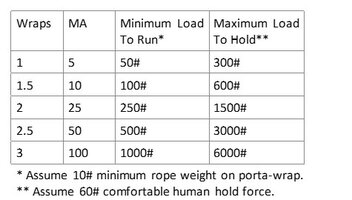
Here are my "rule of thumb" weight ranges for different wraps: [See PortaWrap Load Ranges. JPG]
PortaWrap Load Ranges.jpg
This calls "One Wrap" when the rope comes in the porty at the top, goes under the porty once, then around the post on the top to the groundsman.
This assumes a Coefficient of Friction of 0.25 for nylon rope on aluminum porta-wrap. Ropes can vary a lot, higher and lower than this amount.
Reading the chart - If I estimate the load will be 125#, then 1.5 wraps might work, but groundsman would have to have a very light touch on the rope or the load won't run at all. For 125# 1 wrap would work much better, meaning it's easy to let run and easy to stop the load and hold it.

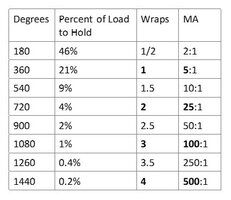
For those who want more precise measurements, here are the actual percentages, then how I fudged them to make them memorable.
PortaWrap Mechanical Advantage.jpg
 
Bart said: "Still waiting for someone to calibrate a porty for tension ratio vs wraps. Its exponential."

I have developed my own rule of thumb for porta-wrap friction. Maybe it will be helpful to someone.
It obviously has to make many (too many) assumptions. But I still find it useful.
Here are my "rule of thumb" weight ranges for different wraps: [See PortaWrap Load Ranges. JPG]
View attachment 92166
This calls "One Wrap" when the rope comes in the porty at the top, goes under the porty once, then around the post on the top to the groundsman.
This assumes a Coefficient of Friction of 0.25 for nylon rope on aluminum porta-wrap. Ropes can vary a lot, higher and lower than this amount.
Reading the chart - If I estimate the load will be 125#, then 1.5 wraps might work, but groundsman would have to have a very light touch on the rope or the load won't run at all. For 125# 1 wrap would work much better, meaning it's easy to let run and easy to stop the load and hold it.

For those who want more precise measurements, here are the actual percentages, then how I fudged them to make them memorable.
View attachment 92167

That sounds about right!
 
Bart said: "Still waiting for someone to calibrate a porty for tension ratio vs wraps. Its exponential."

I have developed my own rule of thumb for porta-wrap friction. Maybe it will be helpful to someone.
It obviously has to make many (too many) assumptions. But I still find it useful.
Here are my "rule of thumb" weight ranges for different wraps: [See PortaWrap Load Ranges. JPG]
View attachment 92166
This calls "One Wrap" when the rope comes in the porty at the top, goes under the porty once, then around the post on the top to the groundsman.
This assumes a Coefficient of Friction of 0.25 for nylon rope on aluminum porta-wrap. Ropes can vary a lot, higher and lower than this amount.
Reading the chart - If I estimate the load will be 125#, then 1.5 wraps might work, but groundsman would have to have a very light touch on the rope or the load won't run at all. For 125# 1 wrap would work much better, meaning it's easy to let run and easy to stop the load and hold it.

For those who want more precise measurements, here are the actual percentages, then how I fudged them to make them memorable.
View attachment 92167

Love these visuals for RELATIVE capstan friction. I am trying to figure out what the "Degrees" column represents in the bottom chart. Thanks
 
Love these visuals for RELATIVE capstan friction. I am trying to figure out what the "Degrees" column represents in the bottom chart. Thanks
I probably should have left the "degrees" column off to avoid confusion. In figuring friction of a rope going around a bollard or cylinder (in our case, a porta-wrap) what matters is the number of degrees the rope is in contact with the cylinder. So a 'half-wrap' is when the rope contacts the porta-wrap half of a full circle, or 180 degrees. Full wrap is 360 degrees.
 
There are less force vectors for the rope directly tied up high so there is more efficiency, less force wasted. Compared to the force wasted due to the downward force vector based on the angle of the pull line, it's probably a moot point.

This is not actually true. The top tied pull line will also exert a downward force through the trunk itself, similar to that of the base tied pull line which would be calculated by the angle of pull. There would be no meaningful force loss. However, the base tied setup would require more line being pulled due to the increased amount of slack in the system.
 
I probably should have left the "degrees" column off to avoid confusion. In figuring friction of a rope going around a bollard or cylinder (in our case, a porta-wrap) what matters is the number of degrees the rope is in contact with the cylinder. So a 'half-wrap' is when the rope contacts the porta-wrap half of a full circle, or 180 degrees. Full wrap is 360 degrees.
No that totally makes sense now! Thanks for the explanation! I can see this help further explain friction to new ground workers!
 
No that totally makes sense now! Thanks for the explanation! I can see this help further explain friction to new ground workers!
Then if your groundsman is a math geek like me, he'll probably object when he notices that a single wrap only touches the main part of the porta-wrap for 270 degrees, not 360 degrees. At that point you can thank him for noticing, compliment him that he has a promising future in tree work because math and engineering and details matter. Then calmly point out that the contact and turn around the smaller cylinders count also. The almost-90-degrees turn around the exiting post plus the very minor turn around the entry loop on the porta-wrap provide the additional 90 degrees. So, 270 + 90 = 360 degrees, one full wrap.
 
Agreed! Also as you have stated previously, rope diameter and construction are factors too! Even the diameter of the bollard plays into it too!
 
Agreed! Also as you have stated previously, rope diameter and construction are factors too! Even the diameter of the bollard plays into it too!
Yes, the rope construction makes a difference in the amount of friction. Nylon is different from polyester which is different from amsteel. And for the same rope it makes a difference whether it is clean, wet, dirty, or sappy. Then for the porta-wrap the kind of metal makes a difference and whether it is clean or not matters.

The surprising thing about the friction of a material going around a cylinder is that the diameter of the rope and the diameter of the cylinder do NOT matter.
So, the size of the porta-wrap makes no difference in the amount of friction applied, thus no difference in the mechanical advantage. And the size of a rigging ring makes NO difference in the friction applied. The size does make an important difference in the concentration of the heat from friction on the rope.
We use larger porta-wraps and larger rings to spare the rope, not to change the amount of friction (thus mechanical advantage).
 
I’m not buying the diameter of the bollard making no friction difference. There is a huge difference between a 2.5” diameter bollard and a 8” diameter. The circumference is more contact over more rope.
 
The surprising thing about the friction of a material going around a cylinder is that the diameter of the rope and the diameter of the cylinder do NOT matter.

The skeptic in me raised an eyebrow at this comment. Is this a general rule you discovered, or is it applicable to the working limits of the porty? I would think a 1” line (or smaller than 3/8”) would break this rule quickly. Diameters outside of the working parameters would definitely impact the friction and mechanics, would it not?

Have you found anyone using some regression models with some of this data to determine a best-fit?

Great discussion!!
 
Last edited:
I’m not buying the diameter of the bollard making no friction difference. There is a huge difference between a 2.5” diameter bollard and a 8” diameter. The circumference is more contact over more rope.
I know - I was surprised by this as well!

Here's Wikipedia: "Note that the radius of the cylinder has no influence on the force gain." (See "Capstan equation" in Wikipedia).

BUT our intuition and objections are partly right ... friction can come from other places than just the rubbing between the rope and porta-wrap.
This quote helps me: "In theory, the radius of the drum is not a factor, but in practice, if the radius is less than about five rope diameters, internal rope friction adds considerable additional friction. This effect is most obvious around low friction rings and carabiners, and it is why this hardware is not used in multipart tackles." (From https://www.practical-sailor.com/sails-rigging-deckgear/unwrapping-the-revealing-capstan-equation)
That would explain why greater heat is produced and greater wear on the rope happens when rigging off of small diameter objects.

For a deep dive, attached is "Mechanics of Friction in Rope Rescue" article. Thanks to #TheTreeSpider for pointing out this resource.
 

Attachments

I call your Mechanical Advantage a tension ratio as I found that whatever the instantaneous values were they always maintained a constant ratio. and hence the term.

Bending of the rope is ignored in the (exponential) capstan equation. I have some measurements using various diameters of biner etc in a 180 degree configuration in Base tied SRT tip forces thread you can use for reference.

A porty model could be made including the smaller fairlead diameters. Calibrating includes all the effects in one fell swoop hence my interest. Removes the uncertainty of modelling.

thoughts for a winters day :)
 

New threads New posts

Kask Stihl NORTHEASTERN Arborists Wesspur TreeStuff.com Teufelberger Westminster X-Rigging Teufelberger
Back
Top Bottom