Physics Question: Basal vs Canopy Anchor Forces

Untitled3.jpg

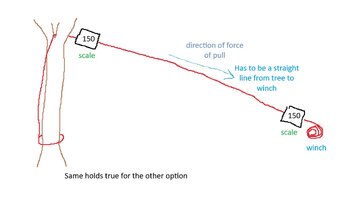
If the direction of pull was anything other than straight from the tree to the winch, the rope would have a big bow in it. That is just silly. You are letting this vector thing try and make up some new laws of physics that don't exist. There is a vector force, but it does not alter the direction of pull, nor does it alter the force of the pull.
@Muggs I'm not sure where you are going with pulleys on this problem. The fellow just wanted to know which was the easiest to pull with. Answer: They are equal. They both take the same force to pull the tree over, provided he cuts below his basal anchor. The direction of the pull must follow the rope. That is what you are pulling with!
 
The force exerted on the crotch is the vector.

Yes, the force direction on the leg between the crotch and the power source will be in line with the rope. Same for the force on the down leg, it will be straight up and down as drawn. The force direction at the crotch (what really matters,) where the two legs meet, will be the angle bisected. It's really a simple concept.
 
View attachment 91687

If the direction of pull was anything other than straight from the tree to the winch, the rope would have a big bow in it. That is just silly. You are letting this vector thing try and make up some new laws of physics that don't exist. There is a vector force, but it does not alter the direction of pull, nor does it alter the force of the pull.
@Muggs I'm not sure where you are going with pulleys on this problem. The fellow just wanted to know which was the easiest to pull with. Answer: They are equal. They both take the same force to pull the tree over, provided he cuts below his basal anchor. The direction of the pull must follow the rope. That is what you are pulling
I enjoy learning and spirited discussions, so carry on. I understand that with a pulley with force on both ends the vector is between the two original forces. I don't understand if friction or the efficiency of the pulley matter for that part of it.

And I think it's relevant to discuss, I realize both methods are fairly similar and the only big practical difference is ensuring that the branch you're over can withstand a basal anchors extra forces, but I wanted to understand it better and this all helps.
 
The force exerted on the crotch is the vector.

Yes, the force direction on the leg between the crotch and the power source will be in line with the rope. Same for the force on the down leg, it will be straight up and down as drawn. The force direction at the crotch (what really matters,) where the two legs meet, will be the angle bisected. It's really a simple concept.
I do not argue there is a force on the crotch downward between the tree and the winch. That is the vector force. It is not however the direction of the pull, nor does it affect the force of the pull. It is just there, contributing nothing to the problem of, "Which is easier to pull the tree over by?". 150 lbs force pulling toward the winch is, 150 lbs pulling toward the winch. To hell with that vector you keep wanting to muddle up the problem with. It is not a player in the question at hand. It really is a simple concept.
 
Last edited:
I'm getting the distinction of a) the external pull per Shadowscape b) how you're loading the tree wood at the pull attachment point.

Two different topics.
External - net pull is toward the winch in rope direction, cinch/pulley tip/base tied whatever

Wood - don't pull way out in a branch. pull/anchor/vector from a union on the trunk, or directly on the trunk
- don't only pull on your side of the codom unless you're feeling lucky; transfer the pull to the back codom
- don't attach pull above rot unless you intend to snap off that portion
- etc common sense


edit - I read more posts more closely and the "wood" topic could be renamed "internal tree forces" e.g. extra compression in trunk from base tie tension or bit of local torque at the union trying to tear off the branch or even better yet (nerd alert) bit of torsion on the union stub trying to twist it from the rope friction force around about half or so circumference. Warned ya!:)


And to play bad science professor, imagine that instead of just going over one crotch to the base tie, you first went over that crotch, out to an adjacent union on another branch, back to some other crotch , repeated that a couple more times and then routed the rope to the base tie. Would all the detailed vector analysis make the pull over force different? Like the bad professor I'm not spoon feeding you the answer. ;)
 
Last edited:
What if we replace the crotch up top with a high efficiency pulley for the basal tie...

By adding this particular "What if" you are actually changing the question. Removing or reducing friction from a scenario is what has dissuaded so many climbers from using a base tie because it unrealistically portrays actual forces experienced in field use.

I interpreted the OPs question as: how much force will each line need to break the hinge and start the tree falling, given the two different tie options. Without adding anything else to the question, the answer will be: the same.

The down side leg of the base-tied tree will move to some extent as the rope is tightened. But as soon as it stops stretching and the load forces stabilize on the pull lines, the load on the pull lines will be the same. This does not change the fact that other forces are involved. Having used both methods in the field, I can see no meaningful difference between the two.

Force vectors are cool and need to be understood. I use them to advantage every chance I get. But unless adding things like back lean, front lean, bending moment, or the hypothetical and impossible removal of friction, the answer to this question will remain the same. As always though, this is just my opinion.
I
 
By adding this particular "What if" you are actually changing the question. Removing or reducing friction from a scenario is what has dissuaded so many climbers from using a base tie because it unrealistically portrays actual forces experienced in field use.

I interpreted the OPs question as: how much force will each line need to break the hinge and start the tree falling, given the two different tie options. Without adding anything else to the question, the answer will be: the same.

The down side leg of the base-tied tree will move to some extent as the rope is tightened. But as soon as it stops stretching and the load forces stabilize on the pull lines, the load on the pull lines will be the same. This does not change the fact that other forces are involved. Having used both methods in the field, I can see no meaningful difference between the two.

Force vectors are cool and need to be understood. I use them to advantage every chance I get. But unless adding things like back lean, front lean, bending moment, or the hypothetical and impossible removal of friction, the answer to this question will remain the same. As always though, this is just my opinion.
I
Thank you, thank you, thank you.
 
I don't think you could actually measure the difference in pull line load. For every inch of tree movement, there will be a corresponding reduction of load on the line. Including the down leg of the base tied line. So things equalize so quickly once the hinge starts to break, I personally have not been able to tell any loading difference.
 
I have never noticed any difference whatsoever between the two. I use them both interchangeably in the field. Is there a difference? Technically yes. Does it actually matter for our work? No.

Any time you have a rope pulling on something, you can split that "force" into 3 distinct vectors: 1 operates in the X axis, 1 in the Y axis, and 1 in the Z.

A rope is essentially a one-dimensional object, but under tension it is still operating in three-dimensional space

If the original question on this thread is "is there a difference and why" then my answer is "in almost all situations there is almost zero difference, because reality".
 
Last edited:
I don't think you could actually measure the difference in pull line load. For every inch of tree movement, there will be a corresponding reduction of load on the line. Including the down leg of the base tied line. So things equalize so quickly once the hinge starts to break, I personally have not been able to tell any loading difference.
Pull line load there will be no difference. The direction of force being applied to the tree will change though, if the rope is redirected.
 
I think the interesting part of this discussion is how these two(and we should add in a trunk cinch to make three) different ways of pulling over a tree introduce force into the tree overall. Any time a rope is pulling on one side of a trunk more than another, there is torsion introduced into the wood, and depending on the species, condition of the wood, spatial restraints, this may or may not make a difference. A base tie can exacerbate this asymmetry and introduce more twist depending on what side of the trunk the termination leg ends up on. A perfectly centered trunk cinch is the most neutral way to apply pulling force in a single plane. In 99% of cases, none of these differences matter.
 
This discussion has me thinking about another, possibly more interesting question, which is, at what height does a pull line reach a point of diminishing returns in terms of contributing to pulling a tree over. At what height does the rope start to pull the tree down into the ground more than laterally. Maybe best for a new thread.
 
One last thing. The base tie will actually help because the vector force that @L3VI is hung up on is acting somewhat in the direction of the pull. It will be insignificant in the big picture however.
View attachment 91682
So with this, you acknowledge that the result of the 150 lbs of pull is not acting along the rope, but somewhere between the rope and the trunk. I'm sure you would also acknowledge that the magnitude of that vector is greater than 150 lbs, just like when climbing SRT on a base anchor, my 150 lb body will produce a 300 lb force at the crotch (neglecting friction, stretch, yada yada...) I agree with you that if he applies a 150 lb pull on the rope in both cases - that he is literally pulling with 150 lbs, but we don't believe that was the question, do we? We think the question is, will one method generate more force to break the hinge - or, in another form, would he have to pull less with the rope base anchored to generate the same breaking force that would be needed with the rope canopy tied?

A force will need to be applied perpendicular to the trunk to break the hinge, right? If no rope were involved, and he parked a lift next to the base and went up 60', he would have to push horizontally with some amount of force to break the hinge. Let's say he pushed with a 139 lbs of force to get the hinge to break. It just so happens that - using trigonometry and his measurements in the original post - if he canopy tied a rope 60' up and stood 150' away - the horizontal force induced by his 150 lb pull will be 139 lbs. Now the question is, if he base anchors the rope, how much will he have to pull to get the same 139 lb horizontal force?
 
To be a stickler, ropes don't break hinges in almost all cases. Ropes generally lose all force on the tree quickly and longs before the hinge breaks ( or breaks completely), especially in our typical arb scenarios (wide facecut and high pull line with a slow pull).

In logging, narrow facecuts, low pull cables (the bottom of the tree moves much less than the top in the and time) with essentially no stretch and fast winches, the pull may still be acting at the time of hinge breaking and separation of log from stump.
 
This discussion has me thinking about another, possibly more interesting question, which is, at what height does a pull line reach a point of diminishing returns in terms of contributing to pulling a tree over. At what height does the rope start to pull the tree down into the ground more than laterally. Maybe best for a new thread.
I have heard this from someone with a lot of experience, he doesn't like to tie anything very high (55-60 ft+) due to diminishing returns due to the pull angle but I didn't really understand why until this discussion. If nobody asks that in a separate thread I might.
 
The question was:
"say you set 2 lines 60 ft up two identical 100 ft trees and then pull on them from 150 ft away one is tied off just above my notch and one just runs up to the union, would I have more pulling force on the ground from the canopy or basal anchor? And why is that?"
The answer is: They would be the same. You would have exactly the same pulling force.

The basal tie would create a vector force on the crotch in addition, but it does not affect the pulling forces.

You can try and twist physics all around in an attempt to squeeze your vector force into this equation all you want, but it won't change the matter.
 
So with this, you acknowledge that the result of the 150 lbs of pull is not acting along the rope, but somewhere between the rope and the trunk. I'm sure you would also acknowledge that the magnitude of that vector is greater than 150 lbs, just like when climbing SRT on a base anchor, my 150 lb body will produce a 300 lb force at the crotch (neglecting friction, stretch, yada yada...) I agree with you that if he applies a 150 lb pull on the rope in both cases - that he is literally pulling with 150 lbs, but we don't believe that was the question, do we? We think the question is, will one method generate more force to break the hinge - or, in another form, would he have to pull less with the rope base anchored to generate the same breaking force that would be needed with the rope canopy tied?

A force will need to be applied perpendicular to the trunk to break the hinge, right? If no rope were involved, and he parked a lift next to the base and went up 60', he would have to push horizontally with some amount of force to break the hinge. Let's say he pushed with a 139 lbs of force to get the hinge to break. It just so happens that - using trigonometry and his measurements in the original post - if he canopy tied a rope 60' up and stood 150' away - the horizontal force induced by his 150 lb pull will be 139 lbs. Now the question is, if he base anchors the rope, how much will he have to pull to get the same 139 lb horizontal force?
No I do not. The 150 lb pull from the winch is acting directly in line with the rope. All of it. That is the only line it can travel. The vector force is acting between the tree and the winch, but that is not the pull line force. You can't transfer force through thin air.
There is a combination of pull line force on the rope from the winch (in a straight line from the winch to the tree), and a relatively equivalent force on the basal anchor line going off at an angle. Combine those two forces together and a portion of that combination is acting as a vector force. But the pull line force is still in a straight line from the winch to the tree. The ROPE is being pulled, not some space some SPACE at another location. It is not physically possible to transfer a mechanical force through a space time warp whatever is being imagined here.
The result of this straight line 150 lb pull is creating another vector force, but it is not taking anything away from the 150 lb straight line pull.
 

New threads New posts

Kask Stihl NORTHEASTERN Arborists Wesspur TreeStuff.com Teufelberger Westminster X-Rigging Teufelberger
Back
Top Bottom