Physics Question: Basal vs Canopy Anchor Forces

150 lbs of pulling force is 150 lbs of pulling force to the same spot on the tree in both cases.
I don't know how I can explain that any better. You are letting vector force clutter your thinking here, and they don't play into this picture.
 
My friend, vectors play into every picture when it comes to redirected ropes. :)

The 150 will be constant on the pull leg, I agree with you there. I'm just pointing out that there's definitely a difference in the forces at play and they are not insignificant.

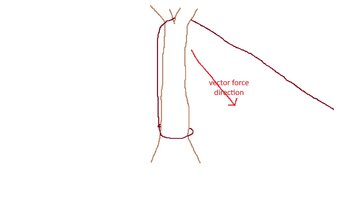
I think the top tie is superior because direction of force is in line with pull but maybe more important is the choke around the main trunk vs being redirected in the union. Potential for union to break, especially with the amplified force.
 
The compression force on the crotch doesn't affect the pull force. He could tie it to the stem 1 foot down from the crotch, or 100 feet down from the crotch. Or 1" down from the crotch. Nothing about any of those will change the pull force needed to bring the tree over. It still is being pulled from the same height on the tree, and the angle of the pull will be the same in each case no matter at what angle the tree is in.
 
The vectors in this case are trying to squeeze the tree trunk downward. So what? Doesn't play into pulling the tree over.
The forces from the back side rope and the frontside rope are more than the 150 lbs combined. The vector forces trying to squeeze the trunk downward are going to be using some of those forces. But the fact remains, if he is pulling with 150 lbs of force it doesn't matter which tie he uses. It is 150 lbs to the same point on the stem being applied.
 
I'm stuck on the idea that you've taken a basal anchored SRT system, with its 180° bend over the TIP, which doubles the force on the TIP, but then moved the pulling point out from under the TIP. Now you've opened the angle, reducing the force on the TIP to something less than 200% but more than 100%.
 
The 150 will be constant on the pull leg, I agree with you there.
That is the only thing that matters in this case. The 150 lb on the pull leg to a specific point on the tree is the same.

Now, I will give you there are vector forces pulling down on the crotch with the base tie. It won't hold the tree back. 150 lbs pull is 150 lbs pull. With a weak crotch you could run into an issue. Give you that. Don't put your line over a weak crotch with a base tie. But back to the original question... Just as easy to pull the tree over with each method.
 
That is the only thing that matters in this case. The 150 lb on the pull leg to a specific point on the tree is the same.

Now, I will give you there are vector forces pulling down on the crotch with the base tie. It won't hold the tree back. 150 lbs pull is 150 lbs pull. With a weak crotch you could run into an issue. Give you that. Don't put your line over a weak crotch with a base tie. But back to the original question... Just as easy to pull the tree over with each method.
To me, the direction of force also matters and should be considered.

I agree, like I said I use the base tie often to pull trees over but it's not a bad idea to know the difference in forces at hand. Especially if using equipment to pull definitely choke the main stem imo
 
I'm stuck on the idea that you've taken a basal anchored SRT system, with its 180° bend over the TIP, which doubles the force on the TIP, but then moved the pulling point out from under the TIP. Now you've opened the angle, reducing the force on the TIP to something less than 200% but more than 100%.
Yes. What are you getting at? What you say is absolutely true... But none of that affects what it takes to pull the tree over in the way of pulling force. As long as the pull angle is the same, and the point at the top is the same
(that being the crotch, whether tied to or rope going over) the force acting on pulling the tree over is identical.
 
I'm talked out for this evening.
@Maplegeddon213 it doesn't matter which you use, the force needed to pull the tree over
I don't know what to think here because I'm too dumb to know whose more right, but I'm grateful for the discussion and I'm going to keep an open mind and keep reading about MA systems and how they work with vectors and magnitudes and forces. Thanks all!
 
I think it depends on the crotch diameter and bark. Small diameter and smooth bark for a basal anchor is going to act more like a pulley, redirecting some of the pulling force downward, reducing the total pull horizontally. If it's a big crotch with plenty of friction then I wouldn't consider it a factor to worry about, basal or canopy should be roughly the same.
 
One last thing. The base tie will actually help because the vector force that @L3VI is hung up on is acting somewhat in the direction of the pull. It will be insignificant in the big picture however.
Untitled2.jpg
 
On a straight up tree, the pull is no different. For a tree that is forward leaning with the pull, you do get a little more help from the downward component on the stem due to the basal tie. You also get more bending on the stem, so increased barber chair potential. On a back leaner, the basal tie makes the tree harder to overcome gravity to tip over.
 
That's the only force that matters...
One last thing. The base tie will actually help because the vector force that @L3VI is hung up on is acting somewhat in the direction of the pull. It will be insignificant in the big picture however.
View attachment 91682
That's my whole point, that is now the direction of pull. It is no longer in line with the rope. The force exerted on that union is no longer in line with the rope.
 
20231220_213432.jpg
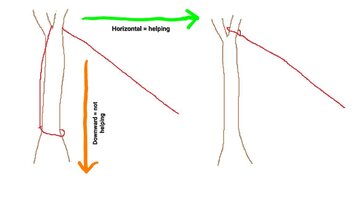
When we pull on a tree from the ground, on flat ground, a portion of the pull is acting in the horizontal plane, which helps us, and a portion is acting downward, which does not help us. This is why we use long ropes and pull from far back, to maximize the portion of the force that is acting in the horizontal.

To use a thought experiment, if our pull was coming from far too close to the tree, then the force would be acting more to pull the tree down into the ground, rather than pulling it laterally. So the reason we get far back is not just so we don't get hit by the tree when it comes over.

Another example would be pulling from higher ground. If we are pulling from up a hill then we know that more of our pull is acting laterally to actually pull the tree over, and less of the force is acting downwards.
 
View attachment 91684
When we pull on a tree from the ground, on flat ground, a portion of the pull is acting in the horizontal plane, which helps us, and a portion is acting downward, which does not help us. This is why we use long ropes and pull from far back, to maximize the portion of the force that is acting in the horizontal.

To use a thought experiment, if our pull was coming from far too close to the tree, then the force would be acting more to pull the tree down into the ground, rather than pulling it laterally. So the reason we get far back is not just so we don't get hit by the tree when it comes over.

Another example would be pulling from higher ground. If we are pulling from up a hill then we know that more of our pull is acting laterally to actually pull the tree over, and less of the force is acting downwards.
True.
But pulling from the same location on either of these trees takes the same force to pull it over. Give or take a tad that you won't notice. Higher up the angle of pull, the less force needed. But it remains the same for both scenarios above.
That's the only force that matters...

That's my whole point, that is now the direction of pull. It is no longer in line with the rope. The force exerted on that union is no longer in line with the rope.
It is not the direction of pull.
Pull on the tree is in line with the pull rope all the time. The vector force is an accumulated force from the front and the rear combined acting in a middle of the road and doesn't play a role in the pull direction, just an additional force of little value in the operation until the tree has leaned far enough so that it helps put pressure more toward that direction.
 
If he hooks a winch to the rope and applies 150 lbs force in that direction. It will still be 150 lbs force in that direction for both. There will be a vector force pulling on the crotch somewhere in between his winch and the tree, but it still will be 150 lbs force in the direction of the winch. You can't not make it not be so. You can't have 150 lbs at the winch and something less at that point in the tree. And it has to be going right at the winch because that is where the rope is going. It isn't going to curly cue around to get there.
Argggggg!
Forget the vector force. It is not playing a useful role here. It is just a force created that is of no value to pulling over the tree and does not alter the required force needed to pull the tree over. Nor does it change any angle of force pulling on the tree. It is just there chilling out hoping it may come in handy one day and trying to break your limb off if you went over a not so safe one.
 
What if we replace the crotch up top with a high efficiency pulley for the basal tie. That would change the direction of pull to the bisecting angle between where the rope enters the pulley and where it exits. I hope we can agree on that. So what I'm saying is that on some smaller and lower friction crotches, they can actually function as low efficiency pulleys and can actually change slightly the forces involved in pulling. I'm talking the difference between a 12" walnut crotch vs. a 3" sycamore or Beech crotch. Negligible in most situations probably, but still something to think about.
 

New threads New posts

Kask Stihl NORTHEASTERN Arborists Wesspur TreeStuff.com Teufelberger Westminster X-Rigging Teufelberger
Back
Top Bottom