Photos - climbing/spiking technique on mid-high angle stems

samsquatch

Participating member
Location
SE MN
Hey guys. Looking for improving my technique when climbing and spiking for hardwood removals on angled stems. I find near vertical stems easy enough to lanyard up, and near horizontal branches I usually shimmy along with lanyard and climbing line in high TIP.
But I find greater angle stems - say 35-75 degree stems - I am far less comfortable with. It seems that I cannot lanyard in and keep my balance on my spikes as easily, mostly because the stem is out of arms reach. I've tried lanyard-ing up on the gravity side of the stem , but that's a little unnerving too as it seems my weight then is pulling the stem down with gravity and far less weight is down into the stem thru my spikes.
Are we supposed to be that good at balancing our 6' bodies on two little points while not using our hands?
If you have photos of you spiking up these types of stems, I'd like to check them out.
Thanks!
 
Last edited:
Are you using the balls of your feet and your toes to help balance?

I wear holes in the leather in that spot on my boots long before the soles are worn out. High quality lineman boots will have patches of double or triple thick leather there, and Wesco highliners/ voltfoe offer a little steel plate on the edge of the sole right there too.

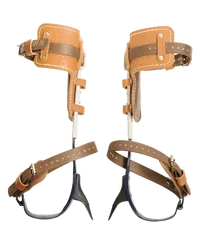
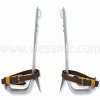
What brand spurs are you using? I tried Klein tree spurs for a short while, and the point felt like it was further away from my foot than Buckinghams or Bashlins, which made it harder and more awkward to balance.

A 540° wrap of your lanyard around the spar will help alot too, but makes it a bit more work to advance the lanyard.

Sorry, no decent pics handy.
 
Agree with 540 wrap from underneath, just shorten lanyard a bit from normal as don’t want to reach too high to grip lanyard,

To be honest I am too lazy now to do it so usually use long lanyard, or pre thrown extra line for long ascents on angled spars and ropewalk up. Do the spur work when I need to though...
 
I balance pretty well on angled trunks now, but in my earlier days it was quite a challenge. It the trunk is fairly smooth you can use all 4's and keep your lanyard above your hands to advance it, but if it gets stuck on things and your relying on hands for support it could be hard to flip your flip line. If there is a remote point you can tie into, you can lean out to the side putting your weight on the high line and use the lanyard just to stop from swinging free. Once into position, the 540 wrap can make for a much more stable stationary spot for cutting, ect.
 
It seems that I cannot lanyard in and keep my balance on my spikes as easily, mostly because the stem is out of arms reach.

First order of business. NEVER spur up a tree on the downhill side. Fighting gravity just makes everything exponentially more difficult.

Watch someone who is good in spurs and working a flipline. You will very rarely see them put their hands on the tree. That's what your flipline/lanyard is for, so learn to trust it and own it. When climbing a leaner you need to run your flipline longer which will allow you to get in a more upright position. Muy importante! Being more upright will allow your nervous system and muscles to relax a little, making balancing much easier. If you keep your flipline advanced above your waistline you can create a triangle between your flipline, spurs, and body also making balancing much easier.

Spurring leaners is an acquired skill which takes time to get comfortable with, so kept at it and you will see progress!
 
Last edited:
Thanks for the inputs. Using Klein’s with tree length gaffs. And the stems in immediate question are from a god awful multi-stem silver maple, more than a dozen 8-12” stems in the canopy, over garage, fence, house, and shed. I could switch to pole gaffs but the gaffs are rusted in right now.
I know what I’ll do, I’ll just use a climb line and a long work position lanyard to get out to the rigging points. Will take time, but I suppose that’s why these jobs are more expensive.
 
if I slip underneath spar I just go with it. If slip underneath smooth spar I want to grip 540 lanyard so acts like a normal lanyard and not tightly wrap on spar (like holding a loose loop around spar). If try release gripping 540 each movement you will tire fast...

Rough bark 540 not so needed (I don’t like sliding a long way if I can avoid it) until get to where cutting as RBJtree said.

If lots of stubs branches req lots of lanyard swaps, then if I can use ropewalk - often set from ground with throwline or even big shot if needed as one realises the issues early in planning the climb...
 
I dont like kleins. My preference is bashlin pole spikes for everything. You could consider double tie in points using either the back end of your rope or a second rope. I have a 75 foot length of rope for that exact situation.
 
Kleins are the ones that hook out to the side a lot right? I think that would definitely make it harder to balance.
CL-1907AR_CN1907AR_CLIMBERS_TREE_GAFFS_KLEIN_1.webp
Yeah, it does. It did for me anyways. Look how much closer to the foot the point ends on Bashlins.
spu502-500.gif
 
Duh! Sometimes the obvious isn't. I had the same situation yesterday and really struggled with it. An 18" DBH box elder. I got the job done, but was exhausted afterwards. There was a decent opposing stem. I could easily have tossed a line up on that stem, higher up, and used it to help keep me upright--kind of a near-vertical limb walk. It would have been so much more comfortable. Next time!
 
A lot of trees that are growing phototrophically like this are surrounded by structure to tie into. Even a low angle distant tie in can provide a lot of positioning stability on an angled stem. I do a lot of Boxelders when I subcontract because they are a challenge for many production climbers. Multiple TIPS is the way to go.
 
After Rico's points try running sharp pole gaffs anywhere they will work (on hardwoods and thin bark of softwoods.) It makes a world of difference to have your boots and balance point in closed to wood, and to have them set by just stepping up not stomping up.

I use Bashlin curved shank climbers and love them. (They also make a straight shank climber.) I have always looked at that big gapping open on the Klien tree gaffs and thought it would be nice on some sluffing softwoods but, I can see how it could cause issues on thin bark hardwood.
 

New threads New posts

Back
Top Bottom