Kathy,
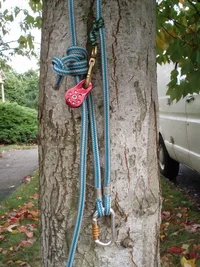
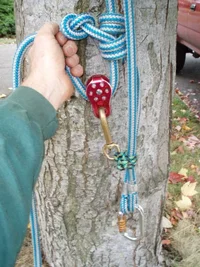
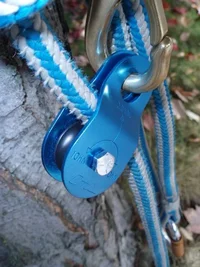
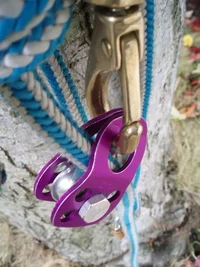
There are a number of ways to back-up Mar-Bars that would probably be ITCC compliant. But, I still have to talk with the officials.
My personal opinion, based on lab tests, field trials, and use in actual tree work, is that just using an upper unit alone provides a very high level of safety, and if you use an upper unit together with a lower unit you <u>are</u> using a backed-up system. (I need to do an article, a video, or at least a detailed post about all this.)
I would like this discussion of MB back-up to take place in the context of a very vigorous and open-minded discussion of safety and the need for back-ups in general. It seems to me that we are developing a double standard with respect to the requirements for back-ups, at least at the competitions. Why should an ascender require a back-up but a climbing hitch not. The arguments I’ve been hearing aren’t very good:
• If the cam in an ascender failed, the climber could have a serious fall.—Well, if the eye splice or termination knot on a Prusik cord or the cord itself failed, you could have the same result. Why require a back-up for one system and not the other? Nobody seems to be looking at actual equipment failure rates. Just how “unsafe” are ascenders anyway?—I’ve used ascenders in tree climbing for about 25 years and never had a failure. I’ve certainly had friction hitches slip, run, or jam during that time.--Why should we expect an ascender to be more subject to failure than a friction hitch? Where’s the case for this?
• Ascenders are only for going up. Ascenders need to be backed up because if you encounter an angry bees’ nest, you’ll then have a means of quickly descending and getting out of harm’s way.—Well, what if you’re using a secured footlock entry. Where’s your instant means of descent. A footlock Prusik isn’t supposed to be used for descending. And, if taking a footlock or wrap on your boot to do an emergency descent using the Prusik only as a back-up is acceptable, why wouldn’t doing the same thing with an ascender as the back-up be o.k.? Also, the bees argument really doesn’t make a case for why ascenders need to be backed up. It makes a case for having a means of descent immediately available. These are two separate issues: back-up= protection in the event of a failure, having a means of immediate descent=a way to get away from trouble or a way to get to help.
Considering the following, the ITCC back-up requirement seems nuts: Ascenders are engineered for the purpose and manufactured and tested under strict standards. Friction hitches are manufactured in the field by whoever ties them, and they’re tested, if at all, according to whatever standard the user decides to use. Ascenders are hardware and have very uniform performance. The performance of friction hitches is highly variable and depends on any number of loosely regulated or unregulated factors: the type of cordage used; the length of cordage used; how the hitch is tied, dressed and set; whether the cordage is new or worn; whether or not there’s pitch on the rope; and whether the cordage is wet or dry. So, with very predictable performance on the one hand and with variable performance on the other, why is a back-up required only for the thing that has the reliable performance?
I need to emphasize that I’m NOT advocating that friction hitches be backed up all the time. There are certainly situations where it’s a good idea to have back-up. That’s why we use fliplines, double crotching, and M riggings. The position I’d like to push is that ascenders don’t need to be universally backed up in tree work and recreational tree climbing. For both friction hitches and ascenders, the need for back-up needs to be determined on a situation-by-situation basis by competent climbers. And, what we need to focus on for both ascender and friction hitch use is developing competent users. What we need to develop for ascender use is something similar to what’s been developed for Prusik use during a secured footlock: A set of limitations that takes into consideration and conveys how a Prusik works. This set of limitations gives a standard by which safe and competent use can be determined. The universal back-up requirement for ascenders that’s currently in place doesn’t allow for any competent, safe non-backed up use of ascenders. It’s a lowest-common-denominator-applied-to-all approach. And, it does nothing to foster knowledge about how ascenders work; what can make them fail and what can make them work well, and what should and should not be done with them.
I’d like to get one or maybe several threads going on these subjects. But, my participation will probably have to wait until next week some time.—My roof was leaking badly, and I need to finish my re-roofing project.
Hasta Luego,
Paul