Overhead working line

I have a question. I have been climbing for about 12 years and in the last 6 months I have had to suspend a line over the tree I was climbing on two different occasions. I had never done this before but I will describe how I set everything up-sorry no pictures I didn't have my camera with me either time. I set a line in one tree and tied it off to the trunk then I placed the rope through a crotch at about the same height in a tree approximately 75' away. Then I tightened the rope with my GCRS. I then placed a pulley on the rope with a carabiner through the eye in the pulley then a friction saver through the carabiner then my rope through the friction saver. My question is if my 200 pounds is on the tightline how much weight is on each crotch?
 
You set up a tensioned speedline. If you've tightened up the overhead there is already a lot of load on the system. Then you hang your load without any deflection and you're getting some big loads. There is a thread or two about speedlines that will give you the calculations.

With a setup like that you could use two biners, alternate/opposing gates clipped to the eye of the pulley and thread your rope through. Or, clip another pulley into the biner and use the lower pulley as a false crotch.

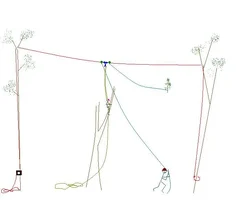
On one job I set up a similar line. But the tree spread across a deck and I wanted to have the TIP fixed and not travel on a pulley. A rope was set in two trees and a bear paw was rigged between them. The big eye of the bear paw was my TIP. As I worked my way through the takedown. My groundies would slack-off one side and tension the other to position the TIP in the perfect place. By doing this it kept my line almost vertical during the whole takedown. Better than having it pulling over at an odd angle.
 
Tell me if you think this idea would bite the big one...

Set the speed line (the overhead line) and have a prusik knot hanging from it. Your climbing line hangs from the prusik. Now, attach a small pulley on either side of the prusik with a long cord hanging from each one. Now, anyone from the ground can grab one of the cords and pull the prusik to the best position.

I just sorta thought this in my head. Not sure if it'd really work.

Hope you like the cartoon!

love
nick
 

Attachments

  • 21837-adjustbl.spdlin.webp
    21837-adjustbl.spdlin.webp
    19.9 KB · Views: 148
YOu should go look up Pixar, they might need your talents :)

That might work but it might take a powerful pull to break the prusik. Tailing the slack tenders parallel to the overhead line would make the pull more fair.
 
The prussic would be loaded completely differently than in its more "normal" usage, and I highly doubt you'd get it to slide while weighted. If you could, with likely great effort, I believe a great deal of heat would be generated.

You could set the overhead line one side slightly higher, hang your work rig from a pulley, with a lateral positioning line on the pulley and tracing back to another pulley at the higher end of the overhead line, then down to the groundie. Start working at the higher end and have the groundie pay out line from a brake as needed, or if necessary, haul you back uphill. Obviously you wouldn't want a great deal of "grade" on the overhead line; merely "enough".

Yeehaw!
 
As clarification, I wouldn't expect anyone to break that pulley while it's loaded. You could lanyard in, give a little slack in the climbing line, then have the ground crew adjust the location.

Glen, about the pulley (woops, I meant PRUSIK, not the pulley)not being loaded "normally" as you suggested, are you talking about how its being pulled perpendicular to the line, as opposed to parallel how we use it when climbing? It still functions when used perpendicularly.

love
nick
 
Nick,

I may be mistaken here, but I believe Glen was referring to the prussik, not the pulley.

Keep on talkin though, this is interesting stuff...
 
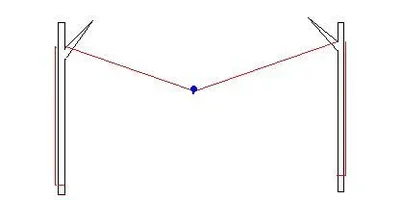
The first tree I did was storm damaged and was sitting at a 30 degree angle "approx". So I started at the brush end and worked my way down the trunk. When I would weight the system the overhead line would create a V and the pulley would sit there and not move at all. Then after I would make the cut I would stand up and walk down the trunk and the pulley would follow me until I was in a polition to make my next cut. I never used my positioning lanyard because I thought the tree could fall out from under me at any time, and it eventually did. The second time that I did this was on a standing tree that was just to decayed to trust. So I guess that I didn't need a pulley at all. After I had the tree down to a height that it could be felled I stood on top of the trunk and had my ground crew pull me into one of the trees that the line was set in so that I could prune it.
 
The V wouldn't be a huge problem for work positioning but the question I have is how much tension should you have on it and how would you measure the tension, is 1/2" rope sufficient in this system if a fall occurs ?
 

Attachments

  • 21858-sky line.webp
    21858-sky line.webp
    3 KB · Views: 80
I guess I just dont understand the complexity of having a 'high lead', a pulley running on it, a bear paw attached to the upper pulley and then a climb line attached to a bear paw, and then raising and lowering each end of the 'high lead' to position the climber exactly where needed.
Why not just have two pull back lines attached to each end of the bear paw? that way you would'nt need to raise and lower each end of the 'high lead'? But if the 'high lead' was set up parellel to the ground would'nt the pulley travel smoothly and thus eliminate any need for pull back lines?
maybe I did'nt understand what you all said...
Frans
 
The way that I worked the system there should never be a fall because I fully weighted the overhead line before I made each cut. I don't have any problem with the safety factor of the rope my main concern was with the load on the trees that are holding the overhead line. In both situations I believe that this was the only safe way to do these trees but in the latest situation the crotches that I had to use to get above the tree that I was removing were pretty small. I did fully weight the system and test it before I left the ground and was not concerned with the integrity of the system while I was working but afterword I started thinking and was wondering what forces were in question and if I ever have to do this again where my concerns should be focussed.
 
As Tom said when you create a tyroleon Traverse you must be very careful the increase in load in both directions are huge.In Theory at 180 degrees the force will be infinite!!!!!!!!!!!!.Though this is pretty impossible as the weight in the line will cause some change in angle....Angles at 120 degrees are going to create the weight of the object on each anchor and once over 120 starts creating more than the weight of the object on each leg its a bit like drawing a longbow There is an equation to work out exact force but would need to know the weight of the object and the angle of the rope....


Didj
 
Absolutely right, Didj. At 150 degrees, which is about as close to flat as one can reasonably get a line between two trees when it is loaded by a human body, the load on each leg is 200 percent of the hanging load. There would also be some MA on the crotches the high lead runs through, and using a GRCS to tighten everything up startes you out with who knows how much load, too. It could easily be quite a bit before you add the climber's weight. You really have to watch out in these situations. If even a small fall or swing is possible it can get out of hand real fast.

That said, I've done this before a couple of times, once to reach a goshawk nest on a suspect snag and once to go someplace where there was no tree at all. It is a good tool to have in your bag, just keep the potential loads in the very front of your mind. It is pretty impressive to observers, that's for sure.
 
That is for sure. The first time that I did it the job site was being inspected by my work comp insurance company. They are a company that specializes in insurance for arborists and loggers and they inspect a jobsite every year to see that we do everything safely and make suggestions on how we could do stuff safer. The inspector said that he had visited around a 1000 jobs and he had never seen anything like that. He was VERY impressed. /forum/images/graemlins/grin.gif
 
Frans,

The time that I set that system up was probably fifteen years ago. Now that I have more knowledge I would probably set it up differently. Like others have said, this isn't a very common setup but like any special tool, it might be the only solution.

There are many names of a setup like this. Arbos know it as a speedling, rock climbers, a Tyrolean traverse, loggers as high lining. I've posted this before but it's worth trotting out again:

http://www.osha.gov/SLTC/etools/logging/manual/yarding/yarding.html

A while ago I did some research into using a hot air or helium balloon to raise a climber into position. It's feasible but spendy. The system I envisioned would have the balloon guyed out in three directions. A capstan winch would be setup in a piggyback to move the balloon in three dimensions. The climber's TIP would be suspended from the balloon. Now I'm just waiting for the right job to make it happen.
 
Hot air balloon sounds like a great idea. If you get a job like that I would like to help. /forum/images/graemlins/grin.gif The other day I was doing some hazardous removals for the city where I live and even though our company has done all the cities work for 20 plus years this was the first time I have done work since they hired a city forrester and I was teasing hiim all day about needing a crane. At one point he said "next I suppose that you will want to use a hilicopter". I told him if he gets a job lined up to use a helicopter I will not charge him for my time. /forum/images/graemlins/happydance.gif
 
On Rope has good info on this subject. They use the trem "high line". I agree that the forces on either end could get large. You need to also look at the angle of deflection and the direction of pull on the upper rigging points.
 

New threads New posts

Back
Top Bottom