TheTreeSpyder
Branched out member
- Location
- Florida>>> USA
Been waiting to bring this up in EyeSplice thread, but figure i'd give a fresh start.
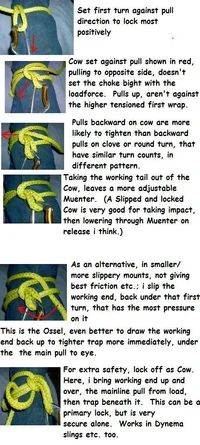
A Cow Hitch is very simple and faithful. "In Tree" etc. working with smaller line, slings etc. for directing and controlling mounted carabiners and devices; i might use a Cow Hitch too, for adjustability to different mounting sizes that a number of chokes with sling etc. doesn't work.
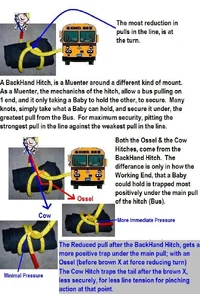
A lot of times, the branches might be kinda small, slippery in texture for less friction by area and intensity for hitch to grip. When in question, i go to an Ossel Hitch; viewing it as an altered form of Cow/Muenter hitch strategies, that share the reverse in turn direction to make restricting bight, that other double turn hitchings (clove, round turn) don't have.
The Muenter function/base made first, can make either a Cow or Ossel easier to adjust, and takes most of the load, then the finish of the Cow or Ossel, finishes the trap. Ossel trapping under the more intense, direct pull of the loading i think.
i still believe in the 2 leg support of the long eye or round sling for this lacing as superior. Flat rope of webbing or hollow Tenex, leveraging less, due to less dimension, on the bend in rope at the carabiner forming either eye or loop support.
Great Hitch, with one simple alteration i think, good fer small line pulling a larger too.
A Cow Hitch is very simple and faithful. "In Tree" etc. working with smaller line, slings etc. for directing and controlling mounted carabiners and devices; i might use a Cow Hitch too, for adjustability to different mounting sizes that a number of chokes with sling etc. doesn't work.
A lot of times, the branches might be kinda small, slippery in texture for less friction by area and intensity for hitch to grip. When in question, i go to an Ossel Hitch; viewing it as an altered form of Cow/Muenter hitch strategies, that share the reverse in turn direction to make restricting bight, that other double turn hitchings (clove, round turn) don't have.
The Muenter function/base made first, can make either a Cow or Ossel easier to adjust, and takes most of the load, then the finish of the Cow or Ossel, finishes the trap. Ossel trapping under the more intense, direct pull of the loading i think.
i still believe in the 2 leg support of the long eye or round sling for this lacing as superior. Flat rope of webbing or hollow Tenex, leveraging less, due to less dimension, on the bend in rope at the carabiner forming either eye or loop support.
Great Hitch, with one simple alteration i think, good fer small line pulling a larger too.