
Navigation
Install the app
How to install the app on iOS
Follow along with the video below to see how to install our site as a web app on your home screen.
Note: This feature may not be available in some browsers.
More options
You are using an out of date browser. It may not display this or other websites correctly.
You should upgrade or use an alternative browser.
You should upgrade or use an alternative browser.

- Location
- Retired in Minneapolis
What would you suggest Butch? It's always great to get ideas from other vertical professions.
R
rich_h
Guest
Regardless of how the shackle is hooked up it is apparantly illegal to do it at all. I will post what information I have regarding this situation tomorrow, but, it basically says that tying into the ball in any circumstance with any configuration is not acceptable.
I am not trying to stir up a controversy here, but the current information I have (through a companies citation) says that at no time in any situation is it ok to tie into the crane ball for tree work.
All of us know the dangers associated with hazardous removals. Most likely all of us know that using a crane to assist in these situations makes life much easier. The problem may be that we as an industry know this and the bodies that regulate us do not. If , in fact, we are not allowed to use a crane to assist us in these dangerous situations, then we need to figure out a way amend this and fix it for the future.
As I understood it most every tree company that I have ever heard of and worked for would be in violation of these regulations regarding tying into the ball. We need a definitive answer from someone.
I am not trying to stir up a controversy here, but the current information I have (through a companies citation) says that at no time in any situation is it ok to tie into the crane ball for tree work.
All of us know the dangers associated with hazardous removals. Most likely all of us know that using a crane to assist in these situations makes life much easier. The problem may be that we as an industry know this and the bodies that regulate us do not. If , in fact, we are not allowed to use a crane to assist us in these dangerous situations, then we need to figure out a way amend this and fix it for the future.
As I understood it most every tree company that I have ever heard of and worked for would be in violation of these regulations regarding tying into the ball. We need a definitive answer from someone.
Lumberjack
Branched out member
Loading the pin is safe, it does afterall carry the weight, if anything cross loading would be frowned on (as would a tree climber on an oil rig). The biggerest risk is the pin spinning, which is highly unprobable. On the last crane job the oiler rigged up a piece on the ground (dunno why??) with the running side of the strap rubbing the pin, I stopped and reset the shakle, I dunno what he was doing/thinking.
Riding here is prohibited, it has happened 2 times although neither were anything major. Here the crane can lift 10k lbs at a 90' radius but 250lbs of flesh at a 30' radius and gear will send the crane topling down.
How I tied in those 2 times was rope through the hook with a short eye to eye going from the climbing rope to above or on the block.
A friction hitch on the cable would also work.?
Riding here is prohibited, it has happened 2 times although neither were anything major. Here the crane can lift 10k lbs at a 90' radius but 250lbs of flesh at a 30' radius and gear will send the crane topling down.
How I tied in those 2 times was rope through the hook with a short eye to eye going from the climbing rope to above or on the block.
A friction hitch on the cable would also work.?
- Location
- Retired in Minneapolis
It seems that the choice of the large shackle solves two problems. The first is the small compromise in loading the pin. In actual fact, I think this isn't a big deal. When I've seen break tests on smaller shackles, cross loading doesn't compromise the strength. Then, sine the shackle is rated at 34,000 pounds I think that the safety factor is high enough to allow for a bit of strength loss.
More importantly the dimensions of the large shackle keep the FC strap out away from the ball and hook. A nice cantilever setup.
More importantly the dimensions of the large shackle keep the FC strap out away from the ball and hook. A nice cantilever setup.
Lumberjack
Branched out member
Keeping the stuff away from the ball...... thought being to prevent the chance of the ball smushing the strap/web running down it against an object.. or keeping the rope from rubbing on the ball (dont see why that matters but I have very limited experiance, perhaps friction?).
Both times I have tied in the line has been multi parted, only on this last job have I used a single line, the Aux line on the 175ton.
For a single part line I think I would have my line in the hook and a large eye/small eye line with a friction hitch on the winchline and the small eye with a biner to hook into the loop of the climbing line. Perhaps a nylon sling same thing.
I assume since its suck an ungodly large shackle we are excusing breaking the rule of no life on rigging gear?
I guess I need to buy a crane so I can ride the ball and see what its like /forum/images/graemlins/grin.gif
Both times I have tied in the line has been multi parted, only on this last job have I used a single line, the Aux line on the 175ton.
For a single part line I think I would have my line in the hook and a large eye/small eye line with a friction hitch on the winchline and the small eye with a biner to hook into the loop of the climbing line. Perhaps a nylon sling same thing.
I assume since its suck an ungodly large shackle we are excusing breaking the rule of no life on rigging gear?
I guess I need to buy a crane so I can ride the ball and see what its like /forum/images/graemlins/grin.gif
Absolutely no riding the hook downunder! It's NOT ON.
Under special circumstances you may apply for permission to ride the hook where there's no other form of access, for instance ... dead unstable tree and tower wont reach etc you have to ride the hook ... but chances are you'll be retired or the tree fallen over by the time the red tape turns green.
Over here they throw us into the category of forestry and fishing! And I have no idea why the fishing part is there.
Under special circumstances you may apply for permission to ride the hook where there's no other form of access, for instance ... dead unstable tree and tower wont reach etc you have to ride the hook ... but chances are you'll be retired or the tree fallen over by the time the red tape turns green.
Over here they throw us into the category of forestry and fishing! And I have no idea why the fishing part is there.
For whatever reason, if it hasn't been discussed on the buzz, I attended meeting in California with head safety hauncho's who passed it. THe deal was, again with the bark beetle catast., was there was a whole lot of trees and cranes so it would behoooove the whole lot of us to ride up real quick. THis is the deal.
YOu could clip into the ball but because it has been under a load you could only use it for a secondary point. Your main point had to be above the ball on the cable which had a device similiar to the Gibbs asc. like for your flip line.
For whatever reason, and I am not a crane savvy guy, but the cable was not considered as being under a load like the ball on everything picked. So for those regulations I just used a heavy prusik and lashed it around the cable then put a double locking snap on it, and tied into it. THen threw my flipline through the clip on the ball and away I went. I do not know if this law continued to catch on or not.
YOu could clip into the ball but because it has been under a load you could only use it for a secondary point. Your main point had to be above the ball on the cable which had a device similiar to the Gibbs asc. like for your flip line.
For whatever reason, and I am not a crane savvy guy, but the cable was not considered as being under a load like the ball on everything picked. So for those regulations I just used a heavy prusik and lashed it around the cable then put a double locking snap on it, and tied into it. THen threw my flipline through the clip on the ball and away I went. I do not know if this law continued to catch on or not.
- Location
- Retired in Minneapolis
The CalOSHA program has become permanent. Lets hope that in this case like many other regulations, where California goes the US follows

RogerM
Carpal tunnel level member
- Location
- Louisville,KY USA
Thanks Norm, I'm sure that there are many other versions
out there. I liked the Idea of the "fat" prussik directly
on the load line and lanyard"ing" on the hook also.
out there. I liked the Idea of the "fat" prussik directly
on the load line and lanyard"ing" on the hook also.

Norm_Hall
New member
- Location
- Wauconda, (Chicago),IL,USA
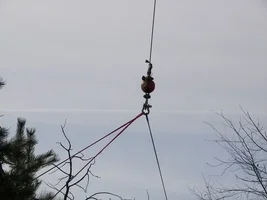
I appreciate the concern guys, but the pin is secured against unthreading by the carabiner. There is absolutely no way the pin can become unthreaded. We think this is a safer connection than putting the FS around the bow. Then there is nothing to prevent the pin from unthreading. We do use the bow for multiple slings. The crane hooks have burrs on them from wire rope slings. Take a look.
Attachments

roxy
Participating member
- Location
- Home In The Driftless
Hopefully TCIA will go to bat on this; it's only, like, the main reason any of us belong to an organization like TCIA. R

Raven
Branched out member
- Location
- Northwoods
Loggers?
I thought we were 078 Landscapers.
I thought we were 078 Landscapers.

Riggs
Participating member
- Location
- Bryn Mawr , Pa.
A crane has so many other potential failure points , why do they just pick on the ball ? I can't say I would want to even work with a crane if I thought for one minute the "ball" would fall off. I've been riding a crane since the 80's and I can't remember one close call. Did you ever see that kid book where they say the hand bone is connected to the wrist bone , the wrist bone is connected to the arm bone ..etc. etc. , ? They should have a crane book like that . We all go to work to come home to our families , and sometimes it's hard to make an unsafe situation "safe" , and tying into a crane is definetly one of those situations we need to do in some cases, to be home for dinner .
- Location
- Retired in Minneapolis
Here is a bit more from Peter's and my conversations:
Peter,
We hear that OSHA doesn't allow, and will fine, use of a crane for supporting a climber. But ANSI allows it. It seems like I'd be concerned about getting a fine from OSHA since they regulate the workplace. What do we tell people? Is using a crane allowed or not? From your replies it seems like it depends on the inspector.
Tom,
I believe that as long as the operation follows ANSI to the letter, any citation could be beat on grounds of greater hazard. That OH company got in trouble and we couldn't help them because they violated ANSI protocol.
--------------------------
Sent from my BlackBerry while I'm travelling for TCIA.
Peter,
We hear that OSHA doesn't allow, and will fine, use of a crane for supporting a climber. But ANSI allows it. It seems like I'd be concerned about getting a fine from OSHA since they regulate the workplace. What do we tell people? Is using a crane allowed or not? From your replies it seems like it depends on the inspector.
Tom,
I believe that as long as the operation follows ANSI to the letter, any citation could be beat on grounds of greater hazard. That OH company got in trouble and we couldn't help them because they violated ANSI protocol.
--------------------------
Sent from my BlackBerry while I'm travelling for TCIA.
R
rich_h
Guest
Tom,
Thank you for the follow up to this situation and the clarification of why the company was fined. I feel quite a bit better knowing that TCIA is willing and able to step in and stand up for us as well as knowing that the ANSI standard developed for our industry means something to OSHA afterall.
Thank you for the follow up to this situation and the clarification of why the company was fined. I feel quite a bit better knowing that TCIA is willing and able to step in and stand up for us as well as knowing that the ANSI standard developed for our industry means something to OSHA afterall.
We have a chance to change this, over time. It is slow going, but I think that it is a battle that we can win.
The older guard at OSHA will often not even discuss the issue. I heard a quote that sums up how to deal with this type:
"You can teach an old dog new tricks, but you have to wait for dinosaurs to go extinct.”
When I have pressed some of the old school thinkers about this, they fell back on the fact that the crane manufacturers often prohibit this. One can only assume that they do this to limit their liability, and that it is not truly related to the climber being at risk.
Peter Gerstenberger’s comments make a very important point; we need to follow our own standard if we want OSHA to do the same. I would recommend that anyone planning on using a crane this way, read, and follow the ANSI Z133.1 standards, EXACTLY as they are written. If we don’t take our safety standards seriously and follow them, why should OSHA?
I am going to try to get copies of the new standard into the hands of as many OSHA compliance officers as I can. I have spoken to a number of them who did not know it existed and said that they would use it if they had it.
When the new standard comes out ISA and TCIA usually sell them at a very low rate. We should all think about buying a few extra and getting them into the hands of the OSHA compliance officers who we may have to deal with in the future. I also think that the organizations should support this as well.
What do you think?
Tim Walsh
Arboriculture Safety Consultant, Researcher, Doctoral Student
603-867-0899
t.m.walsh@att.net
The older guard at OSHA will often not even discuss the issue. I heard a quote that sums up how to deal with this type:
"You can teach an old dog new tricks, but you have to wait for dinosaurs to go extinct.”
When I have pressed some of the old school thinkers about this, they fell back on the fact that the crane manufacturers often prohibit this. One can only assume that they do this to limit their liability, and that it is not truly related to the climber being at risk.
Peter Gerstenberger’s comments make a very important point; we need to follow our own standard if we want OSHA to do the same. I would recommend that anyone planning on using a crane this way, read, and follow the ANSI Z133.1 standards, EXACTLY as they are written. If we don’t take our safety standards seriously and follow them, why should OSHA?
I am going to try to get copies of the new standard into the hands of as many OSHA compliance officers as I can. I have spoken to a number of them who did not know it existed and said that they would use it if they had it.
When the new standard comes out ISA and TCIA usually sell them at a very low rate. We should all think about buying a few extra and getting them into the hands of the OSHA compliance officers who we may have to deal with in the future. I also think that the organizations should support this as well.
What do you think?
Tim Walsh
Arboriculture Safety Consultant, Researcher, Doctoral Student
603-867-0899
t.m.walsh@att.net

- Location
- Bloomington, Indiana
[ QUOTE ]
Here is a bit more from Peter's and my conversations:
Peter,
We hear that OSHA doesn't allow, and will fine, use of a crane for supporting a climber. But ANSI allows it. It seems like I'd be concerned about getting a fine from OSHA since they regulate the workplace. What do we tell people? Is using a crane allowed or not? From your replies it seems like it depends on the inspector.
Tom,
I believe that as long as the operation follows ANSI to the letter, any citation could be beat on grounds of greater hazard. That OH company got in trouble and we couldn't help them because they violated ANSI protocol.
[/ QUOTE ]
Tom:
Do you know what ANSI protocol the company violated? From the posts above I thought that the company was in compliance with ANSI.
Here is a bit more from Peter's and my conversations:
Peter,
We hear that OSHA doesn't allow, and will fine, use of a crane for supporting a climber. But ANSI allows it. It seems like I'd be concerned about getting a fine from OSHA since they regulate the workplace. What do we tell people? Is using a crane allowed or not? From your replies it seems like it depends on the inspector.
Tom,
I believe that as long as the operation follows ANSI to the letter, any citation could be beat on grounds of greater hazard. That OH company got in trouble and we couldn't help them because they violated ANSI protocol.
[/ QUOTE ]
Tom:
Do you know what ANSI protocol the company violated? From the posts above I thought that the company was in compliance with ANSI.
Interesting to note what I found when looking up the information for the chipper accident:
http://www.osha-slc.gov/pls/imis/establishment.inspection_detail?id=307540385
Notice that ANSI Z133.1 is referenced in the citation. New York is covered under federal OSHA, I beleive.
So, if it is OK for New York OSHA compliance officers to reference the Z.....?
http://www.osha-slc.gov/pls/imis/establishment.inspection_detail?id=307540385
Notice that ANSI Z133.1 is referenced in the citation. New York is covered under federal OSHA, I beleive.
So, if it is OK for New York OSHA compliance officers to reference the Z.....?
New threads New posts
-
test
-
-

-
First time rope and harness tree climber shows the best attitude
- Started by moss
- Replies: 7
-

-


