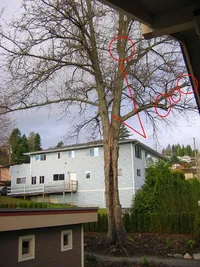
opinions on an oak

Well it seems that i can recommend a removal without any misgivings at all. There are targets 360 degrees around the tree, including a very busy post office parking lot. Thanks for all the advice.

Thanks for your in depth advice guymayor, but I have a feeling this client really wants to have the problem gone, not stil hanging over his head so to speak. I will let him know that it is possible to greatly reduce the chance that the tree will fail in the near future, with a good deal of work.
 
[ QUOTE ]

1. The oak isn't native to the area


[/ QUOTE ]

Hardly a reason for its removal.

Some of the best specimens of trees that exist are not located in their native region.

Are you saying that because a tree is not native it has less value than a native tree?

If that applies to humans as well, there should be no people of european descent in the U.S.A. as they are not native to that region!
 
removal! secure it before you climb it...

jp
grin.gif
 
If the owner doesn't live there, then risk tolerance is very low and removal is what happens. Lengthy advice was a snippet from October Arborist News CEU article.

Morphine for a nail in the foot. That's a good analogy.
applaudit.gif


You take out the nail, then you either treat the injury or get rid of the injury by cutting off the foot.
icon310.gif
 
Climb it, but only as a removal. That's our job. Who else can? Take side weight off as you go up. Tie in to the most vertical leader, finish the job. Sacrifice the shrubs if necessary. Charge a lot, so you can take your time with it, describe it to your client as a very challenging, even dangerous, situation for a climber, which it appears to be from the photos.
 
I vote it goes.

Looks like to close to the fence-line anyway and some shoddy pruning in the past.

Looks like one of the leaders about half way up was topped ot something and a strange mark runs down the upper side of the leader and meets with the crack ... sunburn?
 

Attachments

  • 66515-gords1.webp
    66515-gords1.webp
    255.4 KB · Views: 71
If the tree is right next to the post offices parking lot, why not use a bucket or a lift to do the work that needs to be done? Definitly seems like the safe way to go. As well I would remove it. The crack will never heal and only get worse. Rods and cables would only hold it for so many years, until the main trunk rots out enough for the whole tree to fail.
 
[ QUOTE ]
Sacrifice the shrubs if necessary. Charge a lot, so you can take your time with it, describe it to your client as a very challenging, even dangerous, situation for a climber, which it appears to be from the photos.

[/ QUOTE ]Not for a climber who takes the time to think things through and strap the trunk together. It's not often necessary to sacrifice anything if you plan right and get the right gear to the job.

Clients already know the work is dangerous; exaggeration sacrifices credibility.
 
I'm with you, guymayor.

I'd strap the trunk if necessary, of course. I wouldn't sacrifice any shrubs if I didn't have to. And I wouldn't present the problem to the client as anything more than what is. Being on site, and taking the time to think things through is the wise, the only, course.
 
if you have access to a bucket, use it! if not, climb it! but make sure again, to secure the two leaders, get to the split secure it with several straps or heavy duty rope, then secure the leaders up further from the crack maybe 1/2 to 3/4 and take load off as you go up, good luck! you could also throw a rope up in the tree and have you and some mates yank on it to see what the crack does before you get up into the tree...

jp
grin.gif
 
[ QUOTE ]
have you and some mates wank on it


[/ QUOTE ]

WHAT!........ jp you better ask a brit if this is a good idea!

Following on from what treesandsurf was saying.........if you cannot use a bucket or crane and climbing is the only option.

Following bracing..........

Put a rigging block in each of the stems at the same height and run your bull rope through both blocks, this will help to dissipate the weight of limbs being lowered through the whole tree. Pulling the stems together.

Good luck Gord!
 
I haven't read through the whole thread, but looking at the first 2 pics, my gut reaction is to through-bolt it, then put a dynamic cable up top.

Prune deadwood and thin tips to reduce weight first, of course.

love
nick
 
[ QUOTE ]

WHAT!........ jp you better ask a brit if this is a good idea!


[/ QUOTE ]

hey axenot, you know what I meant, I guess you read into what you want to read there huh?
blush.gif


I'll go change it anyway, don't want to develop any sort of rep around the community now would I
smile.gif


jp
grin.gif
 
[ QUOTE ]
Nick you should take the time to read the whole thread.
Your management plan is frightening to say the least

[/ QUOTE ]

In a different location and with a different client, Nick's plan would make perfect sense.
smile.gif


Absentee property managers have different values than residents.
 
Looks like a crane removal candidate from the postage stamp sized drop zone...I would not like to have a climber in a big fat heavy splitting (rotting?) white oak, with no where to escape.
Whatever you do, put in writing that your first recommendation is REMOVAL due to the tree presenting an imminent HAZARD. Then have the homeowner sign off and return to you. File in their client folder. Take pictures and file those, too.
Depending on decay in main stem, root conditions, etc, that tree *could* be preserved with properly done reduction pruning and many supports installed, but given the location, and the fact that those measures do not GUARANTEE the tree is no longer hazardous, the question is *should* it? You the arborist shoulder the risk if you perform that service. Risk dictates what happens to this tree.
Let us know how it turns out.
 
My plan is, if we do indeed remove it, to put two straps a few meters above the union and then a rope maybe two-thirds up the stems to hold them secure. And as axeknot said, utilize rigging points in both stems to minimize the forces pulling the stems apart during rigging. And take reasonably sized pieces. :D

Thanks for all the advice.
 
[ QUOTE ]
You the arborist shoulder the risk if you perform that service.

[/ QUOTE ]How does that happen? If the owner makes the decision, the owner shoulders the risk. The arborist takes on no extra risk by properly doing proper arboriculture. The owner owns the tree and so should own the decision and own the risk.

If the arborist is rash enough to make a recommendation on a high-risk tree, then s/he exposes him/herself to needless liability. If asked for an opinion, abstain. Simple.
 

New threads New posts

Back
Top Bottom