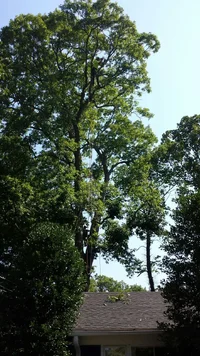
Old White Oak with TearTear

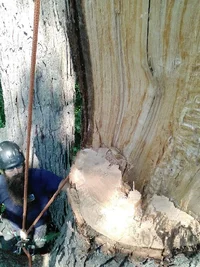
What did the resistograph tell you. Looks like some white rot i n that tear. Please keep us posted on progress, guy m. Will appreciate your efforts.
 
The stem with the tearout appears subdominant, and leaning away from the house. So where is the residual risk now? Looks minor so not sure what convincing is needed.
If it's too ugly, paint it black.

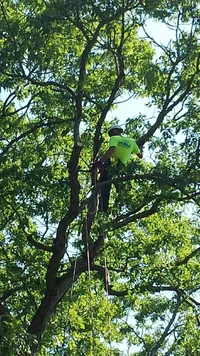
Big cuts like in the 2nd pic may increase the risk of remaining branches failing. A small lateral growing in a better direction might have worked, if there was one.
The cut on the tearout wound looks as good as it can be--good work! The sagging ends on that leader, and on the dominant stem, could be lightened up; 10% off? to allay perceived risk, and hopefully initiate some interior growth.

Soil improvement can speed CODIT.

 
Last edited:
For more precise cutting, as on that whiterot infected tearout 'stub', Stihl's MSA 160's small bar and chain is great for carving. ;) I'll bet you could find one somewhere lol. Finish with chisel per need.
 
What did the resistograph tell you.
Not much. Everywhere else seems as solid and healthy as possible.

So where is the residual risk now?
Thats exactly (well almost exactly) what I told the owner. I said that if this one lead didn't tear out we wouldn't be having this conversation at all.


The stem with the tearout appears subdominant, and leaning away from the house
Thats the problem with pictures. Truth is the lead that had the tear is near vertical and the the one over the house is slightly shorter yet has way more leaf cover.
 
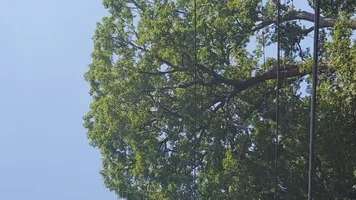
This is a better look at the weight reduction cuts. One thing I failed to mention is that the insurance company told our client to remove all of the growth over the house. That was obviously the wrong move, but she was fine with us reducing each area instead.
 

Attachments

  • 20150804_115848.webp
    20150804_115848.webp
    490.2 KB · Views: 86
O Okay, with that kind of suggestion from the insurance co., understandable. Nice example of adapting their request into something reasonable--proper role for an arborist to play! Now comes the long battle between rot and CODIT, and a lot of that work has to be underground.

Maybe look at the roots connected to the white rot area. How's the base of the tree look?

Did the pruning reduce the height at all? Maybe consider that next trip; <10% off, <2" cuts, 3-9' lengths, should be enough to initiate retrenchment and regeneration of an inner crown.

Big pic there Mark...but good on Aspen to focus on the asset!
 
Last edited:
This is a better look at the weight reduction cuts. One thing I failed to mention is that the insurance company told our client to remove all of the growth over the house. That was obviously the wrong move, but she was fine with us reducing each area instead.

The implication to me of the insurance company demanding removal is that they want zero risk of a payout due to a tree falling on the house. Which to me means that the customer no longer has any insurance coverage from the current insurance company if a tree hits the house, because the insurance company will use the removal order as their excuse not to pay.

What a great scam. Order all of your customers to live risk-free lives, but don't forget to send us your insurance premiums every month.

I think if I were the customer I'd be seriously looking for a new insurance company.

Tim
 
def looks like white rot. How much of the stem was left intact? cable might help, even if angles are not great. Just for a little piece of mind because of the rot. As usuall hard to tell from the pics. I am sure you have it covered, you have prob done this a couple times...;)
 
One spec that often fits old trees with structural issues is: <10% reduction in height and spread, cuts <3" to upright or directional laterals, lengths 3'-6'.
Clear flare of weeds and replace soil near infections with porous aggregate.
Aerate and inoculate soil >1x dbh away, holes >12" deep, 12"-24" apart, to dripline.
 

New threads New posts

Back
Top Bottom