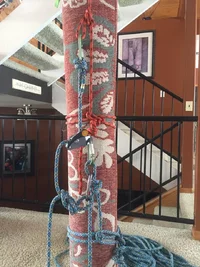
Need an SRT basal anchor

In terms of using a gri-gri for a rescue descent as opposed to a rig or an I’D, it wouldn’t be safe to use if you have it attached to your line as you’re climbing. In theory it is nice, trust me I would have done it a long time ago, but because of the way that a gri gri engages, there needs to be constant tension on it at ALL times for it to stay locked. There will be bounce and slack given to your basal tie off as you climb around the tree, so that gri gri May slip at any second and you better hope you tied a backup knot.

I have however used it as a rescue device where I use wraps of my rope around the tree, tied off and then Used the a Whoopi’s sling with a gri gri below my tie off so that when I climb I’m not using the gri gri for life support but if I were to need a rescue the gri gri would have to have constant tension on it since you’re just dead weight and someone is goin to be running it at that point in time anyway so it’d be just like lowering someone on belay with the gri gri
 
S

Still a little confused...
So are you talking about putting a butterfly right next to the bowline on the end of the rope, attaching the second rope there, and using the friction from the trunk wraps (first with this rope and continuing with the second rope? ) I like that idea... yes, it doesn't pass the whistle test, but I think the only way to pass that test is with the addition of something like the RIG or I'D correct?
The confusion is caused by a "lower-able" base anchor tied at the end of a rope. The alpine butterfly would be necessary in that pic of the trunk wraps with a 2nd rope tied to it. So when you untie the bowline (under tension?) the 2nd rope follows the AB around the 2 trunk wraps and then up the 1st rope's path.
I would prefer to carry the extra gear to the tree....
 
The confusion is caused by a "lower-able" base anchor tied at the end of a rope. The alpine butterfly would be necessary in that pic of the trunk wraps with a 2nd rope tied to it. So when you untie the bowline (under tension?) the 2nd rope follows the AB around the 2 trunk wraps and then up the 1st rope's path.
I would prefer to carry the extra gear to the tree....
What he said. My base anchors honestly are for show. I tell whoever is on the ground if I get hurt and can’t come down find someone who can come get me and don’t touch anything. Assuming their not a competent climber. And of course calling 911 with clear details on location and situation :frenetico:
 
@ghostice

Do you have a time mark where Rich talks about the trunk wraps?

It's around 1:07 - He shows a trunk wrap slipping with load/ unload and then a choked setup - I went to this last summer and it seemed an upgrade over plain wraps (I usually use Colin's Bugg base rather than just rope because of ever present tree sap).

BTW - good advice above about cutting ropes - by golly, I'd have to be pretty committed about the scenario to do that . . .
 
The confusion is caused by a "lower-able" base anchor tied at the end of a rope. The alpine butterfly would be necessary in that pic of the trunk wraps with a 2nd rope tied to it. So when you untie the bowline (under tension?) the 2nd rope follows the AB around the 2 trunk wraps and then up the 1st rope's path.
I would prefer to carry the extra gear to the tree....

Could the rope be *not* under tension since their are all those wraps between the tie and the (relatively minimal) climber weight?
 
With a long enough rope so you can be lowered all the way to the ground, take 3 or more downward trunk wraps, then tie it back to the rope where it goes up the tree with follow thru figure 8 on a bite. Spike the loop that is the tail of the figure 8 with a biner if you think it might come out. It might be a little hard to tie and it takes a lot of rope, just set and dress it well. With 3 trunk wraps, there won't be much or any tension on the figure 8 knot. Wrap down because if you wrap up the rope will pinch itself and lock up.
Additional equipment required, 1 biner, or not if you are confident in your knot and your rope holds knots well.
Skill level of 2 (out of 5) to untie a knot and lower climber.
If you don't have a long enough rope, an additional rope could be tied to the very end in advance.
I've never actually used this because I don't use rescuable base ties. I have used the same technique to tie off and later lower very heavy logs.
 
You mean you dont climb every tree with 3 trunk wraps and a figure 8 follow thru on a bight, clipped for a back up, with a 2nd extra long climbing line tied to the end?
 
With a long enough rope so you can be lowered all the way to the ground, take 3 or more downward trunk wraps, then tie it back to the rope where it goes up the tree with follow thru figure 8 on a bite. Spike the loop that is the tail of the figure 8 with a biner if you think it might come out. It might be a little hard to tie and it takes a lot of rope, just set and dress it well. With 3 trunk wraps, there won't be much or any tension on the figure 8 knot. Wrap down because if you wrap up the rope will pinch itself and lock up.
Additional equipment required, 1 biner, or not if you are confident in your knot and your rope holds knots well.
Skill level of 2 (out of 5) to untie a knot and lower climber.
If you don't have a long enough rope, an additional rope could be tied to the very end in advance.
I've never actually used this because I don't use rescuable base ties. I have used the same technique to tie off and later lower very heavy logs.
Good explanation; three wraps should be plenty and you may even have to take part of those wraps off of the tree depending on the type of tree and the DBH of course. Instead of a figure 8follow through however, I tend to use a double bowline with a fisherman backup or a Yosemite finish, depending on how I’m feeling. But always backup the double bowline for life support
 
Could the rope be *not* under tension since their are all those wraps between the tie and the (relatively minimal) climber weight?
Precisely, the friction of the wraps ends up taking the weight of the climber and the tie off ends up being almost a backup to the friction wraps.

On a side note, the more wraps on a tree, in this situation, the less damage there will be to the bark and cambium, that is, of course, unless you need the rescue
 
You mean you dont climb every tree with 3 trunk wraps and a figure 8 follow thru on a bight, clipped for a back up, with a 2nd extra long climbing line tied to the end?
My first couple years as a climber, before I started buying my own gear, the guy I worked for wouldn't buy a rope longer than 120'. I and the people I worked with knew nothing more than tail tied taught line hitch and always thus climbed mrs/Ddrt. I was frequently in situations where my tip was high enough that I couldn't get down without descending part way, un-tieing, pulling my rope down and re-tieing. Nothing more fun than getting 5 feet from the ground to find out you are out of rope and have to hip trust back up to the lowest limb to re-tie. That was some dumb ass shit.
 
I made a simple system to climb on, that my room-mate ( 110lb, 56 yr old female) could safely lower me on.

I had a ratchet strap that I used at the base of the tree as my base anchor, but a loopie etc could also be used.

I then attached a short section of Arborplex to the base anchor and tied a blakes hitch in the end, which my climbing line ran through. Then for safety in case the blakes ever slipped (it never did) I put a knot about a foot past the blakes hitch.

This way if I got hung up she could just undo the stopper knot and use the blakes to lower me ( no way I would trust her to belay my 210lb ass) we tried this several times with me having my own system as a backup and she never had an issue with lowering me like panicking and freezing her grip on the blakes. However if you were worried about that a few wraps around the base would ensure that the rescue person would need to loosen slack as well as advance line at the blakes to lower the "victim" to the ground.
 
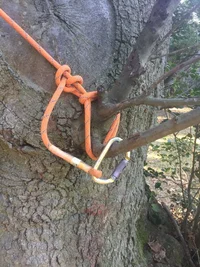
I think I found an SRT basal anchor that I like and would like to see what you all think of it. I wanted an easy to setup, lowerable anchor, that uses minimal gear, required no cutting, and has plenty of rope available.
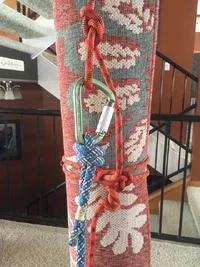
Once your climbing line is in the canopy, you tie the anchor end to the "tree" using a bi-directional running bowline and stopper knot.
1.webp


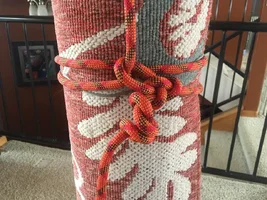
Then tie an alpine butterfly a foot or two up the tree from that.
2.webp


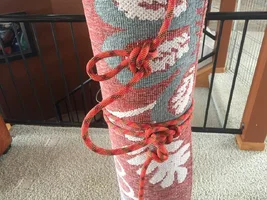
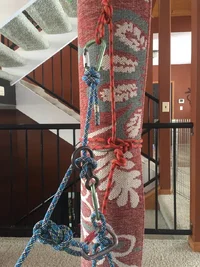
Next take your "rescue" line, lay it out, and using one end do the exact same thing below your climbing line. A bi-directional running bowline, with an alpine butterfly a foot or two up the tree from that.
3.webp


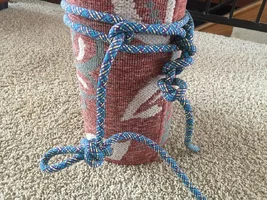
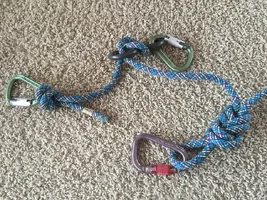
On the other end of the rescue line, tie a double fishermans knot and put a carabiner in it, then put in a figure 8 descender below that, soft lock it off, and tie a stopper knot after that. Also use another carabiner in the stopper knot for safety.
4.webp


Clip the end of the rescue line into the butterfly of the climbing line.
5.webp

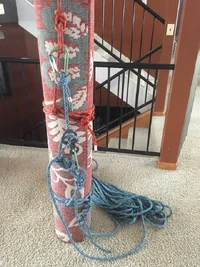
Clip the F8 into the butterfly of the rescue line, make sure it's soft locked and clip the stopper knot carabiner into the butterfly too for safety.
6.webp


Now you're ready to climb.
7.webp


If you need rescue, unlcip the safety knot carabiner from the butterfly, cinch up the F8, and untie the bi-directional running bowline from the main line. The wraps should allow you slow and easy lowering until the rescue line tightens up.

I would think you could also use a GriGri instead of the F8, what do you think of that?
8.webp

There would be no loading and unloading of the GriGri during the climb, since it would be completely loose until you untied the main line which is only in the event of a rescue.

Any suggestions, or input on this setup?
Am I just way overthinking this whole basal anchor thing? Maybe I should just skip setting up the entire second rope thing, and have it in a bag ready to setup instead. I am just rec climbing...
Just getting anxious to get out since we got another 8 inches of snow today. I hate winter.
 
I think simple is better. I get a headache looking at these multistage setups.

I agree with @Tom Dunlap Tom about how nuts it is to have a typical non-climbing day labor ground guy cut a rope in a high stress situation, but I think the rope cutting setups usually are simpler, which is best for high stress situations. The trick is to get the right rope cut at the right time. I wonder if the cut zone could be marked to make it clear where to cut? Just a small midline attachable "cut here" sign paired with a rope knife... You'd have to pre-attach a lowering line before ascending for the day's work, but just leave it in a bag.

It's good to remember that no one has attempted a real rescue by this method, right? So I'm not sure that it is productive to delve into it for it's own sake, but it is fun...
 
If you’re climbing with others, they would need to practice how to lower to not mistakenly untie the wrong rope, as well as how to operate the Grigri, or the Autoblock figure 8.
If you’re climbing solo, not sure someone coming along and finding you just hanging would be able to figure out what to do.
 
... Am I just way overthinking this whole basal anchor thing?...

Yes, I think you are. Ascent only systems used to be the most common choice for long ascents. Because they required a change over before a climber could descend, some type of ground belay was often used, or at least considered.

The advent of the multisender, that allows quickly changing to decent mode, no matter what you are doing, largely negates that danger. We never had a ground based lowering system for MRS because the ground was just a quick pull away. That is now true with SRS tree climbing systems as well.
 

New threads New posts

Back
Top Bottom