My Whoopie

Location
Australia
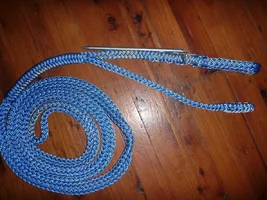
Hi, Pls see attached photo of my whoopie sling.
I will be using it for a ground anchor sling in SRT.

I followed Samson's instructions except for a couple of things-
I stitched the throat in the brummel and back splice.

My concern is the bury does not seem to be the full fid.
I don't like the brummel tucks too close,so I spaced them a little and I think this ment less rope for the bury.

Pls have a look, and don't hold back!!
 

Attachments

  • 277470-P1030079(1).webp
    277470-P1030079(1).webp
    179 KB · Views: 245
I'm no expert and no where as experienced as alot of the veteran splicers on the buzz but it looks pretty good to me.

I would have to agree that your buries on a locking brummel never come how to be the actual bury length. I think its because of what you said, the tucks take up some rope, maybe a little more if you do space them out. I personally have cut my tails an inch or two longer than instructed to compenesate for that and also to make a more gradual taper. Plus, it just makes me feel a little better!
happydance.gif


Curious to hear what the splicing vets have to say though!

-Tyler
 
I'm not prepared to call myself a splicing vet but i've made a few of those and if your brummel is locked (versus stitched), then i would climb on it no sweat. The bury length isn't as critical with the locked eye splice.
Looks like a nice bit of kit to me. I like the tucks to spread out a little bit too.
 
[ QUOTE ]
I'm not prepared to call myself a splicing vet but i've made a few of those and if your brummel is locked (versus stitched), then i would climb on it no sweat. The bury length isn't as critical with the locked eye splice.
Looks like a nice bit of kit to me. I like the tucks to spread out a little bit too.

[/ QUOTE ]

Common mistake, but Brummels actually lower tensile due to fiber compression. Whether you use a brummel or not, always lock stitch the splice.
 
From what I can tell, it looks good.

After having done break tests a few times of a locked brummel vs a straight bury I can say that the loss in strength is very small, sometimes non existent. More often than not 12strands break in the standing part of the rope, nowhere near either eye. I personally do ALL of my 12 strand stuff with a brummel, but that just me. Looks like a nice piece though!!
 
[ QUOTE ]
After having done break tests a few times of a locked brummel vs a straight bury I can say that the loss in strength is very small, sometimes non existent.

[/ QUOTE ]

Yes, but there seems to be a common misunderstanding that brummels mean you can shorten up the bury. Ive even seen some spliced I2I tails that consisted only of the brummels! The purpose of the brummel is to keep the splice from being pulled out, even though the lock stitching must still be done.
 
Very true. The brummels DO NOT mean you can make a substandard length bury!

On anything I do in tenex, i do brummels, then a full fid no taper, then a long fid tapered, which is more than the instructions call for, but its kinda just what works for me, having the ability to dial my stuff in and break it.
 
[ QUOTE ]
...Ive even seen some spliced I2I tails that consisted only of the brummels!

[/ QUOTE ]

The Brummel-only I2I's would have a tensile strength somewhere between 30% and 50% of nominal. I have measured less than 30% in Vectran, and just about 50% in Tenex Tec. The Brummel by itself degrades the rope about like a bad knot. Much better a bad knot than no eye if your splice slips apart!

[ QUOTE ]
Yes, but there seems to be a common misunderstanding that brummels mean you can shorten up the bury... The purpose of the brummel is to keep the splice from being pulled out, even though the lock stitching must still be done.

[/ QUOTE ]

If the lock stitching still must be done, then how does the Brummel keep the splice from being pulled out? What useful thing does it do? The same question applies to your "common misunderstanding" phrase: if you must use a full-length bury even if you tack on the Brummel, then what is it that the Brummel is supposed to do?

I think it is a common misunderstanding that the Brummel is there to keep the splice from being pulled apart. Someone sent me a Vectran eye with a Brummel, a short bury, and a stitched throat for testing. The combined holding power of the Brummel, the stitching, and the friction on the bury were not sufficient: the bury pulled out at about 5000 lbs. But the eye was still there! The Brummel had become a tiny little knot, the stitching was gone, and there were a number of ruptured strands, but the eye was still there. Had I continued to pump the hydraulics, the little Brummel knot would have broken at about 3000 lbs. as I showed in separate tests. Regardless of the quality of the splice or the stitching, that eye was going to support 3000 lbs.

The Brummel gives a guaranteed minimum holding strength to the eye, not the splice.

It would contribute to the security of the splice because of its own significant internal friction, but I agree with Shawn that it has no effect on splice strength. And if there is no chance the bury can come out, as in the case of a full-length splice, then why would one use it?

 
Well, Moray, the discussion on the purpose of the brummel has been covered extensively in this and other forums. Most professional splicers agree that that the brummel is important in arborist applications to help keep the splice from being picked apart accidentally, and that while it does have some inherent strength it should not be factored in to the holding power of the splice.

In other words, the splices ability to retain tensile is dependent on the length of bury.

Lock stitching keeps the splice form being pulled apart accidentally, and the brummel will add to this security.

If you want to continue the discussion on brummels, we could move it to another post. Although it seems that this has been debated sufficiently.
 
At the risk of keeping the brummel discussion in this thread, I'm curious...

If a buried tail is lock stitched, doesn't that impede the Chinese finger trap effect? I'm sure the stitching will stretch with the throat and bury as load is applied but it still seems to me that it would degrade the holding power of the throat constricting the bury.

Anybody have any ideas on that? I honestly don't know one way or the other, just going on my sense of how a bury splice works.
 
[ QUOTE ]
At the risk of keeping the brummel discussion in this thread, I'm curious...

If a buried tail is lock stitched, doesn't that impede the Chinese finger trap effect? I'm sure the stitching will stretch with the throat and bury as load is applied but it still seems to me that it would degrade the holding power of the throat constricting the bury.

Anybody have any ideas on that? I honestly don't know one way or the other, just going on my sense of how a bury splice works.

[/ QUOTE ]

At the risk of jumping in way over my head, it seems a 'proper' (?) lock stitch needs to accomplish two things: 1) be loose enough to allow "Chinese finger trap effect", and 2) be secure enough to keep the bury from 'leaking' out.

I don't know either but would like to. I've seen un-stitched buries spring leaks ... like little 'epicormics' of fibers all over the taper ... ???
crazy.gif
 
[ QUOTE ]
...If a buried tail is lock stitched, doesn't that impede the Chinese finger trap effect? I'm sure the stitching will stretch with the throat and bury as load is applied but it still seems to me that it would degrade the holding power of the throat constricting the bury...

[/ QUOTE ]

I have tested this a number of times with always the same result: the stitching tremendously enhances the finger-trap effect. I can think I can explain why this works.

Imagine a splice where the cover is so loose on the core that there is no friction between the two. Obviously you can pull the core right out with zero effort. If you now put in some loose stitches at the throat there is still no friction between cover and core. But now you can't simply pull the core out. You can add tension right up to the point where the stitches would fail. This tension also causes the cover to squeeze the core along its full length, adding still more holding friction. So you can add still more tension. This leads to still more friction, and so on. What started out as a splice that could not withstand any tension at all can now support several times the strength of the stitching yarn. I measured this magnification effect in one case at approximately 16:1.

It is also clear from this why the stitching must be at the throat. If we place the stitching 2 inches from the throat and then try to pull the splice apart (no eye here, just a direct pull on the core), the 2-inch stretch of cover right at the throat will never see any tension at all, and therefore it will never squeeze the core.

In my own mind I tend to think of the stitching as providing a "seed" holding force. The magnification effect guarantees that the finger-trap effect is very strong right from the get-go.

Without any stitching, as in the case of a loopie or a whoopie, one always (!) puts a bight in the "splice" cover and loads the bight. Loading a loopie this way crushes the cover against the core providing the seed force that stitching would otherwise provide. Even here, if the above analysis is correct, the bight should not be in the middle of the "splice" but closer to the throat.
 
Thanks for the posts, always learning.
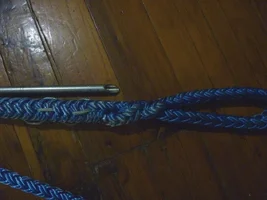
Now my next big question is- given that the bury is only 2/3 to 3/4 of a fid (the photo is deceptive) would you let other member of your crew climb on it?
 

Attachments

  • 277802-P1030083(1).webp
    277802-P1030083(1).webp
    97.3 KB · Views: 82
the whole bury is only 2/3 fid?!? Yeah I wouldnt use it personally. We dont make anything with less than a full fid, and i do a full fid at full diameter, then a long fid taper after that. Im not saying its a bad piece, but I like to have a full fid, bare minimum.

Norm and some of the other splicers on here may disagree wwiht me on that, but thats what I use on all my 12 strand stuff. IMHO, 2/3 fid is too short a distance to do a smooth consistant taper.
 
[ QUOTE ]
...Now my next big question is- given that the bury is only 2/3 to 3/4 of a fid (the photo is deceptive) would you let other member of your crew climb on it?

[/ QUOTE ]

ficus, don't guess. If you have built a sub-standard splice and don't know how strong it is, why would you climb on it?

The simple remedy for your situation is to simply pull the splice apart and re-do it with a proper bury. And while you take the ten minutes to build your bullet-proof splice, you can also enjoy the satisfaction from having started a useful discussion here in cyberspace.
smirk.gif
 
[ QUOTE ]
Norm and some of the other splicers on here may disagree wwiht me on that, but thats what I use on all my 12 strand stuff. IMHO, 2/3 fid is too short a distance to do a smooth consistant taper.

[/ QUOTE ]

I agree 110%.
At least a full fid bury with locking brummels. It also appears as if there is no taper, just dead ended with full volume.
I would recommend a 1 fid full volume bury, followed by a taper. So, about a '1 1/2 fid length' bury total.
Glad to see your taking these as helpful suggestions.
 
Re did the whole thing- full fid bury with a short fid taper. The sling is a little shorter but peace of mind is pricelss- more tenex (for a larger sling) isn't.

Zeb - I didn't intentionally do a short bury I attempted to follow samson's instructions and thats how it turned out(3/4 fid if you include the short taper). This part is a bit vague and may have led to a shorter tail to bury-
"Pass taped end through center
of rope at Mark B. Do not bury Mark A, leave on entry side of standing rope."
How far on the entry? dictates how spread out the brummel is.

Norm- I'm learning alot from the suggestions and glad that the replies are getting more consistant. The instructions say no taper at all, just cut the end at an angle. Why?

The more I learn about splicing the more I lean towards Brian Toss' methods, even though they are not exactly manufacturers spec.

Thanks
 

New threads New posts

Back
Top Bottom