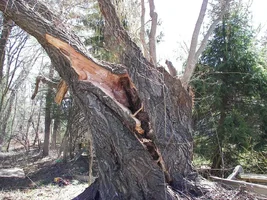
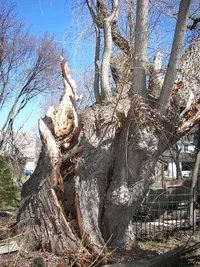
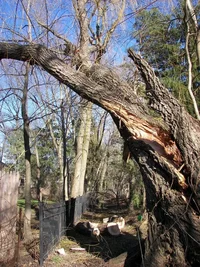
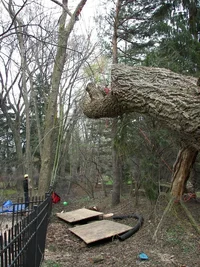
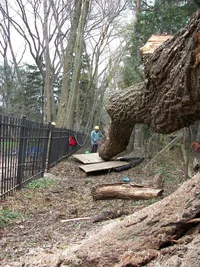
Now we get to the avatar pic.
I was the one doing the topping and engineering, so I don't have any pics from the topping.
How we got the job:
The homeowner called her landscaper when she saw the tree was damaged. The landscaper called numerous tree care firms for quotes. Long story short, we found out the following morning that we got the job because we were the only ones to give a quote. Our quote was a T & M not to exceed $. We figured it would take 1/2 day to set-up the rigging (2 persons) and 2 full days, with 5 persons, to get the tree down and out. It was approx. 80 yards to the clients driveway, which was the closest access.
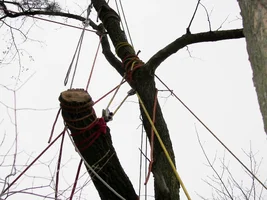
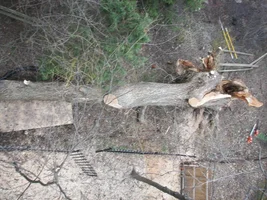
I'll try to explain the purpose of each rope and block, starting from right to left. The furthest right rope (smaller yellow DB 9/16's") is a guy rope to help stable the tree the rigging was set in. It is anchored to a porty 2 near the base of a neighbors tree. The 2nd yellow rope, a 5/8" DB, is set-up in a DWT to help hold the spar up. The DWT block is a 1" Hobbs and the elm tree block is a 5/8" CMI. It is anchored near the base of tree in the clients yard with a porty 3.
Next, in the elm, is a 5/8" DB (red/orange) used as a 'slide line' to help guide the spar down to keep it from going beyond the landing zone. We didn't want it going anywhere near the flimzy aluminum fence.
Above, in the elm, is another 5/8" CMI with a 5/8" DB used to help hold up the spar. Above that is the lowering line (1/2" 3 strand) with a spliced ladder snap for the brush and smaller logs.