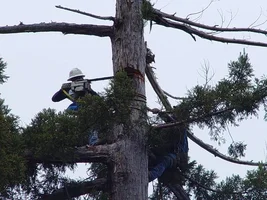
My most difficult cut to make in a tree

I was thinking today while cutting down this tree that the most difficult cut for me seems to be when I am out on a horizontal limb, my climbing line up and over my shoulder to a tie in ubove and behind me.
My load line is running from basicly the same area as my climbing line and at the same angle.
In this situation I need to rope out the end of the limb I am on. The limb is horizontal to the ground and the load needs to be roped out, and guided off to one side or the other.
Cutting the limb with the load line at that paticular angle is hard for me. It always seems like my face cut is just at the wrong angle so the load wants to drop off straight down or only goes a little way to one side or the other. Especially when the limb is very heavy.
When this happens the load line could (and has) come right down on to me, instead of going off to the side. Any suggestions?
Is all this clear? And no I wont post pictures...
Thanks,
Frans
 
I think I follow? Sometimes I would rather place the line closer to the middle of the load to help support it as it holds the hinge. Or, I'll re-direct the load line to the limb being cut. This will keep it from hitting you, but will shake the dickens out of the limb you're on. You probably know all this, but I figured that you'd still want to hear it?
 
[ QUOTE ]
I think I follow? Sometimes I would rather place the line closer to the middle of the load to help support it as it holds the hinge.
Thats just what I was puzzling about. Tie farther out? Closer in? I like your idea of tieing into the middle of the load.

Or, I'll re-direct the load line to the limb being cut. This will keep it from hitting you, but will shake the dickens out of the limb you're on.
When I have a re-direct this is not a problem, same as lowering the load off of itself.
You probably know all this, but I figured that you'd still want to hear it?

Somedays it feels like I dont know squat

[/ QUOTE ]
Frans
 
What about tip tying and cut at the tree or are these limbs too large?
I use a sling on occasion to get foot support below the limb when cutting the limb out and away from the tree, otherwise I just use the hooks.
 
All very clear, but...could you post a picture or two?

I'm no expert on this, but occasionally I see people try to be too ballsy with the notch and they put it straight up and down, as if they were trying to fold the branch horizontally and to the left, which, in an ideal situation, is exactly what you'd LIKE to accomplish, but as soon as the branch starts moving, gravity will take over and if the notch is too aggressive, it just can't do much, and the branch just folds almost straight as you describe.

The more pulling power you have on the rigging line, the more aggressive you can be with the notch. As you know, put a GRCS on it and your notch can be right at the top. But when trying to move the horizontal branch away to the left or right, I try to find a compromise with the notch. I want it to go left, the branch wants to go straight down. The branch is bigger than me, so it will win. Instead, I split the difference and make the notch less aggressive.

I'll put it out there right now. I'm now tree-rigging expert. I've read a few books here and there, and climbed a few trees and tried a few things. I can only report based on what I've done in the tree!

love
nick
 
Pics would help.

If you have a lot of large scaffold limbs, sometimes you can rope the limb out in sections off the limbs above.
try using a tip-tie, and a butt-hitch. Take the limbs out in thirds or quarters, rigging off the limbs above. Using two lines lets the people on the ground "tram" the limbs away.
 
OK Frans...a couple of questions. How are you putting that face cut in and what kind? what kind of wood ? and how flat out are your angles ?. ok Three...

The type of wood your cutting makes all the difference in the world as you well know and if the angle is bad compounding the problem, I dont care if you have a GRCS or not the wood will break to soon.

Are you quartering off your face ? or are you going to severe and having to cut almost or all the way through your hinge.

Mark is right about the placement of your load line.To far out can mean trouble and to close as you have found out can be trouble also. You need to find that happy medium to work with the hinge.

When I'm in that predicament, I quarter off my face and make the back of the face cut wide to.Meaning, a 12" dia limb I may have 1/1/2 to 2" gap between the top and bottom of the back of the face.This allows the limb to carry through more without breaking wood.Sometimes you have to break out the face or make another cut through the center of that one and break it out in two pieces.

This is why the top of that redwood came down so fast at the tripple R.besides the height. It gained alot of momentom before breaking. Heres a pic of that face cut being taken out.

If this is more confusing then your post , give me a call....lol
 

Attachments

  • 24553-popping out the face cut.webp
    24553-popping out the face cut.webp
    88.7 KB · Views: 220
[ QUOTE ]
OK Frans...a couple of questions. How are you putting that face cut in and what kind? what kind of wood ? and how flat out are your angles ?. ok Three...


The type of wood your cutting makes all the difference in the world as you well know and if the angle is bad compounding the problem, I dont care if you have a GRCS or not the wood will break to soon.

Are you quartering off your face ? or are you going to severe and having to cut almost or all the way through your hinge.


Mark is right about the placement of your load line.To far out can mean trouble and to close as you have found out can be trouble also. You need to find that happy medium to work with the hinge.

When I'm in that predicament, I quarter off my face and make the back of the face cut wide to.Meaning, a 12" dia limb I may have 1/1/2 to 2" gap between the top and bottom of the back of the face.This allows the limb to carry through more without breaking wood.Sometimes you have to break out the face or make another cut through the center of that one and break it out in two pieces.

This is why the top of that redwood came down so fast at the tripple R.besides the height. It gained alot of momentom before breaking. Heres a pic of that face cut being taken out.

If this is more confusing then your post , give me a call....lol

[/ QUOTE ]

The limb situation I am talking about is large horizontal limbs 12" and greater in Dia. No attachment points for a load line overhead (otherwise this would be normal removal situation and I would not be asking, but thanks, "speelyei").
I have experimented with tieing far out on the end, but the farther out on the limb I tie, the less torque on the load line I have. This is because the farther out I go the load line angle is increased to the point that the load line is almost parallel to the ground.
When I tie close to the cut, I have no torque at all on the limb. The limb usually just hangs out for a second and then flops straight down.
So what I have learned from Mark C.s & Greg's posts is to modify my tie in point for the load line to strive to tie into the balance point.
Then modify my face cut.
Could you all explain more about the hinging effect when cutting behind or below the face cut? I know depth of each is critical.
Specificly, what happens when making a back cut ubove or below the face cut? And then when the branch is under load?
Oh, and yes I own a GRCS, and we all (my crew) know how to use it.
Frans
 
Frans,

This is probabaly an obvious question, but here goes...

Can you use a tagline to initiate the swing?

Spidey has written and illustrated some limb hinge techniques.

When I read Dent's book in '84 it dawned on me that everything that he wrote about leaning trees and manipulating the hinge wood could be applied to limb cuts. One thing that I've found is that the face cut position, hinge thickness and the offset above the hinge apex of the backcut have to be exagerated.

Jerry has a name for a cut where you make a series of parallel kerf cuts to get the limb to bend over but not break off. Once the limb has bent around into the right aspect you make the felling cut. Every once in a while I've used this cut to make the limb move on two trajectories. At first I might want the limb to hinge down. Then I make kerfs in another plane to make it move along a second arc. Doing that is fun!
 
</font><blockquote><font class="small">Als antwoord op:</font><hr />
Frans,

This is probabaly an obvious question, but here goes...

Can you use a tagline to initiate the swing?

[/ QUOTE ]

Whoops first thing that came in mind to me at the original 1st post. As i sometimes 'think' a tagline is to much work i encounter myself in a hazardous situation trying to get the limb the right way. Then i think of myself; 'you f*ckup, you should have taken the time to set that tagline'.

rgrds Ronald
 
Frans,

This applies to falling techniques, but applies almost the same to Limb wood. Most backcuts are made level with the face. If you walk out into a logged area you will hardly ever see see a stumpshot. Not in Cali anyway. The reason for a stump shot in falling is mainly barriers. If you suspect the tree or limb to hit something then you should have some sort of stump shot to prevent kick back.

Cutting below the face. Main reason and hardly ever used except in some cases, is for a low pull on the tree and heavy back leaner. If you have a 100' tree and your pulling at forty feet with a back lean. This application will apply. It will leave a step in the back cut so trunk would will hvae something to press up against until trunk comes over center. Depending on the pulling force, if you make a standard cut, you could sheer it off the stump and loose it.

So 98% of all my cuts are made level. No use in mamking that wood move any harder then it has to .

Well those are my opinoins. Any condridictions?

Thanks
Greg
 
I like what you said Greg. The only time I cut below my apex is when pushing the tree with a loader. This gives you a little protection and support for the hinge.

99.9% of my cuts are made level to the apex. I believe that I getr more holding power from that cut. Also, Frans, I try to cut a limb that is horizontal as close to the trunk as possible. This adds holding time due to ther collar fiber present. Anyone else do this?
 
[ QUOTE ]
Frans, I try to cut a limb that is horizontal as close to the trunk as possible. This adds holding time due to ther collar fiber present. Anyone else do this?

[/ QUOTE ]

Mark, cutting in too close to the collar CAN divert the limb because the grain is going all over the place. I do agree that snuggling the cut close to the base of the branch means a bigger dia. of limb, hence more wood to work with.
All great points everyone made in response to my question, thank you. The proof will tell on my next job...
Frans
 

New threads New posts

Back
Top Bottom