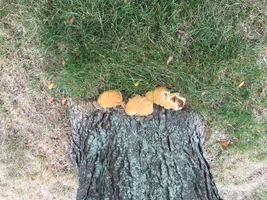
Mushrooms at base of honey locust

IMG_2926.webp Hello

Another question on behalf of my mother-in-law (I should probably help her get an account here).

She has a honey locust in her front yard. She was told that mushrooms growing at the base means it is diseased and should come down. I defer to the experts. Thoughts? See pic attached.

Thanks in advance

John
 
Does look to be arising from the base of the trunk. Perhaps a form of Inonotus?

Recommend a local arborist who does primarily consulting and inspections rather than mostly removals assess the tree for decay.
 
The mushrooms (in this case a shelf fungi) needs to be identified first and then the extent of decay, amount of holding wood must be determined along with the response of the tree to the decay.

Perhaps an Inonutus, but would need to see more to confirm.

This is not a job for an arborist who primarily runs a chainsaw. Hire an RCA (Registered Consulting Arborist) and get a written opinion. Do not take the word of somebody who's education has been on the end of a chainsaw and who needs more work running that chainsaw and chipper.
 
IMG_0350_ml.JPG
 
I just found these on another H locust in Boulder last week. Thick and tough, dense little guys. Looks the same to me. Interested if anyone can ID also. Also been having issues with Bronze Birch Borers in HL this year. Doing a lot of damage.
 
BBB on Honey Locust? You sure it is not another borer?

Read these for ID of polypores:

Gilbertson, R. L. & Ryvarden, L. (1986). North American polypores. Vol. 1. Oslo: Fungiflora.

Gilbertson, R. L. & Ryvarden, L. (1987). North American polypores. Vol. 2. Oslo: Fungiflora.
 
Another buprestid borer seems more likely but treatments and lifecycles are all very similiar.
Address the stressors attracting the borers and insecticides labeled for the critter.

I do see quite a bit of honey locust borer on new transplants but very rarely on more mature specimens unless they are on their way out for other reasons.
 
There is an article in Fungi, Vol. 8, No. 5. entiltled Some Root and Butt Rots Caused by Inonotus spp. that is worth reading

The other basic reference is The Genus Inonotus: A Synopsis by Ryvarden
 
Thanks for the info fellas. I have a borer we found on our chipper, a couple actually and it sure fits the Bronze Borer pic. Also holes in the honey locust that fit. I will try to post pic and will try to stop by the extension office today and see what they say. Of course could be from another tree but we were working on only honey locust that day.....
 
D shaped holes do imply an Agrilis or possibly Chrysobothris borer but those metallic borers can look similiar to each other with the exception of EAB. Who knows though, maybe BBB has a wider host list than expected. I would expect the locust to have the Agrilis locust borer though. Address the reasons that borers are attracted to the tree first and foremost...
 
Mrtree, I'm a bit embarrassed to ask, but who publishes the journal "Fungi"? Is that the complete name? I know that Advances in Botanical Research occasionally publishes a volume titled "Fungi". Is that it? They had a volume on fungi, including some wood decay stuff in 2014 (volume 70). Of course, there is a whole raft of recent online-only journals out there and I may have missed it. Or is it an old journal? I'm usually pretty aware of them. It's not popping up for me at the US National Ag Library, university libraries to which I have access, or the Thompson-Reuters Web of Science. It is on the "List of mycology journals" at Wikipedia (not a reliable source, I know) but without a link to an online presence or a publisher.

 
To call Fungi a journal is being rather generous. Fungi is a magazine that covers mycophagists, some science, folklore, forays, cultivation etc.

Check out fungimag.com
 
Oh and the other basic reference is Poroid Fungi of Europe, perhaps (Sir) Leif Ryvarden will complete the North American rework but until then.
 

New threads New posts

Back
Top Bottom