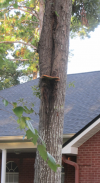
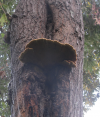
Mushroom growing on tree

I’m not great on the mycology front, but that vertical crack/grafting looks suspect to me…… hard to tell from photos tho. Plus I don’t have oaks where I’m at, so I’m pretty clueless.
 
At this point, not looking at tree health, but stability.

That is a rather old wound. Lots of reaction wood around it, which is good.

That is a large opening, which is not good.

Assuming they want to keep it, I'd recommend an up close inspection by someone who is trained/experienced with risk assessment. They should sound and probe that area to see how extensive the decay is/how strong that reaction wood is. My initial thought is probably not significant strength loss there.

The fungus: hard to say from those pics. It is not totally irrelevant, but not at all unexpected. No doubt there is decay in a wound that big. The "mushroom" you see is a fruiting body of that decay...
 
Last edited:
Absolutely need to ID the fungus and tree species.

Clearly a large section of heavy tree is above the defect and infection, in close proximity to in important, immovable object.

Definitely needs an in-person inspection by a Qualified arborist.


If something like that was growing out of your arm, what would you do?


What is reasonable? What do you mean by healthy?

What are the problems you see there?
 
In hopes of a teaching moment here, even pretty coarse field identifications require knowing little physical facts as in: Shape and size of pores, is the top of the bracket smooth, shiny, furry, hairy? Are there gradations in color? Is the bracket stiff, leathery, brittle or ? I'm not talking microscope here (yet). After saying there is no way to ID from the image, I'd start with ruling out (or in) Phellinus gilvus, Inonotus hispidus, and Ischnoderma resinosum. Now, those three are all quite different, but would appear similar in the posted image.
 
All I have is more questions. Is that a canker below and left of the conk? Is that a crack or seam above the wound?
The tree has two different issues. ‘Health’ and then ‘Structure’

That looks like a large wound, but it also has a huge amount of reaction wood. Can you estimate the amount of decay with a probe? Some decayed wood gets quite hard where it’s exposed to weathering, but is spongy below the ‘crust’

I highly doubt the tree would fail at the wound wood ‘zone’. But quite possibly above or below it as the stress is no longer uniform.

As for ID of the fungi. My first *GUESS* is Inonotus.
Saying that I only work on half a dozen to a dozen oaks per year!
 
Always a mistake to anthropomorphise stuff like this imo Sean.

Its a plant, not a human or even an animal, there is no equivalence.
I'm not trying to anthropomorphize the fungus, rather point out the need to know accurately what is happening.

What do you think about this situation, Mick?
 
Old wound, possibly large limb or even another stem.

Depending on the context of the tree and the value to the client, I’d recommend removal.
 
I didn't see any dead limbs or areas with wilted leaves, so it looks healthy to me other than the old damaged area and mushroom. I wish I knew the homeowners so I could take a closer look from above. I'll keep an eye out for someone there.
 
I didn't see any dead limbs or areas with wilted leaves, so it looks healthy to me other than the old damaged area and mushroom. I wish I knew the homeowners so I could take a closer look from above. I'll keep an eye out for someone there.
That wouldn’t be my concern (the tree dying)

My concern would be the hollowing out and weakening of the area around the wound and fungus.

Supporting the crown under heavy wind pressure that area might twist/let go.

All about context of course.
 

New threads New posts

Back
Top Bottom