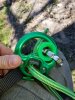
Moss Cinching Lanyard prototype

Hi hello, sorry to derail. The cinch has changed my life. Been keeping up with the thread as much as possible but it's a frickin novel lol. Just have a couple quick questions. If I just use a carabiner, wrap the lanyard around the trunk and clip it back onto the lanyard rope, the carabiner pressed against the trunk is not considered side loading? Also, this removes you from the circle of death correct?

A wrap then cinch is a solid strategy. I do it frequently. When the wood is down in the 2” diameter range I do 3 wraps then cinch.

Bear in mind (mandatory disclaimer) I reserve cinching an alloy carabiner for positioning running a saw or hand saw. Or any other task where I want good stable positioning. If I cut my climbing line the lanyard will keep me in the tree. What more could I ask for?
-AJ
 
A wrap then cinch is a solid strategy. I do it frequently. When the wood is down in the 2” diameter range I do 3 wraps then cinch.

Bear in mind (mandatory disclaimer) I reserve cinching an alloy carabiner for positioning running a saw or hand saw. Or any other task where I want good stable positioning. If I cut my climbing line the lanyard will keep me in the tree. What more could I ask for?
-AJ
I often just take another wrap through the carabiner if I'm at a union but want a single line lanyard. If I need to cinch though, I will, and take wraps if it's to skinny.
 
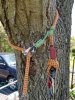
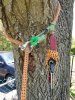
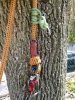
A couple days ago working, cinching lanyards at the top. If it was just a carabiner on the end 3 wraps. For the red carabiner lanyard no cinch just a closed loop. The ring performs better on install and removal than the slic pin bow shackle, the round shape is easier to work a bight through. The bow shackle tends to lock the bight towards the narrowing throat of the shackle, it pinches tight so taking it out takes a few milliseconds longer ;-)

49837850913_155b3a14bb_b.jpg


-AJ
 
Here's some video taking down a weird arched over black oak, the cinching lanyard is used in all major modes. Long vid as usual but it might give more insight for those curious about how the lanyard functions in real working use.


-AJ


I'm late to this thread but just finished reading through everything. I love to see critical thinking applied to the work and systems we use. I haven't commented yet because I really have nothing else to add to what everyone here has contributed. This is a fun thread to follow. So far my favorite is the quickie or slick pin shackle in the double eye splice since its removable from the eye and mid line attachable. That being said, I do have one issue I would like to ask the group about if I may. It involves side loading aluminum carabiners for a cinch. At the 2:50 mark in the video you show and justify cinching the crab as totally legit. Are we really ok with this? How many new climbers come to these forums looking for advice and insight into techniques. If they see this being advocated, they might just use that as a canopy anchor. I would never teach cinching an aluminum crab like this to any climber. I'm not even keen on using steel ones for this in life support. I mean the quickie link was basically invented to replace this exact configuration. Now I know in reality the crab will likely never see a load great enough from a human to cause any damage. Thats not really the point though. They are not designed for his configuration. If ever there was a blemish in the metal from the manufacture process, we would never see that weak point with a visual inspection. I also don't like this because it greatly increases bark debris and other foreign matter getting mashed in and near the gate parts. I just don't understand how we can advocate choking an aluminum carabiner in a system that may see the full hanging weight of a person, regardless of how large the diameter of the limb is. Maybe its just me but this is a pet peeve of mine. I don't want to derail this thread but I have to ask this.

Outside of that tiny rant, thanks for innovating! Might make my work easier if I ever get around to actually setting up a lanyard like this.
 
Good comments @Phil ! This is almost as deep a philosophical tree climber question as “One-handing a top handle saw, yes or no?”. I constantly advocate that a cinched alloy carabiner is for arm’s length (give or take a few feet) work positioning only, not for remote anchors. I’m working on the “cinching lanyard” directly in response to the argument that cinching an alloy carabiner is unsafe. At the same time there have been several excellent break tests done on cinched alloy carabiners that show everything else breaks before the carabiner. I’m personally very comfortable with limited and selective use of a cinched alloy carabiner for specific positioning scenarios,

Then there is the question that frequently comes up, “Should new climbers be allowed to see these dark arts?” (apologies to Marten Penrose, he is the only legit practitioner of tree gear dark arts!). I believe that we should not limit our discussions of new gear and technique out of fear of causing an inexperienced climber to do something dumb. My experience with new climbers and my time as a new climber is that they/we are very cautious. People who tend to be intense risk takers without actual experience, knowledge, and smart risk management practices have so many ways they can hurt themselves before they get to cinching carabiners, i’m not worried.

There will always be tension between current best practices in tree climbing and new ideas coming down the line. It’s a good thing.
-AJ
 
Last edited:
Good comments @Phil ! This is almost as deep a philosophical tree climber question as “One-handing a top handle saw, yes or no?”.

Then there is the question that frequently comes up, “Should new climbers be allowed to see these dark arts?” (apologies to Marten Penrose, he is the only legit practitioner of tree gear dark arts!). I believe that we should not limit our discussions of new gear and technique out of fear of causing an inexperienced climber to do something dumb.

I won't get too far off topic with my response and I actually have some stuff to add to the lanyard discussion.

There is a difference between one handing a arborist saw and side loading a crab. A top handle saw is literally designed and balanced to be comfortably operated one handed. That's the whole point of it. The fact it has a specific hook on the back for a lanyard is just smartly added convenience. One handing a saw is still using the saw the way it was designed. It's simply cutting wood. Granted one handing is more prone to lose of control in the event of a kickback, but one handing to me is a technique that can be used when the operator has exhausted other two handed options for a cut. Side loading a carabiner is straight up not using it how it was designed.

In regards to not teaching new climbers the dark arts and not limiting our discussion on new gear...I agree we should be showing them the dark arts and not limiting discussion. (We're having a discussion right now!) They will see it at some point anyway so it's our responsibility to say, "you may see people cinch a carabiner like this but they are not designed to be used like this. Never use this for a primary lifeline" or something along those lines. I don't like seeing it fully legitimized because the branch is a big enough diameter. If it's going to be shown, it should have the surgeon general's warning presented along with it. If you get your lanyard design lined out and to market I'll be the first one proclaiming "people used to cinch carabiners then this magnificent bastard named Moss pioneered this much better, safer solution that's now available at all fine tree gear retailers".

Part of my gripe with this is that this industry struggles to be legitimate in the eyes of the public. How many times do you see companies working with no hardhats, no harnesses in the bucket, free climbing with spikes until they get to their tie in. All the time. We are a community of professionals who operate in the same market as the fly by nights. We should practice what we preach... especially with life line components.

Now on to the fun lanyard related material!
Moss you inspired me to try a couple thing that will now be a permanent addition to my climbing tool box. My lanyard has no splices. It's a poachers knot with a plastic thimble. I prefer this over a splice because I really like how it fits in my hand...and it's cheaper haha. I keep an 6mm ocean prusik on it at all times. It has never bothered me just chilling on the lanyard. My inspired options was to use a quickie just above the scaffold knot for a cinch. It worked but was roughing up my tape job and I could see it trying to tighten the eye more when I weighted the line. The second inspired option was to use the quickie through the ocean prusik. That's the winner. It's awesome. Additionally, I always use my quickie with a plastic thimble because I like the bend radius and if I drop the sucker it's easier to find. The thimble also stows perfectly in the bridge D on the treemotion Evo. The thimble will not come off the quickie unless I force it off so it's essentially one single bit of kit.
 

Attachments

  • 20200509_122946.jpg
    20200509_122946.jpg
    544.6 KB · Views: 158
  • 20200509_122749.jpg
    20200509_122749.jpg
    1 MB · Views: 145
  • 20200509_123141.jpg
    20200509_123141.jpg
    946.5 KB · Views: 140
  • 20200509_123339.jpg
    20200509_123339.jpg
    967.2 KB · Views: 137
  • 20200509_123712.jpg
    20200509_123712.jpg
    451.7 KB · Views: 140
Last edited:
@Phil Correct me if I'm wrong, but I don't think we're talking about side loading a carabiner here. Side loading occurs with forces spreading the carabiner off its major axis. What the cinching lanyard does is use the spine of a carabiner as a spike to secure the bight of rope through the shackle. Right?
 
@Phil Correct me if I'm wrong, but I don't think we're talking about side loading a carabiner here. Side loading occurs with forces spreading the carabiner off its major axis. What the cinching lanyard does is use the spine of a carabiner as a spike to secure the bight of rope through the shackle. Right?

Moss posted a video showing a cinched, side loaded carabiner. It was at the 2:50 mark. That video was posted back on page 11 of this thread if I recall. I quoted it in one of my comments not to long ago. And yes, the cinching lanyard does not side load anything. I have no issues with using the carabiner to capture a bight through a ring or appropriately sized shackle.
 
I won't get too far off topic with my response and I actually have some stuff to add to the lanyard discussion.

There is a difference between one handing a arborist saw and side loading a crab. A top handle saw is literally designed and balanced to be comfortably operated one handed. That's the whole point of it. The fact it has a specific hook on the back for a lanyard is just smartly added convenience. One handing a saw is still using the saw the way it was designed. It's simply cutting wood. Granted one handing is more prone to lose of control in the event of a kickback, but one handing to me is a technique that can be used when the operator has exhausted other two handed options for a cut. Side loading a carabiner is straight up not using it how it was designed.

Thx for the comments @Phil . I'm not comparing one-handing a top handle to cinching a carabiner, I'm comparing the discussion. We all know one-handing is potentially dangerous but many of us do it safely from time-to-time. There are climbers out there who are leaders in the community who adamantly refuse to one-hand in part for the very same reasons you mention about cinching, "It sets a bad example, there's no need to ever, it's a reflection of a climber's lack of effort or climbing skill if they feel they have to one-hand, etc. etc.". The reality of cinching is it can be done very safely with knowledge of carabiner construction, loading variables and appropriate scenarios. Many will say there are no appropriate scenarios for cinching a carabiner, that's where the discussion is like the one-handing discussion.

I've already mentioned and I think many if not most of you are aware that the Petzl safety literature with the Chicane and Zig-Zag illustrates the use of a cinched alloy carabiner in use on a spar during a take-down. This is an example where Petzl recognizes that this is a safe use and is not cross-loading the spine. If you look at the safety literature for any quality locking carabiner you'll see the very specific scenario illustrated for cross-loading the spine. It is a serious pitfall for rock, alpine, and industrial climbing (on man-made structures). In tree work we have to work quite a bit harder to create an actual cross-loaded spine situation. One the other side of it we can easily avoid questionable loading scenarios and only use the technique where there is absolutely no cross-loading occurring. And really, as I always recommend, don't use a choked carabiner unless very specific conditions exist (non-remote anchor, positioning only, etc etc.). But anyway I'm not telling anyone to do it but it is like one-handing in that it works very well for the right situation and it is controversial.

Nice work on the Quickie rope end variations you're working on!
-AJ
 
A couple days ago working, cinching lanyards at the top. If it was just a carabiner on the end 3 wraps. For the red carabiner lanyard no cinch just a closed loop. The ring performs better on install and removal than the slic pin bow shackle, the round shape is easier to work a bight through. The bow shackle tends to lock the bight towards the narrowing throat of the shackle, it pinches tight so taking it out takes a few milliseconds longer ;-)

49837850913_155b3a14bb_b.jpg


-AJ
This may already have been asked and answered as I've read most of this thread but not all. Can you do this same thing with a loose ring? Is the main reason to have the ring captured on the double eye to keep it close to where you end up using it and prevent dropping it?
 
This may already have been asked and answered as I've read most of this thread but not all. Can you do this same thing with a loose ring? Is the main reason to have the ring captured on the double eye to keep it close to where you end up using it and prevent dropping it?

Yeah, the idea is that the ring is always there, doesn’t get in the way of normal lanyard uses but is right there when you want it, no fumbling, no dropping it. You can take out the cinch easily/quickly one-handed, not quite one-handed for the install ;-) Nothing is perfect.
-AJ
 
Do they have any verbiage on when or this is or is not justified?
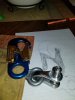
Mostly just an illustration, but I think there is some minimal verbiage. The drawings are clear, it’s a cinched spar anchor/second tie-in for a climber on spikes using their lanyard on the side D’s during a takedown. They are not showing any other cinched anchor uses, it is very specific.
-AJ
 
Thanks for the answer Moss. I am going to try this with a loose ring and wanted to make sure I understood the forces involved, and that I wasn't missing anything(except a second eye in my lanyard haha).
 
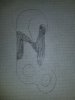
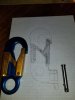
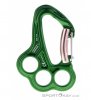
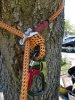
I wasn't going to post this amazing idea I had because I thought it could be worth developing but after some research I think its fair to say its been done already. I was thinking that if you are solving the cinching issue by adding a second eye to the lanyard itself, what if we add a second eye to the snap or carabiner instead? We added more life rated holes to the micro pulley to get the hitch climber, why not do that with a carabiner/snap? I drew these up last night. The snap is just for reference since it wasn't tied to anything and accessible. One option is to create a built in slick pin configuration, the other is to just add another hole for a quickie or slick pin shackle. 20200511_180353.jpg20200511_180237.jpg20200511_181038.jpg I was thinking just turn the bottom into a built in compact rigging plate. Then I googled rigging plate carabiner and this Grivel Vlad carabiner popped up. Change the gate design to fit our standards this is essentially what I had in mind. cartware_3dpicture_S4L6m1.jpg I can see DMM making something like this. I even had a name picked out. Was going to call it the Dragon Snap. They'd be orange and red.
 

New threads New posts

Kask Stihl NORTHEASTERN Arborists Wesspur TreeStuff.com Teufelberger Westminster X-Rigging Teufelberger
Back
Top Bottom