more fun with knucklebooms

The reason is because most kbooms don't have winchlines. When a stick boom is out of level and has say 100' of line out the load wouldn't be under the tip of the boom and therefore sideloading the boom.

Because the load is usually very close to the tip of the kboom it has much less effect on the boom.
 
[ QUOTE ]
Yeah, do it Mike! This is a great thread.

Quick question: Why don't Kbooms need to be level to use, unlike stickbooms which must be leveled??

[/ QUOTE ]

because they are great! ha ha.
 
Classic- I was thinking more about your response...if the Sboom was out of level, wouldn't the side loading of the boom be the same whether there was 10' of load line out or 100'? I'm thinking that is the case because with a level crane and no other factors involved (e.g. wind), the forces on the boom are the same whether the load is 2' off the ground or 100'??
 
Yeah Classic nailed it. Another huge advantage to k
booms is the geometry of the knuckles let's you angle the inner boom just enough that you can go all the way out with the main extensions parallel to the ground and still have amazing capacity (and then if you want angle the jib up over center 20 degrees)
 
No the effect on the boom is much higher the more line you have out. Your right if your facing down hill the load will stay at the same radius no matter how much line you have out(however keep in mind this is still sideloading the boom), but when you turn perpendicular to the hill the load will be way off to one side and the more sideloading you put on the boom and the more likely you are to fold a boom over.

Kbooms are designed a little tougher when it comes to sideloads as well with a 6 sided boom(and Effer's 10 sided boom).
 
The distance from the load to the tip of the boom has next to no effect on the amount of side load the boom experiances. The weight of the cable would increase the side load, but otherwise I can't think of any other reason the side loading would be increased.


Mike, where's the pics!? It's been months!
 
[ QUOTE ]
The distance from the load to the tip of the boom has next to no effect on the amount of side load the boom experiances. The weight of the cable would increase the side load, but otherwise I can't think of any other reason the side loading would be increased.


[/ QUOTE ]

If that is true, again why can kbooms be operated out of level? Is it simply because the boom is built to better withstand side loads?

Being able to safely operate out of level seems like a big plus for kbooms. And that would bring up the question, exactly how far out of level can they be safely operated?
 
As you say, it must be in their design. Most everything has a spec for how far out of level it can operate, it is possible they have a higher tollerance.

A bucket truck can be more out of level than a regular crane, for example. Still it's generally only ~5*.


ETA:
Classic, as you increase the length of the line, the loads displacement from the centerline of the boom increases, but the angle stays the same. The angle is what deterimines the side loading moment on the boom.
 
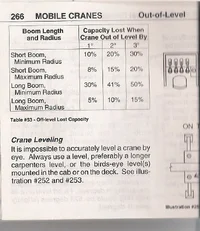
Here is a table from IPT's Crane and Rigging Handbook

As you can see in situations where you have less cable out ie: boomed down closer to the ground, the sideloading has less effect on the boom.

266498-scan0001%282%29.jpg
 

Attachments

  • 266498-scan0001(2).webp
    266498-scan0001(2).webp
    103.8 KB · Views: 58
ETA: Edit To Add

Classic, that makes no reference to cable length, only boom length and boom angle.

Can't a low angle boom drop a hook below the truck's ground level? Can't a high angle boom lift a load to the ATB? The length of the cable doesn't matter. Boom length and angle does.
 
Anti Two Block. The control/sensor that keeps you from pulling the hook through the top of the boom.

Picture running the hook up to the tip of the boom then extending or lowering the boom. In both instances the distance from the winch to the tip of the boom increases, thus pulling the hook into the tip of the boom.

 
Yes you guys are right, I keep thinking about this in a dynamic situation, while the forces are the same whether 10' or 100' of line out in a static situation. In a dynamic situation a load will could swing much more with more line out, which wouldn't happen with a kboom with the load right at the tip, therefore the combined forces of the swinging load and the effects of being out of level would be less on the kboom.

 

New threads New posts

Kask Stihl NORTHEASTERN Arborists Wesspur TreeStuff.com Teufelberger Westminster X-Rigging Teufelberger
Back
Top Bottom