i believe that is True Blue, and manufacturer Samson is very proud of their product;
>>just not so much as to make such a claim themselves i believe.
>>as Tom eludes to, about no one is going to test these ropes as much, as often, for as many years especially while maintaining a solid chain technical documentation(as if could be taken to court, or maybe just co$t millions if miss something could have done etc.), as a solid manufacturer that is in for the long game. They even have data on variances of build etc. years before product to market and sister products that development was stopped on that give more definition as close contrasts etc.
.
Film rating does show smallest loss for this in my memory tho.
>>conservative stewardship of these forces would not be to jump immediately to such an extreme ..
.
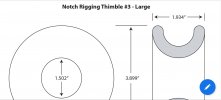
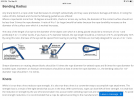
Phil, what is source for the bend radius table please?
>>is it by chance an eye radius and not bit/bollard/pulley radius table?
Termination of force handles differently than pass-thru.
example Half Hitch as termination around Standing Part after a Turn vs. Half Hitch as pre-fix to Timber in Killick.
.
Here is my view of efficiency of strength loss on arc of seems has to be some deformity at contact, how flat rope/webbing cross compares as more defining contrast back to round rope, and then the too tight a bight kinda thermal view (as discussed in film):
The same load to fewer fibers, leverages more force thru them each.
The importance of round rope, host and combined architecture is very key to how all this works in individual parts and then in concert.
.
Some numbers and visuals to elastic comments and different materials and how much of the tensile strength is encroached upon to extrude elastic dampening effect :
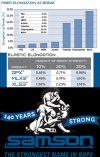
.
THEORY
i think that rope mechanix are arc(mostly mean 180 arc slices towards or opposing input direction) controlled.
Mostly, and as we deal with, as termination (Hitch) and coupling (Bend) of external focused/directional linear force converted to internal diffused/directionless radial arc control.
Round Binding not the same, is INTERNAL RADIAL input from within controlling arcs, so no conversion(loss) to radial.
Bag Knot as Hitch gets linear input, degrading thru controlling arcs to nip, with compounding at arc apex . Same Bag Knot used for Round Binding, now has internal, radial glow of bursting force feeding into controlling arcs. The rope tension all around is equal, not degrading to the nipping nor any compounding like pulley as these are both from directional forces.... Also, their is no conversion loss, so radial mirrors radial as response, for equal force around w/o frictional compounding loss nor directional compounding force.
.
Linear rope run can only friction control with sine, and compound effect by distance. (cosine dedicated to support against load only)
Covert to arc control, avails to bigger matrix of being able to use all of force, cosine and sine against load, AND friction control, that is now compounded by DEGREES. Rope arc does this just as stone bridge arc uses all compression not to crumble under tension that has very low non-malleables have low tolerance for. Rope arc force direction is just reversed to tension, not compression of stone.
.
Rope arcs in capstan/bollard compound mostly friction.
Rope arcs on pulley seek to compound reciprocal factor of same arc :force!
These 2 arc mechanics are a model of opposing extremes of what arc may compound. These 2 are our benchmarks that all linear fed knot arcs are between.
The amount of friction variable itself, dictates how much of each 'parent' benchmark extreme is revealed/inherited by the particular knot arc.
my shared spreadcheat for CoF's, cos/sin/tan, base capstan article att_frict(link)
.
The compounding 2/1(pulley) point at top of arc apex, is also best nip position. BUT not seen in Round Binding. Capstan/bollard and pulley effects not seen in Round Binding, only from linear inputs.
THEORY: The compounding pulley effect, is the counter intuitive residual directional axis of the focused linear input persisting thru the arcs. Compounding faces the direction of input or reverse, but maintaining that directional axis(vertical or horizontal etc.)
per direction of initial input load imposed (until 90 degree rope part if any switches this directional axis to cross axis)
How’s about that 1:1 bend in every loaded running bowline?
i believe that is fair view, but that Half Hitch(HH) in most loaded Standing Part(SPart) of Bowline, encompasses 2 rope diameters, exports only half of what was input linearly to 1 leg of eye, as other half comes from choke of HH.
.
Persistence of linear force thru arcs may also be witnessed in Bowline HH. As long as final bight thru HH around eye is short enough to be rigid enough to keep HH perpendicular to SPart, the HH is not in the line of force from SPart to eye, and is looser, as like a HH pre-fixxing a Timber etc. in Killick. BUT lengthen bight so now HH can fall into forceline and it is now taut full turn around. It is tighter now that in the line of persisting force, this can fail, sloppy build like Sheepshank, (that does add another catch/HH, but as rolls out of what we make i see as full turn a round in usage). The Killick force line will likewise report that the linear in forceline stretch between HH and Timber is tighter than HH. BUT if pull at right angle to spar/not lengthwise, now the arc is tighter and the part between HH/cross and Timber is less so, by the direction of input to same arcs, to reveal the directional linear persisting thru radial control ! Just as the Bag Knot, only now more directionaly imposed, we can see the same framework of rope, gives connected rope parts that can be used differently. Rope can take advantage if architecture exists to do so. Just as if linked rigid parts, to assmeble themselves to respond differently to different loadings, if the architecture/positions exist to do so. Killick can do this going from right angle pull to ABoK's lengthwise pull, but Timber alone not trustworthy enough, does not have the architecture in positions to avail to/against this direction change in same manner.
.
i love this stuff, but guess i should stop here!
Been a long road, but this is what i have come back with!