Mid-line Knots

Re: trailer ball

</font><blockquote><font class="small">In reply to:</font><hr />
But without brakes on the trailer axle...

[/ QUOTE ]
Which is why brakes are, in most states, required on any trailer with more than one axle or a GVW greater than 3,000 lbs.

- Robert
 
Re: trailer ball

I think that the leverage on the ball shank will have a much greater shear effect than a hitch pin that is supported on most of it's length so I personally wouldn't worry about pulling off of a pintle and do it often. Another story that comes to mind about force and breaking stuff happened last year. I was doing some work with a guy that decided he would redirect a 5/8" arborplex around a pine stump to pull an 18' log closer to the driveway because the Bobcat wasn't able to get any traction in the backyard. He was sitting on the driveway pulling backwards with the rope hooked to the boom. I protested and finally went well out of the way after being told, "I do this all the time." He started pulling and after about 15 ft the butt of the log caught a root and the rope parted with a crack and piled up in the cab of the loader with him. Scared the **** out of him. He said, "that rope said it was like 9000lb test."
 
Re: trailer ball

A line letting go or breaking like that, can give a gunshot like report before about cutting a man in 2. A stiff/large 9k used line , jerked on a sharp bend with overwhelming force, can break i guess! Never stand in line (loaded axis again) with a rope under tension, a heavy tarp, branching on the right end at breaking can help buffer the effect.

A good tow hook, ring for safety chain etc. can be point of first turn or bend on way to ball, for turn or roundturn etc. on ball; loading final locking knots less, for more security, easier untie. Especially good if the hook or ring is mounted to pull along it's length and not leveraged as Bradley observes in the hitch ball mount compared to standard pintle (not rising/leveraging, but serving straight out; loading only on strongest axis/column; whereby ball loads is leveraged by pull perpendicular to axis of ball mount).

This deflection from center pull can also place different directional pull on the load to possibly leverage, torque more etc. with the same pull; by changing the direction sligthtly with this option.

If a bend is just taken and no wrap, there will be more loading on the ring/hook, ball and line(s) in between those 2 points, but less strength loss in line from softer inital loaded bend than wrap around sharper initial bend of tying straight to ball etc. Another turn on tow hook/ring will increase friction first; thereby decrease the loading; but weaken the rope more with a sharper primary loaded bend IMLHO.
 
Re: trailer ball

i meant to bring this up before i left and this thread settled down the stack.

i think it is better to have a redirect on the ground when pulling to a high location like with truck; so that as the pull proceeds, the truck doesn't lose traction. When pulling from high, straight to truck, the equal and opposite reaction is up the line, lifting up on truck. When redirected off a stump etc.; the equal and opposite reaction direction is once again back up the line, but this is not a lift.

Here is a knot i rarely use, that my buddy Stretch showed me years ago, but when i'm really tweaking i use this, with the finish lock i recomend for strength. The name i was given, then and now is the "Higgenbotham's Knot" after the 'invenetor' my buddy learnt it from.

It is a knot i think becase the size of the hitch point/spar/ball isn't the first loaded/bent arc/choke ring/turn/hitch, but the ring in the knot itself. Like a bowline in the same diameter rope will have the same strength, the 'rabbit hole' is the first loaded bend/leveraged arc, previous to the hitchpoint, so bowline is a knot. A clove is a hitch, and it's first bend is on the hitchpoint/spar/ball (i don't recomend on ball hitch do to size and taper of mount); a clove hitch's strength too depends on the first bend/arc etc.; so the strength can vary with the size of the mount.

If the 2 1/2 hitches in the original finish , still run the same direction, but are reversed (only with final choke/tail pinched inbetween first half hitch and base Higgenbotham knot design. As the differance bewtween a turn and 2 1/2 hitches and a more secure buntline.

 

Attachments

  • 10715-Higgenbotham.webp
    10715-Higgenbotham.webp
    240.7 KB · Views: 91
Re: trailer ball

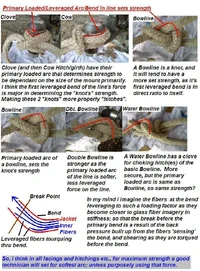
In the same math as the DWT Thread and the Puzzle- Force at Bend Thread ; i think we find the leveraging in a bend to weaken a line to less than it's tensile strength. The line will weaken with a qutable, mathematical range consistent within the equal range examples to it.

i think that the first leveraged bend under load sets this strength. So seek to soften that bend for strength, unless using the bend purposefully to raise the line tension for steering etc.
 

Attachments

  • 10718-Knot Differances - First Bend makes Strength Percentile.webp
    10718-Knot Differances - First Bend makes Strength Percentile.webp
    215 KB · Views: 58
Re: trailer ball

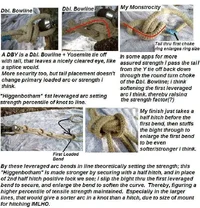
How i further apply these theories of strength preservation thru softer primary leveraged arc/bend in line.
 

Attachments

  • 10720-Knot Differances - First Bend makes Strength Percentile- part 2.webp
    10720-Knot Differances - First Bend makes Strength Percentile- part 2.webp
    188.9 KB · Views: 60
Re: trailer ball

Ken, what you are calling the "Higgenbotham's Knot" is knot #161 in The Ashley Book of Knots (published 1944). I made a post about it on ArboristSite a while back. It is a variation of the Bell Ringer’s Knot (# 172).
 
Re: trailer ball

Thanx Tim, guess i'll have to get that book; and suspected this knot or others that have come around had possibly a previous name etc. Tom's brought it up a few times lately making me think about it more; and if i was at a point of challenging my own creativity or holding it back yet. Ashley Book of Knots $46 at Walmart.Com

Knot has worked well by any name, though more time to lace; for the reasons stated i have found more confidence with it when opted for. Also, i think it is an interesting study of knotting mechanics.

Orrrrrrr something like that!
 

New threads New posts

Back
Top Bottom