Mid-line Knots

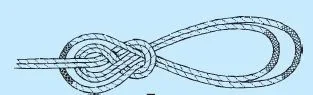
For setting up a Z rig I usually use an Alpine Butterfly. To make a loop in midline to drop over the hitch ball on the truck (My Balls are rated higher than my rope---leave the potential double entendre alone!) I sometimes use a Bowline on a bight but actually prefer "the ugly wad". Tying a bowline out of doubled line in midline looks awful but if you load the bowline loop(NOT the tag loop!) It performs perfectly and unties easily.
 
On a Z-Rig/3:1/Trucker's (i beleive equivalent terms); i too use a butterfly, which is more proper (i beleive) use as the knot is loaded from both ends, not just one.

In tieing down for loading/hauling etc.; i'll Z-rig with base spread (line forms triangle from butterfly to anchors)if i can/ losing some 3:1 efficiency; and impact tight with massive body weight. Then take the tail of the line and wrap a few times around the spread legs of line (perpendicular to the tightening of the rig); then i use the MA of those turns (around spread legs) to leverage bend/sweat in more tension, then lock off that tension. Many times better IMLHO.

In moving a motorcycle etc.; i'll use that to compress a shock on one side of the front fork, by tightening on one side of the handlebar sharply and purposefully; then lock off. Then do same to opposite side to straighten bike back up straight. the tehsion of the lines fighting the tension in shocks is very helpfull. for the really paraniod, bring line across under handle bars, use wraps around both rigs (each wrap giving more MA), and bend your Zrigs towards each other (make sure doesnt press on headlight etc.).

Force is force, in the field or at the garage; leverage bending a tightend line is very efficient, intense leveraging, greater than 3:1 but over a shorter run. The 3:1 though can induce a tighter line, to get more from the leveraging for helpfull support in play or werk; same pattern to practice in different forums.

i also find that bending a tightend line sharply just as a rigged limb starts to hinge to steer horizontally over obstachles below, gives intense support and forces high strength in the hinge(if you catch it with the leveraged force, just as limb starts to hinge, that first flexxing induceing the strength of the hinge made stronger by more pressure at that specific point in time), for it to carry that stronger support through the rest of it's sweep on the hinge. Very power-full strategy for me, backed up by the numbers of leverageing.

Likewise, tightening a Zrig for lift/line pretightening, can be tweaked sharply if after tightening you anchor the tensioned leg of pull, then bend/ impact the line leveraged, especially by falling backwards with impacting bodyweight, then feeding the gained purchase on the line out the anchor to the standing end for sweating in that last and high leverage tension. Just using the 3:1 as a preset for tightening the line, to gain more leveraged force from the tightened line at bending as your real target strategy for quick maximum. As the bend of the line is your leveraged arc, the pretightening the force you feed into that leveraged psoition, and the pull at the anchor/load points the output from the leverage machine (of the bent line) for your efforts. A little blurry at first, as in seeing the 2:1 MA in a DdRT and blurry for the same reason. The patterns are harder to see as points in a system become multipurpose, because of their strategic positioning; especially as they compound on thems-elves in doing so; but catching that part of the curve on your side can be very helpfull!

Orrrrrrrrrrrrr something like that!
-KC

 
</font><blockquote><font class="small">In reply to:</font><hr />
The directional 8 is used by all search and rescue and supose to have the least amount of reduction on the rope.

[/ QUOTE ]
The directional-8 is not as strong as a figure-8-on-a-bight, even when the latter is used as a directional loop.

The bowline-on-a-bight is a good option, but an even stronger loop which will untie easier is the two-loop figure-8 which is tied like the bowline-on-a-bight but with a figure-8 instead of an overhand as the basis.
 

Attachments

  • 9152-figure-8 2-loop.webp
    9152-figure-8 2-loop.webp
    6.5 KB · Views: 56
</font><blockquote><font class="small">In reply to:</font><hr />
Would this balance the load effectively?

[/ QUOTE ]
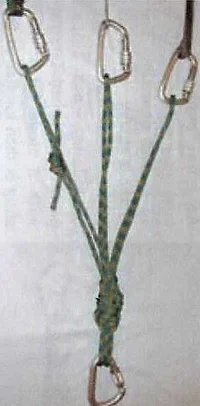
It would offer some load-sharing, but it would not be as truly equalized as some other systems. Though it is possible with a two-loop figure-8 or a bowline-on-a-bight to make a long and a short loop and, using lots of carabiners, make it into a self-equalizing anchor with minimal extension.

The trade off with any load-distributing or equalized/equalizing anchor system is sharing the load vs. sudden extension of the system if one anchor fails. So what I normally use is a self-equlized and focused anchor which is tied off after equlizing in a particular direction of pull so that there is NO extension potential.

- Robert
 

Attachments

  • 9179-3-pt Equalized.webp
    9179-3-pt Equalized.webp
    14.6 KB · Views: 47
How about a figure nine or a 2 loop figure nine. I use figure nine on smaller apps. Don't know how it will fair on heavy loading, shock/static.
That 2 loop figure eight(which I haven't personally tried) looks like it would tighten the snot out of that line.
I posted this question about the mid-line for heavy apps. using 9/16-3/4. Mainly with 5/8 dbl.brd. So these knots need to come undone when heavily loaded. Thanks for the info fellas. Seems the bowline-on-bight with variations to spread load more around the knot gets the belt for this one(for me).
Later
 
</font><blockquote><font class="small">In reply to:</font><hr />
That 2 loop figure eight(which I haven't personally tried) looks like it would tighten the snot out of that line.

[/ QUOTE ]
The bowline-on-a-bight is based on a half hitch, which makes it easy to untie but also relatively insecure - that is, it doesn't stay together well unless under load (which is why the regular bowline always needs to be backed up).

The 2-loop figure 8 is a very similar knot but based on the figure-8, so that the loads are spread out over more turns of the rope.

This knot is used in rescue for loads up to 600 lbs (including potential shock loading) because it's very secure, very strong, and relatively easy to untie after loading. You could make it from a figure nine, but I'm not sure the extra bulk gains you that much.

As you can see in the picture attached, the weakness in the bowline-on-a-bight is the single turn around the standing parts. In contrast, the fig-8 is doubled everywhere and has 3 turns around the standing parts.

Try it - I think you'll like it.

- Robert
 

Attachments

  • 9194-B-on-bight & Fig8-on-bight.webp
    9194-B-on-bight & Fig8-on-bight.webp
    15.4 KB · Views: 68
I had to post this about the ball hitch and pulling with them. I had heard once that it was not a good idea and didn't think much of it. I was at a trail ride in one of my Jeeps about ten years ago. A '72 Chevy Blazer was high centered on a rock and a 1 1/4 ton Kaiser was pulling on it with a nylon strap hooked to his 2" ball then secured to the Blazer's tow shackle. The Kaiser put a little pressure on the line (seemingly not excessive) and a sound like a rifle shot went off followed by the Blazer's loud cammed motor abruptly cutting off. The 2" ball broke off at 2.5 million mph and went through the grill, radiator, water pump, timing chain cover, timing chain, front of the cam, and trashed the cam into the block. That burned into my memory and makes me cringe every time I hear or see a ball being hooked to a rope or strap. If that thing hadn't hit the truck it could have poleaxed one or more of the twenty plus people standing around.
 
So it's not so much that you can't put a rope on it....you just have to respect how strong the anchor is.

In the example with the ball flying off and trashing the jeep, it wasn't that there was nylon pulling on it, it was that they were pulling to hard?

love
nick
 
Force isn't the whole answer, the direction of force should always be traced IMLHO....

i think in towing some of the weight comes down on the columnar strength of the ball instead of totally across. i think this would in turn fortify the ball down firmly against some of the horizontal push/pull, before depending on the bolting.

Scary story about hitch ball! Tight over wide area is best, straight off frame without rise or drop, as to not leverage mount. Bumper hitches just don't rate for any real duty generally IMO.

Those differances aside i do agree with Nick, and i think an all metal link of push and pull in traffic speeds at trailer wieghts, dynamics of turns etc. kinda would shock a system compared to a lot of pulls with buffering nylon 'rubberband' as link to loading in a lot of tree stuff.

After working with line so long, try to get a feel for what you can put on it; take it easy when playing with power....
 
Yeah, plus if you use spectra, the air bags go off, that's cool!
Some guys like chains for pulling, I'll take a rope or strap any day. This thread got me wooried about using the pintle hitch. If the pin sheared, that whole hitch could slide out and shoot at the driver of the stuck vehicle.
 
Re: trailer ball

Like for any rigging, know your anchors.

Hitch ball load ratings vary from 2,000 lbs for a 1-7/8" with 3/4" shank to 6,000 lbs for a 2-1/8" with 1" shank.

And those ratings are for the dynamic loads from a smoothly rolling trailer, not one that's stuck on a rock.

- Robert
 
Re: trailer ball

That is a pretty true observation on the pulling of the trailer. But without brakes on the trailer axle; the same lack of friction that lightens things on the pulling of the trailer; would also work against stopping down from 50+mph suddenly?
 

New threads New posts

Back
Top Bottom