
Meet Lumpy

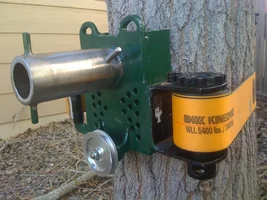
This is Lumpy, a lowering device I just finished fabricating a few weeks ago.The frame is 1/2 inch steel top plate I cut from an 8" I beam. I left a one inch tall spine on the back of the plate when I cut it from the "I". Then I welded 3" angle to the face of this plate. Another piece of angle in the oppisite direction to recieve the strap. 1/2 inch wall 3 1/2 diameter pipe for the bollard. I must thank the guys at Stein for the most elegantly simple and easy to use fairleads. All tolled this "Lump" of steel weighs close to nintey pounds, hence the name. The holes are for surface area around the bollard to dissipate heat. The pulley underneath is for pretensioning on the fly and is oriented so it can be used with another pulley on the load line for a 3 or 4 to one MA if light lifting is needed. I used this on a good size cottonwood removal last week and it performed rock solid. Multiple thousand pound plus pieces with smooth and predictable friction. I will own a GRCS soon enough but in the meantime I have Lumpy to knock around.
 

Attachments

  • 269811-photo.webp
    269811-photo.webp
    177.8 KB · Views: 469
Love the ingenuity. Three questions if you don't mind me asking:

1. How much time did it take you?
2. How much in materials did it cost?
3. Why not a larger pipe instead of a 3.5"?

Just curious!
 
Winch,
I spent $40 on the steel from a scrap yard
$56 for the weld on winch, strap, and tension bar ($96 total)
About four hours on this one because the first one always takes the most time. I spent a decent amount of time just messing with mock up part combinations until I felt satisfied. I have since built three more and those only took about two hours each. As far as drum diameter, I think that this size seems to be close to the size of all the top lowering devices, GRCS Hobbs Stein all are close in size for that particular part. I theorise that bigger is probably not necessary due to increased friction per wrap on the larger drum and possible groundie disorientation. On my last job we were lowering (overhead) 1200# logs with two to three wraps and the groundie seemed to have no trouble with control.
 
Nice!

Looks like attachment points for a MA system on there.

Are you planning on fairleading through a block mounted above the device if off-angle?
 
southsound, I have already had off angle rigging and the fairlead that is on the device performed swimmingly. I spent the most time thinking abot this one feature. Looking at and using the grcs and hobbs, I was looking for consistent performance that was easy to use and fast to set up on every pick. All that the first fairlead on a drum is meant for is to keep the rope as it enters the device i at the base to minimise leverage and to direct the outgoing line. I felt the simpler the better. Having watched the groundie wind the drum after my set-up, I feel that this configuration saves between 20-55 seconds per pick compared to the porta wrap. Not only the time savings which may not seem like much but WHEN it is occuring. I have observed that smooth rythm of production at critical times of the day can take hours off the end. Not sure how a few minutes can end as an hour or two faster at the end of the day, but it keeps me looking for any little thing that can smooth the way.
 
I think we learned in a recent past thread that the diameter if the drum has negligible effect on the amount of friction, its the amount of turns that plays the biggest role. The drum size is more for favorable bend radius on the rope. If someone knows the thread, feel free to dig it up!

Looks great, and for such a small investment must be totally worth it!
 
I'm interested in this thread you mention, JeffL, it was also mentioned in mine on the Dual.

It does sound like a really worthwhile investment - great job - I wish I had the fabrication skills needed to do something like that. I have a welder, just haven't had time to learn how to use it well - too many trees!

I was always under the impression that smaller diameter bollards burn ropes easier. I have seen my share of glazed/burned ropes over the years, and have seen less since I stepped away from the portawrap. This could be because my groundies are getting better, not because of the diameter of the bollard, but still, the bend radius.

Thanks for sharing!
 
Viking, thanks for the complement.
JeffL, I was not aware of that data, thanks for pointing it out. I would submit from my observations already that the SURFACE texture does dramatically affect friction. I originally ground the bollard with a 40 grit flapwheel. On its test run in a dead cottonwood my groundie was unable to lower a 150# branch with one half wrap. Back at the shop I re-sanded it to 120 grit and the following job went much smoother. I am kicking around the idea of having the bollard chromed or galvanized depending on the price.
 
Sure, PU, if you have a GRCS for $100 I'm Interested. I'm just the bad combination of gear hungry tree guy with a plasma cutter and a welder :)
Why buy something when you can make it and give your own silly name as well. In one week I now have 4 lowering devices and all the options that I can cook up for them. Way more fun than scraping together 3grand for one silly old boat winch.
 
I agree, I had my buddy make me one a couple years back and I love being able to design and build it the way you want it, and learning from it to make the next one better and better. Its really quite gratifying. I think I have maybe $100 into mine between materials and payin my buddy, and I wouldnt trade it for the world.
 
Welcome the Buzz Jonathan. Nice work. You gotta post some working photos.
icon14.gif
 

New threads New posts

Back
Top Bottom