Right then, here goes.
This was the hand out from the ISA conference talk. A lot of text, I know. It's hard to describe with less words though, so bear with me.
The Climber Tree Assessment booklet exists in english, german, dutch and a french version is in the pipeline. There were only a limited number of the english version printed. I've been talking to a couple of people about the possibility of a US version. I'll keep you posted.
Risk and Hazard Assement for Arborists
Some thoughts on a systematic approach to accident prevention in tree care
Working at height brings with it some inherent risks. This is true of tree work as it is of all other high angle occupations. In the following talk a model for practical risk and hazard asssement will be presented that was introduced in various european countries three years ago. It targets the practicing arborist as well as the ground worker, and by doing so acting in a complementary fashion to formalised risk assesments.
Depending on the country and it’s specific legislation there will be a varying degree of paperwork and documentation involved in assessing the risk prior to work at height. The aim of this documentation being to formalise the approach to the assessment of the many hazards that have to be considered before and during the job, the quantification of the risks and the implementation of remedial actions taken to reduce the risk to an acceptable level.
Terms such as hazard, danger and risk are often used without giving due consideration to their exact meanings and implications:
• Hazard: The possibilty of an accident/ damage occuring
• Endangerment: The interaction of a person/ activity with a hazard
• Risk: The probability of an accident occuring and it’s consequences
• Action: A remedial action taken to limit the risk to an acceptable level (risk management)
From the defintions above it’s clear that hazard can be objectively identified and risk can be assigned a value. However, as soon as a person becomes involved a „soft“ element is introduced: This is harder to quantify and a degree of subjecitvity becomes inevitable. „Risk“ is in effect the interface between hazard and a person. As such one is able to influence it’s level through appropriate actions. In order to be able to do so the hazard and risk have to be recognized and assessed beforehand.
One possiblilty to assess the level of risk involved in hazardous activities and to portray them in a graphic fashion are risk matrixes, as used for example by health and safety organisations or by the military.
The „Risk Assement for Climbing Arborists“ is a model based on such risk matrixes. It was introduced in Europe three years ago at the „Augsburger Baumpflegetage“ in Augsburg, Germany.
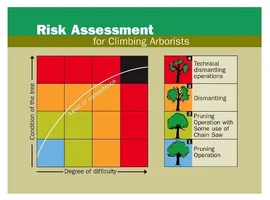
It consists of a matrix going from blue in the bottom left hand corner to green, orange and red through to black in the top right hand corner. The vertical axis represents the Visual Tree Assessment (VTA), the horizontal axis the degree of difficulty of the job that is to be done. On the one axis the condition of the tree deteriorates in the direction of the arrow, on the other the degree of dificulty increases in the arrow’s direction. These two factors can be combined into the matrix, resulting in a color coding, from blue for „easy“ through to black for „unclimeable“. (see Attachment 1)
A further piece of information that is incorporated into the model is a curved white line that represents the level of competence of the climber and of the crew on site, starting off steeply, portraying the rapid progress made in the first weeks or months of climbing, levelling off higher up, in effect representing the process of „life long learning“.
This is a much more gradual process, but it’s the only reliable way to acquire the necessary knowledge and skills to be able to operate proficiently in complex situations (portrayed in orange and red in this model). Also, different people progress to different levels.
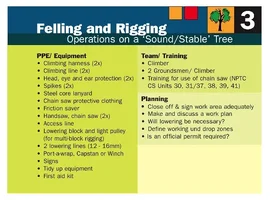
The figures (one to four) in the tree condition boxes refer to check-lists, consisting of three modules each: „PPE (Personal Protective Equipment)/ Equipment“, „Team/ Training“ and „Planning“. (See Attachment 2)
In order for the crew to be able to do the job in accordance with the level as defined in the risk matrix all three modules have to be complete.
For example: equipment is missing and the team is forced to improvise (PPE/Equipment) , or important points have been overseen in planning (Planning) or the climber is working with an inexperienced ground crew (Team/ Training). In all of these instances the team’s position in the matrix is going to be moved to the left and down, resulting in a less than optimal level of performance, i.e. less complex/ demanding work can be undertaken.
There are many ways in which the „Risk Assement for Climbing Arborists“ can be used:
• The check-lists can act as pointers for the crew on site (not as a compulsory references or guides). They allow the team to assess whether they are equipped and able/ competent to do the job in a practical fashion.
• The model allows one a color coding of jobs; a colored marker on the work-sheet could refer back to the risk matrix, giving the crew an idea of what to expect before they arrive on site.
• The model gives the person acquiring the work some indicators for points that could be relevant from a practical point of view („PPE/ Equipment“, „Team/ Training“).
• The level of competence curve allows the climber to assess his or her degree of skills and competence in regard to the condition of the tree and what is being asked of him/ her.
Whilst obviously simplifying a very complex matter, the „Risk Assement for Climbing Arborists“ is detailed enough to offer indicators in a wide range of situations and also encourages constant ongoing re-assessment of the situation. It can easily be used as a graphic, userfriendly supplement in combination with more formalised in-depth risk and hazard assessment techniques.
The concept behind the „Risk Assement for Climbing Arborists“ is to bring together points that are relevant to the various members of a team. This includes planning, climbing and ground-work. The objective has to be to encourage a systematic approach to the planning and use of techniques before and during the job and to visualise the assessment of the condition of the tree, the competence of the team or the individual and the level of difficulty involved in the work.
/forum/images/graemlins/icon314.gif