loose hitch

Re: DFL pg 74 TCC

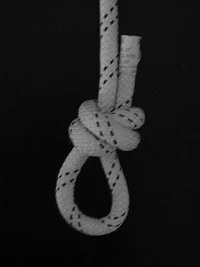
And, by the way, Jepson is incorrect in calling what is pictured on page 74 of the Tree Climbers Companion a "double fisherman's loop".

A loop knot, like a figure-8-on-a-bight, a bowline, or a butterfly creates a secure loop. What Jepson describes is a double overhand NOOSE. A noose knot creates a loop that cinches when the standing part is pulled.

While it would be accurate to call it a double fisherman's noose, it would be clearer to call it a double overhand noose since the overhand is the most basic of all the knot families and is the basis for a number of commonly used knots, bends, loops and nooses.

dbl_overhand_hitch.jpg


For simplicity and clarity,
- Robert
 
Re: DFL pg 74 TCC

Thanks for the info Robert. I always hate how different groups of people call the same things by different names. The whole "Stilson/Cow Hitch" issue was a real pain.

It really isn't a 1/2 of a dbl fishermans since you turn the rope back onto itself. That changes the original knot and it's effects. Good point.

I've never felt good about using the double overhand knot to terminate without pretensioning unless I leave a long tail. For an 11mm line, I would leave nearly a foot of tail.
 
Re: DFL pg 74 TCC

You can sometimes alleviate some of the confusion by properly attaching the word "hitch" or "bend" to the end of a knot's name.

A bend is a knot that ties the ends of two lines together I(double-fisherpersons bend...or sheet-bend, the one many use to send up the lowering line...i guess you could just use a square knot! ;)

A hitch specifies a knot tied around another thing. A distal hitch becomes nothing if you slide it off the rope. Same with the clove hitch.

love
nick
 
Re: DFL pg 74 TCC

I received a brand new hank of 1/2" Safety Blue today. I normally do not bother reading the attached card but I glanced at it to see if there was anything interesting.

In the paragraph titled TERMINATING, it says
</font><blockquote><font class="small">In reply to:</font><hr />
Safety Blue should be terminated using a figure-eight knot, double fisherman's knot, bowline knot or splice.

[/ QUOTE ] To be honest, I don't care if you call it a knot, hitch, loop or whatever. It just plain doesn't matter to me. But I know what a double fisherman's is, and I can use it or identify it whether it is used to attach a rope to a biner or to another rope. I really do not care, but the "double fisherman's" term is common enough and familiar enough to where everyone should know what is being described.

Yes, terms should be universal. And it looks like the industry has adopted this term to describe this knot. You can call it Aunt Martha for all I care, but I will always call it a double fisherman's and everyone I train will be able to identify it as a double fisherman's.
 
Re: DFL pg 74 TCC

</font><blockquote><font class="small">In reply to:</font><hr />
To be honest, I don't care if you call it a knot, hitch, loop or whatever. But I know what a double fisherman's is... the "double fisherman's" term is common enough and familiar enough to where everyone should know what is being described.

[/ QUOTE ]

Not to be argumentative, but then what is it that you're calling, and everyone understands as, a "double fisherman's"? Is it the stopper knot, the noose, or the bend? They're three entirely different knots with three entirely different functions. And there are a few other variants of the "double fisherman's" as well.

When you have a chain saw, a pole saw, and a hand saw in the truck, do you just ask your groundie to "send up the saw" or do you specify which variety of saw you need?

- Robert
 

Attachments

  • 9587-double overhand noose 2.webp
    9587-double overhand noose 2.webp
    16.5 KB · Views: 56
Re: DFL pg 74 TCC

Thank you, Rescueman! You put it much more politely than the thoughts that were stirring in my head while I was reading that squirrellish post.

Proper names are important for proper communication. Without good communication, learning is only possible through direct experience. The more people you can communicate with, the more people you can learn from. The more people you can learn from, the better person you can be!

love
nick
 
Re: DFL pg 74 TCC

man you guys are friggin' exhausting. this is the second post ive read in as many weeks that was sabotaged by some BSing of trivial crap. ary had a friend fall using a hitch that may have proven fatal, this is not the first "awakenings" ive read where that hitch failed and resulted in a fall, but instead of getting to root of this very serious issue people want to argue over what to call the hitch. A FELLOW CLIMBER TOOK A DAMN FALL AND THAT WAS WHAT THIS POST WAS ABOUT!
 
Re: DFL pg 74 TCC

Another example of "Short Attention Span Theater" Such is the medium that we're using.

A fellow that I know had a hitch slip and he fell. An apple tree so he wasn't high but he broke his wrist. After agoninzing about what he did wrong he concluded that he tied his hitch and then weighted it without testing it while he was on his lanyard.
 
Re: DFL pg 74 TCC

it was not my attention span which got in the way. i was not refering to the open discussion about what the hitch was but more towards "point scoring" one-upmanship of the post's conversational direction. perhaps my fault for not being clear enough in my disappoinment. your post, tom, was more what i would like to have read here...a guy you know fell from a tree and it was beacuse he did not test his hitch safely before climbing under weight. i would like to know where this guys "anchor" hitch failed prior to it slipping out. mistakes are made prior to a fall which lead to the fall. what were those mistakes and how can we learn from them to prevent them ourselves.
 
Re: DFL pg 74 TCC

Chad,

When I talked to my buddy who fell, he said that his mind was on other things, not paying close attention to details. Even though it was the friction hitch that failed, not the anchor hitch, the result is the same, a fall.

What have you learned from this? Have you changed any procedures?

Tom
 

New threads New posts

Back
Top Bottom