Liquidambar critters

NickfromWI

Participating member
Location
Los Angeles, CA
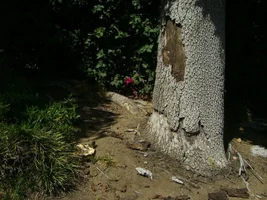
I went to look at a Liquidambar styraciflua (aka Sweetgums) a couple weeks ago. The owner has a row of them lining his driveway. He says he has been slowly losing them over the years and wants to see if he/we can find out what is the cause and if there might be something that can be done to slow the eventual demise of the trees.

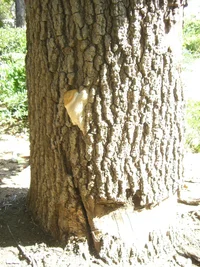
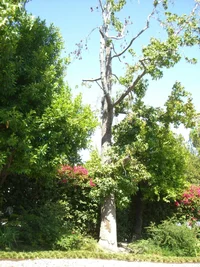
I am highlighting one of the trees in these pictures. The symptoms are:

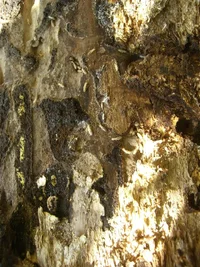
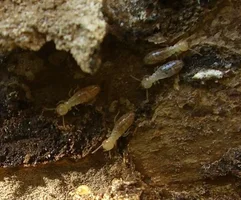
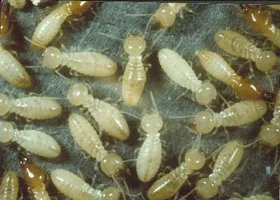
Larva tunneling under the bark
Fungal growths on the trunk and around the base of the tree
Strong die back at the tops of the tree
Oil-like staining down the trunk of the tree
Bark peeling off

The owner wants to do everything he can to save the trees. Though a couple are obvious removals, he is opting to have them drastically reduced (removing all the dead limbs) so as to "get some more use" out of the tree.

I asked what happens if the tree falls. He said, "as long as it doesn't happen just as I am driving by, then the worst it can do is take out that fence....and that fence is cheap to replace."

Can you identify the larva, the fungus, or the stains? The larva is the one I am most interested in. I know that 100 miles east of here, there is a problem with the Liquidambars being attacked by the Glassy Winged Sharpshooter. I don't know what the larva look like and can't find it online.

Here is a picture of the whole tree.

love
nick
 

Attachments

  • 91033-wholetree.webp
    91033-wholetree.webp
    588.3 KB · Views: 214
did you examine the root crown/ the fungus and the bugs look like scavengers from here.

i see a lot of sweetgum here but never seen none like that, course i am a long way from california. in nc they are hard to kill, tho many hate them cuz they got balls.
 
I did dig around the basal flare of each tree. I only could find the insect crawling just under the rotting bark. I ASSUMED this meant they were eating the cambium, causing more bark to rot...but that was a mere guess that I kept to myself.

The sweetgums to OK here. In times of drought, they are susceptible to sudden limb drop- then people get paranoid. It's okay...they fix the problem by making the trees much smaller...then the rains come, the trees grow quickly, get heavy, then it gets dry again..you can kinda see where I am going with this...

There is an insect here in SoCal called the Glassy Winged Sharpshooter and there is a version of it that is known to attack liquidambars and apparently it is considered a major threat to local agriculture...so I just want to make sure this is NOT what we're dealing with here...

love
nick
 
I found some pics on the web. Looks like a big, brown 'leaf-hopper' (that's what we called them when I was a kid). They carry Xylella fastidiosa, a bacterium, which causes big problems in grape vines, citrus, almond, alfalfa and oleander. One article I read said that they produce "copious amounts of watery excrement" which gives plants a white-washed appearance. Might be something to look for.

The insects in your picture don't look like any of the pictures of GWSS I found.
 
Oh, Jeez. Before I get in trouble..Again...I took that picture off a web site called internet4classrooms.com. K?

Thanks Jersey! Right back at ya.. Pitcher plant? and is that a Cattleya orchid in the background? Pretty, pretty, pretty!
 
Hey Nick,
Those would be termites for sure. The fungus on the trunk could be saprophitic but I noticed in the photo of the base of the tree, off to the left, just at the edge of the liriope there seems to be a conk growing. It is white as is the growth on the trunk and looks like the top of a chefs hat. That looks to me to be ganoderma of some type. Possibly aplenatum. Hard to say from so far away. Best bet is to send a sample to the local Hort Science folks and let them iD it for you. then you will know for sure. Best of luck.
Bruce
 
Damn. Just when I actually knew what a bug was, someone comes in and gets it ahead of me. I was so excited to be able to tell Nick that those were termites. Now my knowledge is spent.

I would recommend removal of that tree and any others that are so far gone as to have termites in them. I know we want to save trees but in doing so we leave a lot of weak trees around incubating more pests. I think I must be entering a "just put them out of their misery phase of arboriculture."
 
[ QUOTE ]
I would recommend removal of that tree and any others that are so far gone as to have termites in them. I know we want to save trees but in doing so we leave a lot of weak trees around incubating more pests.

[/ QUOTE ]Why do you call termites "pests"?

confused.gif
 
Nick, what's up with the axe marks at the base of the tree? Is that from the assessment? Was the driveway widened at some point? I'd be curious about the history of the driveway.

The tree is so far gone that everything in there now appears to be secondary to the original problem (whatever that was). Are there other sweetgums on the site that are still in reasonably good shape to give you more clues as to the original problem?
-moss
 
I asked the owner about the axe marks, and he said he'd never noticed them before! He lives in a VERY nice part of town (above the Sunset strip) and we couldn't imagine someone coming all the way up there to JUST hack at the base of a sad looking tree. We credited to a misguided gardener. I only wonder what ELSE they have done!

Termites...man. That's so easy. Just to verify- these larva were a little larger or the same size of an adult termite. Is that correct?

love
nick
 

New threads New posts

Back
Top Bottom