Lifting with chains??

southsoundtree

Been here much more than a while
Location
Olympia, WA
I talked to a local crane operator. He likes to use chains because he thinks they are easy to inspect, strong, and durable. He was talking about using chains that had hooks with gates on them for double wrapping and clipping. Fast.

They are not locking hooks, I don't think.

He will go either way, slings or chains.

I know some people use wire rope chokers. Some slings. and some chains. Don't know how people terminate their chains, though. I just saw a video, maybe here on TB, where they were using chains.

What are your thoughts on this versus lifting slings or chokers?
 
I know this isn't helpful, but, if a crane company showed up with chains, I would shut it down and call it a day. There is this misconception that if it's made of steel, it's stronger and better. Well, if that isn't a misguided thought, I don't know what is. It's dangerous enough in the tree with slings let alone a steel chain whipping around. Sorry to be on the negative side but there are so many options other than chains. Just my 2 cents... :-)
 
some on TB use chains, we've talked about it long ago.

I'm sure they will speak up. They said they bite real good and liked using them. I think AllMark had them in an old video of his come to think of it.

For a chain to be rated for overhead lifting though, they are very expensive.

I haven't used them and don't plan to.
 
[ QUOTE ]
I know this isn't helpful, but, if a crane company showed up with chains, I would shut it down and call it a day.

[/ QUOTE ]

Don't you think that is "throwing out the baby with the bath water"?
wink.gif


Chains can be used effectively for lifting loads. They are a tool like any other. They can be used appropriately.

If I need to use chains, which I use only on really large wood that the cables won't fit around, I use them. The chains my crane guy is on a bridle and each leg is rated at 10,000lbs in a choked configuration. Not bad.

I wouldn't even consider using chains on smaller diameter logs... Now that would be ridiculous.
 
[ QUOTE ]
I know this isn't helpful, but, if a crane company showed up with chains, I would shut it down and call it a day. There is this misconception that if it's made of steel, it's stronger and better. Well, if that isn't a misguided thought, I don't know what is. It's dangerous enough in the tree with slings let alone a steel chain whipping around. Sorry to be on the negative side but there are so many options other than chains. Just my 2 cents... :-)

[/ QUOTE ]

I understand that all steel is not created the same.

The chain, in the choked configuration would have to be within the SWL.

I wonder more about the hooks to be use to choke.

It for a big spreading maple that would pretty much have a clear drop in for the chains, so I don't think that there would be the risk of the chains hanging on a branch, and then suddenly dropping into the canopy.


BTW, FWIW, he's a certified crane operator (I don't know who certifies???) and has had his own crane(s) for 20 year. This doesn't indicate proficiency, I know, but some level of knowledge.

With lifting chains/ chokers, how can people account for metal fatigue? With slings that aren't visibly damaged, how can one count on material fatigue?
 
[ QUOTE ]
some on TB use chains, we've talked about it long ago.

I'm sure they will speak up. They said they bite real good and liked using them. I think AllMark had them in an old video of his come to think of it.

For a chain to be rated for overhead lifting though, they are very expensive.

I haven't used them and don't plan to.

[/ QUOTE ]

I'll have to search, or just read all the old crane use posts.
thanks.
 
[ QUOTE ]

Chains can be used effectively for lifting loads. They are a tool like any other. They can be used appropriately.

If I need to use chains, which I use only on really large wood that the cables won't fit around, I use them. The chains my crane guy is on a bridle and each leg is rated at 10,000lbs in a choked configuration. Not bad.

I wouldn't even consider using chains on smaller diameter logs... Now that would be ridiculous.

[/ QUOTE ]

Pics of this bridle? haven't hear of it? I'll do some research.

How are you connecting for choking? Are you using something different than a hook?

Why big wood but not small?
 
I'm looking at lifting the main 3.5' bigleaf maple trunk in small sections.

I was figuring on having to notch the trunk sections for whichever lifting connection.

I did some rough calculation so far about weight per foot of the trunk, but need to recalculate to double check.

Thought about setting up my own chart/ cheat sheet for this specific tree (i.e. a 12" average diameter by 10' is "x" pounds, a 15" x 10' is "y" pounds, a 15" x 15' is "z" pounds).


Manitex 22101 22 ton is a consideration. Small set-up area, or I'd go with a larger crane.
 
The tree extends down another 10' or so below what you can see.

P1060750.jpg


I've rigged off the back quarter that was far from the stump. Gotten some dead wood off it, and some crossing limbs.

view from the back yard. For scale, I'm barely visible as a silhouette on the left main crotch. You can barely make out my SRT rope going to the base of the tree.
P1060748.jpg


P1060749.jpg


I could rig the tree down, but will still have a huge trunk in a very tight, sloping area with a deck downhill to deal with, so its trunk weight is still the sticking point.
 
[ QUOTE ]

BTW, FWIW, he's a certified crane operator (I don't know who certifies???) and has had his own crane(s) for 20 year. This doesn't indicate proficiency, I know, but some level of knowledge.

[/ QUOTE ]

As you probably know, Washington State requires the operators of Construction and Maritime cranes to be certified. There are a number of certified testing companies throughout the state.

Cranes used in the tree industry would fall under the construction crane requirements. The only exception to operator certification was one given to electric utilities for their work, which for the most part requires a separate and specialized Nationally accredited test.


[ QUOTE ]

With lifting chains/ chokers, how can people account for metal fatigue? With slings that aren't visibly damaged, how can one count on material fatigue?

[/ QUOTE ]

The simple answer is that with lifting devices used within or near their SWL, non-visible material fatigue will not occur.

The metal fatigue you are probably thinking of is the microscopic fatigue and crack propagation which occurs in material undergoing duty-cycle or extreme cycle use. An example would be the welded bracket for an automobile shock absorber. Something that undergoes millions of stresses and vibrations, especially when the application is in an area where stresses accumulate, like corners. Slings and chains fail because of rust, miss use and overloading. These all will result in conditions which will be visible to best practices and common sence inspection by a qualified person. These will most likely be cracking, bending, stretching, corrosion and strands breaking. Catastrophic failure from unseen metal fatigue is so unlikely it could be called impossible
 
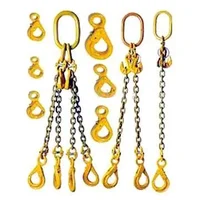
Chain alings are probably the easiest to inspect, you look for bent links and their stretch. the tag will state the original length, when it is longer by a certain percentage(the number has slipped my mind right now) they get tossed.

the way the hooks close is pretty safe, the gate is actually the part attached to the sling so they take some effort to open.
251676-Cha_G_80_Chain_Sling___Accessories.jpg


I've never used them, but I've been told they are good for balancing picks.
 

Attachments

  • 251676-Cha_G_80_Chain_Sling___Accessories.webp
    251676-Cha_G_80_Chain_Sling___Accessories.webp
    19.1 KB · Views: 52
I have used chains but now have other slings I use and rarley use the chains. Chains can be heavier to use. I think proper inspection of chains is actually harder based on the length. every link needs to be inspected. They are more durable long term. I would not use them without a hook that had a latch and make sure they the orientation is proper so when loaded they dont pressure the latch.
 
my favorite thing to do is hand rig the brush and call in the crane for the trunk! of course my guy only has a three hour minimum and at $100 bucks a hour that usually puts the trunk on the ground and pays for drive time. it beats the hell out of negative rigging. rigging with chain on small material is a nightmare waiting to happen. although that balancer rig that ctm showed does look like the bomb if combined with nylon slings. those cargo hooks are not rated to be the choking point in an over head lifting operation; if a rigger working for me was caught doing this they would get scolded and retrained, the second time they would be fired. just like a carabiner isn't a choking tool. a little off the subject does any one else think those hooks suck balls? we had to use them alot in multi lift rigging operations when i was an ironworker. the weight of the sling is enough to keep the hook from opening! try holding up an inch and a half choker and fool around with one of those pieces of crap. as far as locking hooks go i like the ones with the pin that goes through the mouse and the hook those are bomber and user friendly in my opinion.
 
[ QUOTE ]
Chain alings are probably the easiest to inspect, you look for bent links and their stretch. the tag will state the original length, when it is longer by a certain percentage(the number has slipped my mind right now) they get tossed.

the way the hooks close is pretty safe, the gate is actually the part attached to the sling so they take some effort to open.
251676-Cha_G_80_Chain_Sling___Accessories.jpg


I've never used them, but I've been told they are good for balancing picks.

[/ QUOTE ]

I was busy yesterday... Thanks for posting that James.

And we use locking snaps to choke off the chain. It will not come undone.

I probably wouldn't have considered the usage of chains, but when I started to use a crane on nearly every tree removal, I used what the crane operator had. It was good in a sence that I was open minded to using something I didn't really think fondly of in the first place.
 
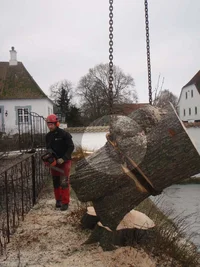
In Denmark I always use chains. Cant see the problem with them.
They have to be inspected by a certified crane inspection company. Inspection is done visual and with ultra sound.
Chains are easy to use. They come down nicely through the canopy and the gate is self locking.
If you trust shakles and wires, why not trust chains?

Merry Christmass. :-)
 

Attachments

  • 258741-Kran1.webp
    258741-Kran1.webp
    136.9 KB · Views: 148
I know!
wink.gif

We had just lifted the main stem (4,6 metrik tons), and we knew it was close to the crane lifting capacity - thats why I cut it as high as I could. And finished the stump afterwards. Put the chain on it so it wouldnt roll inte the water....
 

New threads New posts

Back
Top Bottom