Let's Tackle a Dead'un

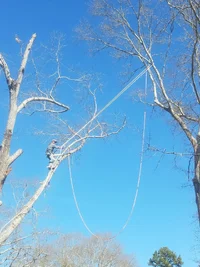
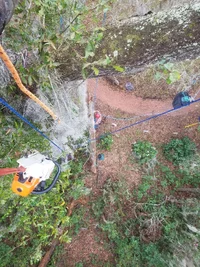
Here is one I did yesterday. The limb I'm on still had a little life but top was broken out so I couldn't rig or safely tie out to the tree I was taking down so I rigged to a close by water oak. Had to be careful not to swing dead stuff back into rigging tree. Any suggestions on one like this?
2018020995101749951518199319825.webp
 
Here is one I did yesterday. The limb I'm on still had a little life but top was broken out so I couldn't rig or safely tie out to the tree I was taking down so I rigged to a close by water oak. Had to be careful not to swing dead stuff back into rigging tree. Any suggestions on one like this?
View attachment 49424
Two ideas come to my mind. Take the dead top of first, so you don't have to wonder about its integrity while working below.
I would definitely redirect my rigging back over another part of the water oak to reduce bending moment, especially seeing as I was tied off on the same limb. I'd probably do the same with my life line, but that's best with SRT.

Sent from my SAMSUNG-SM-G930A using Tapatalk
 
Like that, but obviously to a large central stem, or even through several if there wasn't one stronger than the lead you're using. Rigging rings could do that beautifully.
If the tree wasn't completely dead, you could probably have rigged small from it, while tied into the other tree, taking the dead top first.
1185cfe8e0756831043b8ac3bb690957.jpg


Sent from my SAMSUNG-SM-G930A using Tapatalk
 
Last edited:
Two ideas come to my mind. Take the dead top of first, so you don't have to wonder about its integrity while working below.
I would definitely redirect my rigging back over another part of the water oak to reduce bending moment, especially seeing as I was tied off on the same limb. I'd probably do the same with my life line, but that's best with SRT.

Sent from my SAMSUNG-SM-G930A using Tapatalk
True... I almost never tie out to the same point as rigging line but I didn't really like any other angels so I cut very small pieces. Not ideal I know. For sure could have taken dead top first though. Thanks
 
9E75F599C2B385BDF660F01E95193EC4.webp

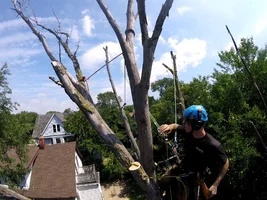
I generally have 2 climbing lines on trees as dead as this elm. No access for a lift, no landing zone for a crane, and right over the top of a house. Really dead trees have to be approached differently than live trees, it's not about production is all about safety. Take it small, build a smart rigging system. Use the tree to your advantage.
 
Here is one I did yesterday. The limb I'm on still had a little life but top was broken out so I couldn't rig or safely tie out to the tree I was taking down so I rigged to a close by water oak. Had to be careful not to swing dead stuff back into rigging tree. Any suggestions on one like this?
View attachment 49424

Wear a helmet
 
20180214_104155.webp 20180214_102522.webp
20180214_102545.webp
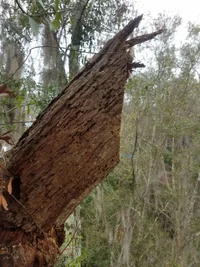
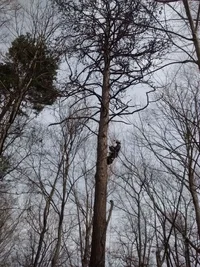
This decayed pine spar had strong heartwood and failed (upon intentional load) in the root ball, details below:

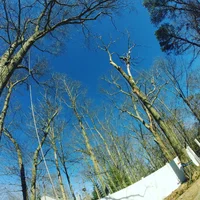
I'm anchored in a laurel oak, as is my rigging. The pine spar is ~20" diameter, leaning at a 15° angle towards and resting on the major low crotch of the oak at ~45' height. The 15' rigged piece in 2nd photo was above the crotch. The pine sapwood is completely decayed down near the ground, exposing heartwood that is about 1/2 the diameter of the intact trunk. It looks and feels very decayed and ready to break. Nothing broke. I had to salami saw off the cracked top above the crack - it would not come off with a bunch of kicks. I shoved the remaining 45' spar four feet sideways and it did not snap down low. I tip tied it and hauled it down with my mini skid with a sudden and sustained pull at full power. The trunk remained unbroken and the roots pretty much broke off where they entered the root ball. This tree originally presented as having failed at the root ball (it had a straight trunk and was leaning on the oak) so this is not a commentary on roots failing on dead trees - they may have failed when the tree was still alive. What I take from this is that the pine spar looked as bad as possible, yet did not crack - either up high where it was already cracked or down low where it was relieved of all sapwood...
 
Looks like a technical one Treetop. Were you using two lowering lines?
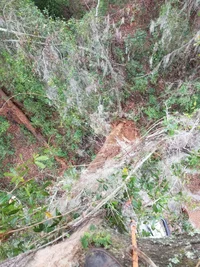
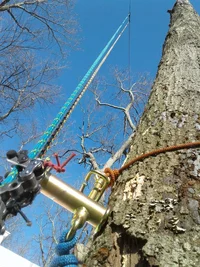
At some points we did use two . Even three on one piece that I calculated may break. Lots of half hitches down stuff that would crumble. The other thing I felt was worth taking a few minutes to use my basswood pole and knocking off all the small crumbly ends that could shake off in rigging. And taking the weight over the drop zones the crew was working first so as that big dead weight wasn't overheads during other operations. Later as we moved higher or equal to the main rigging point in the yard,which was pretty far away from tree we switched to a ring on dead eye slijng and span rigged a lot as well. Had guy lines and rigging lines from three other trees. As well As my tie Ins that were in two fairly far away trees. Even side loaded I was very confident in the integrity of them as I climbed each tree to access in the morning. It probably took us an hour to set tie in points and guy and rigging lines with apta and hand throws. I took a dead limb off for neighbor in process for a good discount for letting us use his trees. Tworopes made this dream a reality. I shoulda filmed more it was a good one. Here's one picture20180318_165859.webp from the bottom up with the new Stein rc2000 I picked up that roped in like two logs , mostly a guy line for the day. And the way a prusik two lines together to chunk down at end with multisling to keep climb line over top away from logs flipping away.
 
Bringing this back from the dead, because I don't understand a few of these suggestions...

Pole saw weighted side and leave the opposite side as ballast

Back-weight the top? Is this so that there isn't as much lateral force imparted to the stem as the top leaves?

I think August hunickie suggested it in one of his videos, but slice/slash cut the top too minimize lateral forces as the top comes free
1) on conifers, salami cut the tops where possible, to get them down without inducing any bending moment in the stem,

What other provisions are done to keep being whipped by limbs or speared by the butt? I.e., how do you keep the thing from coming straight down in the scenario where there is no lean and the rigging does not impart lateral force to move the piece away as it comes free?

Self-lower your tops, which should be small enough to natural crotch on your own. Why coordinate with an expert roper on the ground when you can be the expert roper, with first-hand, realtime info.

Is there a thread where this is explained in more detail, or is it in The Fundamentals, perhaps? I haven't referred there to investigate yet, but if you know of the top of your head...

I've had trouble finding many videos of natural rigging tops - maybe one or two Billy Ray's, and one other.

It sounds like you need sturdy stubs to negative natural crotch rig. Is this correct?
 
What other provisions are done to keep being whipped by limbs or speared by the butt? I.e., how do you keep the thing from coming straight down in the scenario where there is no lean and the rigging does not impart lateral force to move the piece away as it comes away from the tree.

No real preparation needed, you could of course snip branches with a pole saw that might hit you if you want... Or stand in a spot that they'll miss you...

However the technique requires a FAST like really really FAST cut to be executed properly, and generally can't be done effectively in more that a 4-6 inch cut (species dependent if course) and any branches that'll hit you are small enough to either break or bend as they go past (also they'll be relatively speaking slow moving since the top hasn't had much chance to drop yet)

The whole point of this style cut is to keep the top as close to vertically upright as possible, so there are no lateral forces generated, usually you cut it so it slides of on the direction of natural lean, if none is present a gentle twist of the saw bar mid cut is usually sufficient to get it moving enough to slide off the cut. Sounds complicated, but in practice is very simple

 
It sounds like you need sturdy stubs to negative natural crotch rig. Is this correct?

Taking small tops, you'll find that a Rig 'N Wrench on a 6' ultrasling is probably safer and faster than trying to natural crotch them. On excurrent trees, you can either leave a small stub below the cut to keep the sling from slipping, or notch the stem. You have to haul the rigging line up there, one way or another, and the addition of the RnW and sling is practically nothing in terms of weight and inconvenience.
 
No real preparation needed, you could of course snip branches with a pole saw that might hit you if you want... Or stand in a spot that they'll miss you...

However the technique requires a FAST like really really FAST cut to be executed properly, and generally can't be done effectively in more that a 4-6 inch cut (species dependent if course) and any branches that'll hit you are small enough to either break or bend as they go past (also they'll be relatively speaking slow moving since the top hasn't had much chance to drop yet)

The whole point of this style cut is to keep the top as close to vertically upright as possible, so there are no lateral forces generated, usually you cut it so it slides of on the direction of natural lean, if none is present a gentle twist of the saw bar mid cut is usually sufficient to get it moving enough to slide off the cut. Sounds complicated, but in practice is very simple
Best to practice this technique in non critical situations where you have a maximum amount of control rather than in a critical situation where all of a sudden you have that "oh shit" moment.
 

New threads New posts

Kask Stihl NORTHEASTERN Arborists Wesspur TreeStuff.com Teufelberger Westminster X-Rigging Teufelberger
Back
Top Bottom