Lessons of the Storm

TheTreeSpyder

Branched out member
Location
Florida>>> USA
Walking through a small section in Florida; i note the devastation to the wooden giants; trees toppled and torn all around. Large pieces of naked sky glaring thru where it catches you by surprise. The grisly lessons of ground zero; once again the best that can be gotten from these killing fields too.

As people run in fear, trees become this evil to some; so untrustworthy. But, really; most of the failures can be broken down into a few categories that Doc Shigo covered fully, and there are many more trees standing than fallen! If some of the compromising features and practices were taken care of long ago; the trees would seem even more wondorous for all the more that would come thru intact.

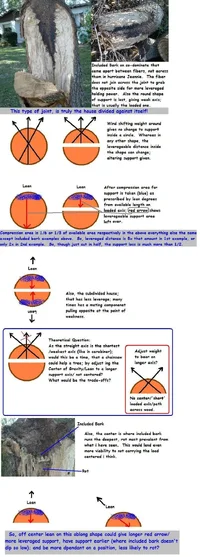
Most noted amongst these failures are the disruption in supportive grain across to branchings by codominate/ included bark/ 'siamesed' together trees; as a set with a common failure point. The seperated fiber into indivdual, non round supports seems to cause several problems; that eventually can lead to the individual members shearing apart between the sheets of grain that do not bind across. The included bark even prying the branchings apart.

Here are some other thoughts on these weakness; including a question on how the weight should be borne for greatest holding power.

/forum/images/graemlins/propeller.gif
 

Attachments

  • 13200-incl bark 5c.webp
    13200-incl bark 5c.webp
    251.2 KB · Views: 90
The last hurricane to power thru here was Miss Jeannie. By now most of the weaker trees and limbs had been 'removed' by the previous storms. Like a thinned herd we had less of such damage; even in sight of a more powerfull hurricane!

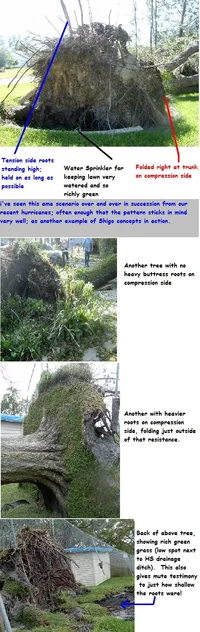
Now, most of the damage seemed to be trees torn over from the ground. We had seen some of this in the earlier hurricanes. These seemed to fall into 1 of 3 groups: A) Trees so small; as to not have enough weight/mass/inertia to resist change and/or as so not very well developed root systems either. B) Rotted roots breaking near the trunk; if root crowns had been visible they probably would have been healthier and more inspectable to limit such 'tragedy'. C) Soaked ground/ shallow rooted from lots of water (nice green lawns)that didn't seem to give trees a chance to stand in some instances and toppled over with massive root resistance, tensioned roots ripping wide from trunk as they tried to hold on.

"C" didn't seem to happen a lot..... Until ground was so saturated from previous hurricanes, and Miss Jeannie added more; and high force winds. Now, even though the 'herd' was thinned; we had lots more damage, from whole trees toppling. Lots of water, large tree alone, limbs trimmed high, green grass and large root mass pitched up into the air became a familiar sight.

The fold would come on compression side, just past any massive roots; with wide fan of roots ripping out on opposite side trying to resist to their last shearing. The ground could have been poor draining always, or just from more water than ever before. The shallow rooting seemed to go with heavily watered lawn areas; whethr from sprinkler, or low area that is last to drain; making water (too?!) freely available over the years.

/forum/images/graemlins/propeller.gif
 

Attachments

  • 13346-Too much water long and short term.webp
    13346-Too much water long and short term.webp
    272.1 KB · Views: 58
Mark, I now what you mean. I figure Ken is getting into situations like this daily. I'm sure if I was dealing with trees blown over like Ken is probably doing, I would develop procedures that would allow me to deal with several different situations without much thought.

Ken, do you have anything to share, even standard operating procedures?

Joe
 
That's pretty close on 1 strategy Mark. Also trying to arc the force over root mass to stump for better flip i think. Never really re-seat totally 'square'; dirt has moved to prevent exact mating if nothing else.

Care must be taken; sometimes the stump sits back down or partially (sometimes violently) so when cutting the last weight off; so there is always that question about leaving the weight of the lever on there preventing it working by itself. Once we had to put a 4x4 under root plate to keep from closing on the water pipes that still needed worked on.

Most of these seem in the front yard; people have had heavy equipment drag to street, city has had payloaders and dump trucks out for such large things. Some have caught a crane nearby for moving stump to road also. Cranes jumped up about $20-30/hr in price, then went with an 8 hour minimum too. Waiting list for cranes freed up about 2-3pm nonetheless.

Had some smaller trees; well some 40-50' pine, that 'fail over' simirarily but only half way; from rotten roots on compression side. They got caught in trees etc. leaning towards target houses etc. We 3/1 truck pulled back upright and over the opposite direction with high leverage; at least it worked to get them away from houses here. Drawing it backwards over maintains the same axis it 'hinged' on; everything reverses; and the corrupted compression side roots, now become corrupted tension/hold roots as tree falls opposite to were it was. The busted now tension roots don't resist, and the trees folded down nicely into place.

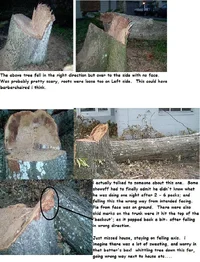
Here are some pix; of cuts made by folks trying to get by on their own. Lessons all around like a battlefield of twisted bodies. Some real losses, like any other slaughter, the only good that can be gotten is in the lessons!
 

Attachments

  • 13379-dangerous hinges 18d.webp
    13379-dangerous hinges 18d.webp
    225.8 KB · Views: 71
Ken: thanks for the reply.

Mark: I've never been a big storm damage person. For me the procedures haven't been as well thought out as the people who thrive on blown over trees. Those stumps must be rough to handle. I'm sure if I worked with you for any length of time I'd learn a thing or 2 about storm damage and handling stumps.

Joe
 
Speaking of which;

With the first hurricanes we had mostly splits at ground or branching, classically on included bark; favouring co-dominates just as the good Doc said....

Some tipovers, mostly traceable to weak roots broken off near the trunk lloking decayed and dry (crown covered, green overwatered grass), or just standing in water and soil couldn't hold.

The latter not really a tree fault; but solidness of the ground connectionn itself. By the time Miss Jeannie torqued around and tore thru here; we were already soaked from 2 hurricanes; then ~8" more water. Now, most of the trees down had folded close on compression side, but tension side really looked like it tried to hold on and were strethced long.

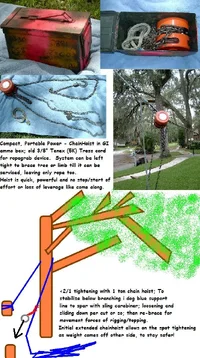
So, any way we braced a few trees and branches till we could get to them, or extra safety while climbing etc. Really liking the rugged simplicity of a chain hoist. Once, we pulled a tree forward with it as far as possible; then finished off with truck pull to fall a huge palm against it's new lean over a house. i don't think that neither hoist or truck could have done the job. The hoist lessened the leveraged angle of the lean, and then still exerted it's force, then truck pulled the less leveraged, still being pulled by hoist palm forward into the face.
 

Attachments

  • 13473-ChainHoist Brace.webp
    13473-ChainHoist Brace.webp
    224.1 KB · Views: 51
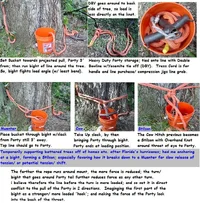
i have a few ammo boxes that sit in a line of matched sizes (even fit a few in a line under tool box in mini pickup); they come with a pressurized rubber seal that keeps dampness out. Got one for jumper cables, chanis and parts etc. A double tall stores Sherrill BigShot, and longer throw lines quite nicely.

Here is my Porty Bucket; ready for anything! i've put 2 shackles in bvowline eye to hold Porty and spread out weight on bowline eye. i picked the line up on a deal, for this as well as more demonstration (or better) on my sight.

This strategy of placing Porty on too long a line/tail works well with other lines too. The Stillson is dependable, easy to remember; and breaks down to a muenter for slow release of tension on more utility applications. i think of making a cow hitch, just like both ends were bound and i'm choking a sling on; then lock with 1/2 hitch on throat. Too start, and for general applications, i usually preach 2 1/2 hitches to finish; alike the standard lock off finish of round turn, clove, Fig. 8 device etc. for comanded consistency; then relax back to just 1 half hitch lock on this hitch; but still 2 over night etc. (for bracing).
 

Attachments

  • 13474-Porty Bucket 015.webp
    13474-Porty Bucket 015.webp
    250.7 KB · Views: 58

New threads New posts

Back
Top Bottom