
Navigation
Install the app
How to install the app on iOS
Follow along with the video below to see how to install our site as a web app on your home screen.
Note: This feature may not be available in some browsers.
More options
You are using an out of date browser. It may not display this or other websites correctly.
You should upgrade or use an alternative browser.
You should upgrade or use an alternative browser.
Large Linden in need of Bracing
- Thread starter flyingsquirrel25
- Start date

marlinspiker
Participating member
- Location
- Pennsyltucky
A well written report and terms and conditions page should help with this. I recommend removal often times to obviously critical risk trees and clients dont want to lose the tree regardless of condition. This doesnt mean that we wont perform risk reduction tactics. At least I have the written recommendation should it fail.

guymayor
Branched out member
- Location
- East US, Earth
It's not the BMP to comply with, as much as ANSI. Here's the *draft* version: http://www.tcia.org/sites/tcia.org/files/A300Part3-Drft1-V1-Supports-PubRev-07%272012.pdf
You'll note the table at 35.5.5 looks a lot like overkill. How much drilling can one tree take?
If X or jomoco or anyone else experienced wants to comment on the draft, go for it!
Writing recommendations for removal in order to CYA? We are all responsible for what we do, and do not do. Deviating from standards is often defendable.
Good on you for making the owner decide, and carrying out the work, and giving trees a chance.
You'll note the table at 35.5.5 looks a lot like overkill. How much drilling can one tree take?
If X or jomoco or anyone else experienced wants to comment on the draft, go for it!
Writing recommendations for removal in order to CYA? We are all responsible for what we do, and do not do. Deviating from standards is often defendable.
Good on you for making the owner decide, and carrying out the work, and giving trees a chance.

Thanks for the preview Guy.
I have the same beef with this standard that I had with the old standard.
Why can't this committee make the critical distinction between hard wood species and softwood species when using lag terminations?
I don't get it. I don't care how "sound" the bloody wood is when using J lags, I care about how hard that wood is, and whether it can come anywhere near the hardware's rated capacities before pulling out of that wood?
J lag use in pine trees, coral trees and many other softwood trees should be prohibited!
Why can't you guys see that?
A complete dope could install a cabling system in a pine or coral, to specs, and still have an ANSI compliant ticking time bomb quite capable of harming both people and property.
And that sucks in my opinion.
jomoco
I have the same beef with this standard that I had with the old standard.
Why can't this committee make the critical distinction between hard wood species and softwood species when using lag terminations?
I don't get it. I don't care how "sound" the bloody wood is when using J lags, I care about how hard that wood is, and whether it can come anywhere near the hardware's rated capacities before pulling out of that wood?
J lag use in pine trees, coral trees and many other softwood trees should be prohibited!
Why can't you guys see that?
A complete dope could install a cabling system in a pine or coral, to specs, and still have an ANSI compliant ticking time bomb quite capable of harming both people and property.
And that sucks in my opinion.
jomoco

flyingsquirrel25
Carpal tunnel level member
- Location
- South East, PA
[ QUOTE ]
If I understand you quoted for 10 bolts based on BMP but have installed only 5 (based on customer budget). Does this mean that you are now responsible if this tree breaks? Who takes responsibility if a job is not completed to BMPs?
[/ QUOTE ]
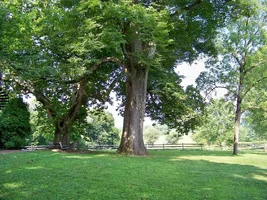
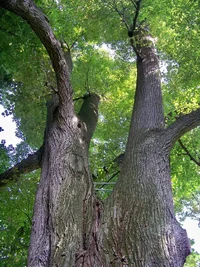
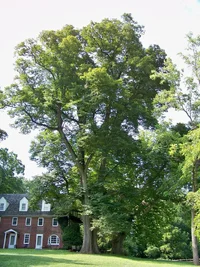
I hope I didnt miss represent what I was doing. I suggested 10 bolts, 4 cables (double stacked due to size), an end weight reduction and Lightning protection update. The lady has money, and lots of it. But didnt want to spend it. I was at just under 5k for all of it. When I presented to estimate she just about dropped her drink. I was able to convince her that all the bolts and 2 cables were the absolute minimum I would do, with the understanding that the rest of the work would get done when she had the money to spend.
I am going to send her a full invoice with everything we did and everything we suggested. And make note that the owner decided due to cost not to complete everything.
If I understand you quoted for 10 bolts based on BMP but have installed only 5 (based on customer budget). Does this mean that you are now responsible if this tree breaks? Who takes responsibility if a job is not completed to BMPs?
[/ QUOTE ]
I hope I didnt miss represent what I was doing. I suggested 10 bolts, 4 cables (double stacked due to size), an end weight reduction and Lightning protection update. The lady has money, and lots of it. But didnt want to spend it. I was at just under 5k for all of it. When I presented to estimate she just about dropped her drink. I was able to convince her that all the bolts and 2 cables were the absolute minimum I would do, with the understanding that the rest of the work would get done when she had the money to spend.
I am going to send her a full invoice with everything we did and everything we suggested. And make note that the owner decided due to cost not to complete everything.
Attachments
flyingsquirrel25
Carpal tunnel level member
- Location
- South East, PA
flyingsquirrel25
Carpal tunnel level member
- Location
- South East, PA


[ QUOTE ]
If X or jomoco or anyone else experienced wants to comment on the draft, go for it.
[/ QUOTE ]
Like to read and comment, on vacation, using my phone..... I killed half of a purple plum once, installing one rod, very important learning experience that I want to share and looking forward to reading the draft.
If X or jomoco or anyone else experienced wants to comment on the draft, go for it.
[/ QUOTE ]
Like to read and comment, on vacation, using my phone..... I killed half of a purple plum once, installing one rod, very important learning experience that I want to share and looking forward to reading the draft.
[ QUOTE ]
It's not the BMP to comply with, as much as ANSI. Here's the *draft* version: http://www.tcia.org/sites/tcia.org/files/A300Part3-Drft1-V1-Supports-PubRev-07%272012.pdf
You'll note the table at 35.5.5 looks a lot like overkill. How much drilling can one tree take?
If X or jomoco or anyone else experienced wants to comment on the draft, go for it!
[/ QUOTE ]
I opened it and read over the whole thing. Quite excellent written work. So many things I thought were not going to be included, were included and worded very well. Congrats to all that worked on it.
I agree with somehow it would be good to instruct not to use J-lags when the wood properties are soft, whether decid or conifer. But how do you write that?
A few small things.... I always wondered about the term, supplemental SUPPORT system. To CYA I'd rather use the term supplemental strengthening. I don't write in my estimate, "cable installed to give support", I always write "cabled installed to add strength". Because if done right, you can't argue that it added strength. Support seems like support, something that is doing all the holding together to me.
"only one termination shall be attached to an anchor". What about when one cable might not be strong enough, so you double up two cables for the needed strength. something I've had to do. both cables are pulling exactly the same on the anchor.
About box cabling. I've done it simply for the purpose that box cabling has more anchors. I did this on a huge hollowing Tilia tree. I could have put in a three cable system with a centering ring (which i love to do, so pretty), but this only gives 3 anchors. I was worried about future decay due to the topped tree (some idiot did 10 yrs earlier) and decided 6 anchors was a better choice, that way, if one anchor pulled threw, there was still another anchor in that leader that might keep that leader from hitting a structure.
Oh, what about running a cable through a smaller leader, in it's route to the larger leader you want to anchor to? I haven't seen any problems in the trees I did this way in the past 5 years, but need more years to see for sure.
But I'm just being picky. Quite excellent how it is!
There will be more to write about next time around, when I release my cabling system to the public and then you'll have to write a few more standards for it too.
It's not the BMP to comply with, as much as ANSI. Here's the *draft* version: http://www.tcia.org/sites/tcia.org/files/A300Part3-Drft1-V1-Supports-PubRev-07%272012.pdf
You'll note the table at 35.5.5 looks a lot like overkill. How much drilling can one tree take?
If X or jomoco or anyone else experienced wants to comment on the draft, go for it!
[/ QUOTE ]
I opened it and read over the whole thing. Quite excellent written work. So many things I thought were not going to be included, were included and worded very well. Congrats to all that worked on it.
I agree with somehow it would be good to instruct not to use J-lags when the wood properties are soft, whether decid or conifer. But how do you write that?
A few small things.... I always wondered about the term, supplemental SUPPORT system. To CYA I'd rather use the term supplemental strengthening. I don't write in my estimate, "cable installed to give support", I always write "cabled installed to add strength". Because if done right, you can't argue that it added strength. Support seems like support, something that is doing all the holding together to me.
"only one termination shall be attached to an anchor". What about when one cable might not be strong enough, so you double up two cables for the needed strength. something I've had to do. both cables are pulling exactly the same on the anchor.
About box cabling. I've done it simply for the purpose that box cabling has more anchors. I did this on a huge hollowing Tilia tree. I could have put in a three cable system with a centering ring (which i love to do, so pretty), but this only gives 3 anchors. I was worried about future decay due to the topped tree (some idiot did 10 yrs earlier) and decided 6 anchors was a better choice, that way, if one anchor pulled threw, there was still another anchor in that leader that might keep that leader from hitting a structure.
Oh, what about running a cable through a smaller leader, in it's route to the larger leader you want to anchor to? I haven't seen any problems in the trees I did this way in the past 5 years, but need more years to see for sure.
But I'm just being picky. Quite excellent how it is!
There will be more to write about next time around, when I release my cabling system to the public and then you'll have to write a few more standards for it too.
guymayor
Branched out member
- Location
- East US, Earth
I agree with somehow it would be good to instruct not to use J-lags when the wood properties are soft, whether decid or conifer. But how do you write that?
A few small things.... I always wondered about the term, supplemental SUPPORT system. To CYA I'd rather use the term supplemental strengthening. I don't write in my estimate, "cable installed to give support", I always write "cabled installed to add strength". Because if done right, you can't argue that it added strength. Support seems like support, something that is doing all the holding together to me.
...semantics
"only one termination shall be attached to an anchor". What about when one cable might not be strong enough, so you double up two cables for the needed strength. something I've had to do. both cables are pulling exactly the same on the anchor.
...2 cables on one anchor = side loading; how could they pull in the same direction?. Better to install a 2nd anchor
About box cabling. I've done it simply for the purpose that box cabling has more anchors. I did this on a huge hollowing Tilia tree. I could have put in a three cable system with a centering ring (which i love to do, so pretty), but this only gives 3 anchors. I was worried about future decay due to the topped tree (some idiot did 10 yrs earlier) and decided 6 anchors was a better choice, that way, if one anchor pulled threw, there was still another anchor in that leader that might keep that leader from hitting a structure.
...sounds reasonable, and compliant
Oh, what about running a cable through a smaller leader, in it's route to the larger leader you want to anchor to? I haven't seen any problems in the trees I did this way in the past 5 years, but need more years to see for sure.
...through-cabling the smaller leader? ok. writing some precautions on that might be good.
There will be more to write about next time around, when I release my cabling system to the public and then you'll have to write a few more standards for it too.
...no one better qualified then, than you!
A few small things.... I always wondered about the term, supplemental SUPPORT system. To CYA I'd rather use the term supplemental strengthening. I don't write in my estimate, "cable installed to give support", I always write "cabled installed to add strength". Because if done right, you can't argue that it added strength. Support seems like support, something that is doing all the holding together to me.
...semantics
"only one termination shall be attached to an anchor". What about when one cable might not be strong enough, so you double up two cables for the needed strength. something I've had to do. both cables are pulling exactly the same on the anchor.
...2 cables on one anchor = side loading; how could they pull in the same direction?. Better to install a 2nd anchor
About box cabling. I've done it simply for the purpose that box cabling has more anchors. I did this on a huge hollowing Tilia tree. I could have put in a three cable system with a centering ring (which i love to do, so pretty), but this only gives 3 anchors. I was worried about future decay due to the topped tree (some idiot did 10 yrs earlier) and decided 6 anchors was a better choice, that way, if one anchor pulled threw, there was still another anchor in that leader that might keep that leader from hitting a structure.
...sounds reasonable, and compliant
Oh, what about running a cable through a smaller leader, in it's route to the larger leader you want to anchor to? I haven't seen any problems in the trees I did this way in the past 5 years, but need more years to see for sure.
...through-cabling the smaller leader? ok. writing some precautions on that might be good.
There will be more to write about next time around, when I release my cabling system to the public and then you'll have to write a few more standards for it too.
...no one better qualified then, than you!

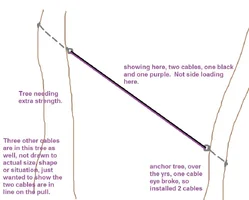
the two cables could just be viewed as one cable maybe??? Just being picky with the wording, that's all. I know WHY the "rule" was created and intended to prevent of course. I was just showing two cables to the same anchors that no one usually thinks about.
I wanted more cable strength but didn't want another huge rod drilled in the anchor tree and another yard eyesore in the landscape.
I wanted more cable strength but didn't want another huge rod drilled in the anchor tree and another yard eyesore in the landscape.
guymayor
Branched out member
- Location
- East US, Earth
X, nice illustration. the clause that conflicts with is
33.5.4 Only one termination shall be attached to an anchor.
To make that scenario compliant, maybe add "..., unless the termination is on a backup cable that is in line with the original." howzatsound?
jomoco, re soft woods maybe instead of
33.5.5 Lag-thread hardware shall only be installed in sound wood. The hole for the lag-thread
hardware shall be 1/16" to 1/8" (1.5-3 mm) smaller than the diameter of the lag." it could be
33.5.5 Lag-thread hardware shall only be installed in undecayed wood of sufficient strength. The hole for the lag-thread
hardware shall be 1/16" to 1/8" (1.5-3 mm) smaller than the diameter of the lag, or in soft wood the same diameter as the lag.
Or do you have a better idea for wording changes?
33.5.4 Only one termination shall be attached to an anchor.
To make that scenario compliant, maybe add "..., unless the termination is on a backup cable that is in line with the original." howzatsound?
jomoco, re soft woods maybe instead of
33.5.5 Lag-thread hardware shall only be installed in sound wood. The hole for the lag-thread
hardware shall be 1/16" to 1/8" (1.5-3 mm) smaller than the diameter of the lag." it could be
33.5.5 Lag-thread hardware shall only be installed in undecayed wood of sufficient strength. The hole for the lag-thread
hardware shall be 1/16" to 1/8" (1.5-3 mm) smaller than the diameter of the lag, or in soft wood the same diameter as the lag.
Or do you have a better idea for wording changes?
oh, my, i just read over my past post and saw i never talked about my purple plum experience.
I learned that the person drilling the tree must look at and consider what the hole will be drilling through. Most trees are healthy and the living tissue is fairly even all the way around the tree's circumference. Other trees are NOT.
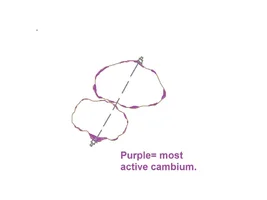
Living, productive, essential tissue might be localized in certain areas and these areas should be avoided with the hole; as the hole might disconnect this vital tissue from linking the crown to the roots an vice versa.
I learned this on a purple plum tree. Old tree, v-crotch between the two halves of the tree. Black knot fungi present throughout the tree and in it's system I'm sure. Twisted trunks a bit too if I remember. Anyway, a fluted old trunk, due to the black knot fungi and other things in it's life.
V-crotch was splitting. I told the homeowner, no big deal, I'll drill one hole and install a rod in the crotch area and it'll be strong enough to stay together.
As I've done with hundreds of trees.
Three days later, homeowner calls and said half of the tree wilted on the first day and now that half is droping it's brown leaves.
I figured it some how HAD to be something with my rod I installed.
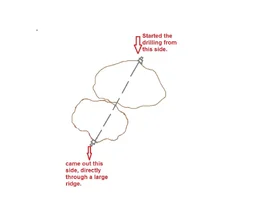
Looking it over, I noticed that when I drilled, the bit came out directly in the middle of a large ridge.
Then I thought about the ridge, what does that ridge mean? It's a ridge because it is growing and productive. The other sunken in areas of the trunk are barely growing, maybe barely alive. This ridge was the "main vein" of this side of the tree and I cut it off.

You may want something writen about how the installer should view the entire circumference and not drill through the only productive portion of the tree. Stay away from ridges and areas with growing "stretch marks".
I cut the tree down, ground out the stump and replaced with a good sized forest pansy redbud at no charge.
I learned that the person drilling the tree must look at and consider what the hole will be drilling through. Most trees are healthy and the living tissue is fairly even all the way around the tree's circumference. Other trees are NOT.
Living, productive, essential tissue might be localized in certain areas and these areas should be avoided with the hole; as the hole might disconnect this vital tissue from linking the crown to the roots an vice versa.
I learned this on a purple plum tree. Old tree, v-crotch between the two halves of the tree. Black knot fungi present throughout the tree and in it's system I'm sure. Twisted trunks a bit too if I remember. Anyway, a fluted old trunk, due to the black knot fungi and other things in it's life.
V-crotch was splitting. I told the homeowner, no big deal, I'll drill one hole and install a rod in the crotch area and it'll be strong enough to stay together.
As I've done with hundreds of trees.
Three days later, homeowner calls and said half of the tree wilted on the first day and now that half is droping it's brown leaves.
I figured it some how HAD to be something with my rod I installed.
Looking it over, I noticed that when I drilled, the bit came out directly in the middle of a large ridge.
Then I thought about the ridge, what does that ridge mean? It's a ridge because it is growing and productive. The other sunken in areas of the trunk are barely growing, maybe barely alive. This ridge was the "main vein" of this side of the tree and I cut it off.
You may want something writen about how the installer should view the entire circumference and not drill through the only productive portion of the tree. Stay away from ridges and areas with growing "stretch marks".
I cut the tree down, ground out the stump and replaced with a good sized forest pansy redbud at no charge.
Attachments

guymayor
Branched out member
- Location
- East US, Earth
yup makes sense to me. So where you you add this wording?
[ QUOTE ]
yup makes sense to me. So where DO you add this wording?
[/ QUOTE ]
beats me.... I'm just passing on info learned from experiences, I'm not part of the team writing it. I'd be honored to be apart of it sometime though and would invest time in it if I was part of the team.
yup makes sense to me. So where DO you add this wording?
[/ QUOTE ]
beats me.... I'm just passing on info learned from experiences, I'm not part of the team writing it. I'd be honored to be apart of it sometime though and would invest time in it if I was part of the team.
New threads New posts
-
test
-
 Hitchhiker 2 on a shackle
- Started by Johnathan Jackson
- Replies: 0
-

-
 How much is your Climber/ Lift Op vs. Groundworker lowering brush and wood?
- Started by southsoundtree
- Replies: 6
-
 'Urban Forestry Today' Webcasts @ Noon (Eastern) continue - Oct 22 & Nov 12
- Started by UFT
- Replies: 0
-

-
