lag screw eyes for safety

We discussed procedures for possible trunk splitting about a month ago...one of the ideas posed was using eye hooks (lag screws) to safety from when concerned about trunk splitting.

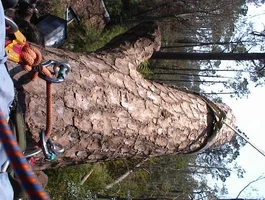
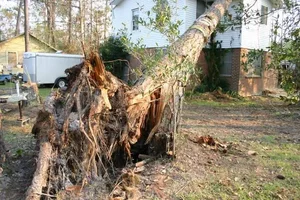
I am in Picayune, MS doing disaster relief in this area and Slidell. A few days ago, we took a large pine off a house. I had to straddle the trunk to make some cuts and did not want to be lanyarded to the trunk underneath in case it split..there was already a large rupture at the base where Katrina torqued it down.

Here are some pictures of how I used lag screws for safety...thanks to CharlieB and darkstar for the idea.

There are more pictures at:

http://www.arboristsite.com/showthread.php?t=24470&page=10&pp=15

and also on "Page 12" of that thread.
 

Attachments

  • 30992-DSC00008(2).webp
    30992-DSC00008(2).webp
    6.3 KB · Views: 223
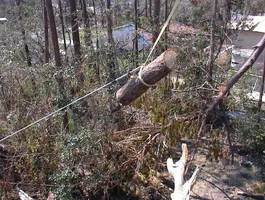
Here is a piece we removed with a Warn winch and tag lines...we had a high belay point in a nearby pine.
 

Attachments

  • 30994-DSC00014(2).webp
    30994-DSC00014(2).webp
    98.6 KB · Views: 169
Is there a chance you can take a pic of 1 of the screw eyes not in wood? (Your 1st pic didn't upload).The thought of using them is good, but they are designed to have a straight pull from the drilled hole. The way you are using them, they have a downward load.
How about using nylon strap binders just above your anchor and using an adjustable friction saver or RG? Using bore cuts will also help in relieving tension on "tension fibers".
Doing storm work can be very dangerous and therefore, keeps us focused on safety.
Are there decent places to stay down there?
 
[ QUOTE ]
Is there a chance you can take a pic of 1 of the screw eyes not in wood? (Your 1st pic didn't upload).The thought of using them is good, but they are designed to have a straight pull from the drilled hole. The way you are using them, they have a downward load.
How about using nylon strap binders just above your anchor and using an adjustable friction saver or RG? Using bore cuts will also help in relieving tension on "tension fibers".
Doing storm work can be very dangerous and therefore, keeps us focused on safety.
Are there decent places to stay down there?

[/ QUOTE ]

Good point on the side loading. I have read of some with 2500 pound test but they don't have them at the local Picayune, MS Home Depot...I just got the biggest I could find. What does not show is the high line I was also using...it was for a bailout if needed.

We did use straps like that some...especially at the trunk where it was so gnarled up and split.

Can you tell me where to read about "bore cuts and tension fibers"?

Wood under tension is certainly a consideration down here; I'd like more info.

I'll see about places to stay. I have seen a lot of camper trailers, unsure about motels. Our team is staying with a family that is looking out for us while we work in this area...not having to camp out makes life a lot simpler. We are more efficient as a result.
 

Attachments

  • 31008-IMG_8341(2).webp
    31008-IMG_8341(2).webp
    81.2 KB · Views: 123
Bore cutting is best suited for large leaners.
The tension wood is in the back of these trees so you want to reduce the tension on the inside leaving a back strap of wood which is cut to fell the tree afterwards.
The tree in your last picture has top bind and end bind.
The tension wood is on the bottom.
The Fundamentals of General Tree Work best describes these.
 
A few ideas on lags as safety devices. This is just my two cents worth.

I assume that you are using the lags because a traditional system with a lanyard around the trunk may cause you to be pulled into the tree in the event of a split. My theory would be to reduce the chance of the split below the cut as much as possible through proper cutting techniques, load binders (above and below the cut) and weight reduction as necessary. If a threat of a split below the cut is a concern a split above the cut is a greater concern. The lags do nothing to reduce the chance of “barber chair.” If none of the above options were available then I would reconsider my approach thoroughly.

In the event of an emergency the lags appear as if they would hinder a quick exit. You are adding yet another complication to what very well may be an all ready cluttered and confusing area of ropes, slings, connecting devices and what not. If the climber becomes injured and a rescue is necessary the lags may also hinder lowering of an injured climber.

Furthermore, if a split were to occur below the cut, the lags or rather the holes they create may become part of the split and come loose or pull out. An unexpected release of a balance point may become very interesting especially if you are running a saw.

Now that I have bored you with all that I will say that perhaps the best reason against this technique is the simplest. There are at least two widely known and afore mentioned (in other responses) systems to circumvent the splitting trunk scenario.

In conclusion, I fell that using lags in the described manner complicates a quick escape, may cause difficulties if rescue should be necessary, may come loose if the split crosses the lag entry points, and does nothing to reduce the chance of a split above the cut. In effect you anchor yourself to the weakest part of the system, the tree. If a split should occur and you survive the opening what is going to happen to you when it closes? To be cliché an ounce of prevention is worth a pound of cure.

Thank you for your patience in my rather long winded reply.

Tony
 
[ QUOTE ]
A few ideas on lags as safety devices. This is just my two cents worth.


[/ QUOTE ]

I am reading it and thinking about it..thanks. Good input.
 
Rather than anchoring yourself to the lags you should look into getting a Rope Guide or making one yourself. The pulley and busing can be bought separately from Fresco.

Choking the RG on the stem allows you to stay in your normal setup and still get to the ground.
 
[ QUOTE ]
Choking the RG on the stem allows you to stay in your normal setup and still get to the ground.

[/ QUOTE ]

Thanks for the tip...I have started looking at Sherrill's with a RG in mind.
 
Even simpler, and just as effective, IMO, is simply choking your lifeline around the stem. In the event of a split, all that will happen is the espanding trunk will push your friction knot down. Of course it is best to use a figure 8 in addition to a friction knot.

I now choke my lifeline on most all spar takedowns and often on ascents as well, for brief moments. When choking a spar and descending, you need to leave a tail or clip a length of line (slings, etc, anything will work), in order to pull down the choked line.
 

New threads New posts

Back
Top Bottom