Is SRT really banned in Germany?

Tom, some notes on the standards issue is discussed on pp 5-6 of the third reference in my note above (not US though). Not only ability to support weight/ stretch but temperature resistance - there's more in the body of this work.
I do find this "cert thing" to be sort of an absurd circumstance - a rope with eye splice, knot tied by the manufacturer, a pulley and a thimble on a prussic is certified when I open the box, but becomes uncertified when I take the knot apart after one use to remove pitch and then re-tie it. Now I have an uncertified system.
Still the issue with RR/ Uni and mechanicals should be simpler to solve, just with a trip to Lester the Tester . . . .
It being late and I having had some single malt, I also wonder that the RW, RR, Uni are invented in the US/ UK and manufactured in the UK - both of whom have really ticked off the EU lately . . . . hmmm . . . a plot everywhere. :)

Addenda: Other thing, in their RW "combo kit" they do say that the ISC RW Pulley does have CE certification:
https://honeybros.com/Item/ISC_Rope-Wrench_Pulley_Kit
 
Last edited:
Can anyone actually produce the standard that they are not passing. My guess would be that it is probably a rubber stamped copy ofvthe UIAA mountaineering standard but I might be wrong.

The question is the underlying problem with most standards world wide. Why can't you Google them, and why aren't they free to own. If you want compliance then start with making the standard free public knowledge.
...They are EXTREMELY expensive.
It's about money and we try to make it about safety, that's why this whole discussion is difficult to argue.
 
...The STRW System CANNOTbe certified to the BS EN 12481:2006. VG11, the committee made up of representatives from various notified bodies, has confirmed that it is not possible for the STRW to be certified to BS EN 12481:2006, as the standard does not permit 'techniques' (the tying of a hitch is classed as a 'technique').

Pretty much nails it, a "technique" cannot be certified, everything needs to be "plug and play" to meet quantifiable standards that make most liability issues go away. Pure mechanicals like the RR, Akimbo, Bulldog Bone clearly have the chance to meet standards if an investment in certification is made (as mentioned, a tall order out of reach of our amazing home-grown inventors).

The comments about "industry control" of the tree gear market reminds me of how an established and law-abiding tree company in the U.S. meets all the insurance, workman's comp, safety, etc. requirements. Tree business owners get a bit irritated with the infamous "pick-up truck and a saw" operation that grossly underbids them. Companies like Petzl are not happy to be out-competed by inventors coming up with game-changing tree tools and bringing them to market against all odds. That discontent is not just from being out-competed, it's the massive overhead and financial risk that a company like Petzl carries in long-term product development, testing, cert, marketing, etc. They likely see Kevin, Paul C., Jamie, Surveyor as PIA rogue gunslingers.

In the software/app world there is a completely different model for large companies to deal with this "problem", they simply acquire the upstart technology. The acquisition strategy can be implemented and rationalized in two ways: #1. Gain ownership/control of a great product, or #2. Crush the competition by buying it out and let it wither on the vine. The high angle gear companies seem to operate on an old-fashioned model of containing all development internally, if it didn't originate on their designer's table, it doesn't exist.

Kevin Bingham and others are following the modern "disruptive technology" model. Kevin crowd-sourced testing and development by distributing prototypes widely and integrating feedback into his product development. If Kevin was an app developer he would've been bought out already or would have conquered the market and become a global giant in the industry ;-) I think we're seeing the growing pains of an industry (high-angle gear) that will have to shift towards and accept the disruptive technology model, it will take some time for that to happen.

I think tree climbers world-wide should be proud of how we are driving innovation outside of the industry model, eventually it will rise to the top if it is truly useful and safe. The SRT gear ban in Germany is a temporary bump in the road.
-AJ
 
Last edited:
I could be wrong but to my mind it was never allowed per se, rather the influx of the SRWP technique has piqued some ears and those ears decided to do something constructive about it. I'm not sure how we propose to develop professional industrial tools if the designers and manufacturers refuse to co-operate to widely accepted certification. Sure, the existing standards may not apply but it isn't rocket science to write a manufacturers standard and test to it. Technique moves faster than tool development and a bona-fide tool 'revolution' is needed to accomodate it. I'm sorry to say this but this threads header is non-constructive to the point of ridiculousness, like British gutter press.
 
The more we look into this, the more it appears to be more a campaign against the use of corded hitches than it is against SRT. Mechanical devices will soon be ce and that is just a matter of time. Hitches can never be fully ce although they can be sold ce. The rope wrench will likely only be able to be sold in Germany in a system with hitch tied and everything in order. while able to sell it, it will not remain ce after the user undoes the hitch and installs it on another rope. Much like ce climb by teufleberger

Many companies in Germany already do not allow hitch based systems dddrt or SRT. ART and the zig zag are the only options for many. Ce climb is an option for Ddrt but not a satisfactory one IMO. We will see where this goes. I am much less concerned about the future of SRT climbing in Europe than I am about hitch based climbing techniques in general.
 
...The rope wrench will likely only be able to be sold in Germany in a system with hitch tied and everything in order....

When rules and safety regulations make no sense it might be worthwhile giving voice as to why. Certification was initiated for quality guarantees on product. How is it that an industry allowed it to be a system-worthiness measure.
 
Couple points come to mind (partially under the influence of single malt again tonite!)

1) If the tying of hitches is the subject of variability/ lack of "certifiability", would it help if manufacturers provided really detailed instructions on how to tie their "certified" knot reproducably - written and pictures with the equipment as well as video on their website, on Youtube, on the vendors websites, etc.
Given the above, it should be easy to set something up (yeah I know this may seem silly on the face of it - we know how to tie a Distel or a Knut etc., but maybe we just have to play along). I'm thinking CE Lanyard here (it's a Distel, it's a Knut, it's a . . . )
This may not be as silly as it sounds - for example I cite Richard's video on tying the Hitchiker stopper knot and the "variability" around it and also the info on how to tie the rope bridge stopper knot on the Visit to New Tribe segment in August Hunicke's video about the Monkey Beaver Harness (it's at about 15:10) - this was really clear. Procedure, procedure, procedure.

2) Presumably there is, in the manufacturers' premises somewhere the "CE certified" knot tying dude. What does it take to become another CE certified knot-ologist in your own company? You get your CE certificate and can tie the knot in an "approved" manner (like some of the vendor's CE certificates you can see on some European websites). But why does some dude in a manufacturer have exclusivity?

3) Kevin, I've never had the pleasure of meeting you and don't know the early struggles to get the RR going, but why not a go fund me page type thing for getting the RR a CE approval if economics are a barrier? Surely ISC has European knowledge about this process in the EU. Once this is obtained, many jurisdictions grandfather other countries approvals as being "certified" equipment in their own jurisdiction. That's a big part of the speed bump gone for lots of your end users. In Canada here, Pfanner has a bit on their website to get your ANSI sticker for your brain bucket.

4) Some jurisdictions may in fact already have exemptions in place for the use of hitch type knots in tree work. In our jurisdiction in Canada, the Alberta Occupational Health and Safety Code 2009 Part 39 Explanation Guide has the following:
"Section 796 (of the OH&S Regulations) Knot exemption
Almost every aspect of tree climbing and tree work involves the use of a rope. To use the rope properly and safely, workers must know how to tie and set a variety of knots and sliding hitches. Sliding or friction hitches are used by workers to ascend and descend trees, and as a belay device. Sliding hitches act as a type of rope grab, sliding along a rope. Commonly used sliding hitches include Blake’s Hitch, the Taughtline Hitch, and a Prusik knot used with a Prusik sling.
Section 150.3 (of the OH&S Regulations) restricts the use of Prusik and similar sliding hitch knots to competent rescue or emergency services personnel, or in an emergency to a worker trained in its use and limitations. Reflecting the extent to which tree care activities rely on knots and ropes, and the fact that tree care workers are competent in the use of these knots, section 150.3 does not apply to tree care operations."

So maybe it may pay to talk to your State OSHA folks even if 1910 CFR (federal) does not address these hitch issues specifically. They may be able to write a State letter/ interpretation bulletin. Maybe good activity for ISA local chapters with a co-ordinated form letter so everyone is on the same page?

Or is the Scottish go-juice getting to me?
 
I could be wrong but to my mind it was never allowed per se, rather the influx of the SRWP technique has piqued some ears and those ears decided to do something constructive about it. I'm not sure how we propose to develop professional industrial tools if the designers and manufacturers refuse to co-operate to widely accepted certification. Sure, the existing standards may not apply but it isn't rocket science to write a manufacturers standard and test to it. Technique moves faster than tool development and a bona-fide tool 'revolution' is needed to accomodate it. I'm sorry to say this but this threads header is non-constructive to the point of ridiculousness, like British gutter press.
Exactly Paul
 
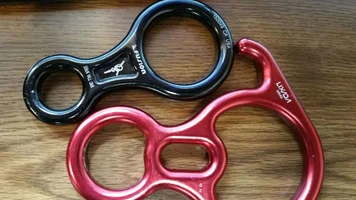
Can someone please help me out. I am looking for the CE standard that figure eights are tested to for ce certification other than the ce certification as a "ring". I can't seem to find it anywhere. I am sure there must be one because it is commonly sold to tree climbers by German retailers to descend off their foot locking line.
 
Can someone please help me out. I am looking for the CE standard that figure eights are tested to for ce certification other than the ce certification as a "ring". I can't seem to find it anywhere. I am sure there must be one because it is commonly sold to tree climbers by German retailers to descend off their foot locking line.

They're rated like rings?!
I got some flak for running one instead of a ring on my double bridge on my cougar.
 
I don't think too many have a break strength rating anymore. They are primarily used like tubers to descend only. Are the ones available in Germany break strength rated?
 
You're right, I found that most are rated. I was basing my opinion on the Mammut eights that I have and only the earliest were rated.
 
You're right, I found that most are rated. I was basing my opinion on the Mammut eights that I have and only the earliest were rated.
Okay. I have only seen two that weren't.
One that somebody wasn't allowed to use at comp with no brand and an old kong 8.
 

New threads New posts

Back
Top Bottom