Just a follow up on this post.
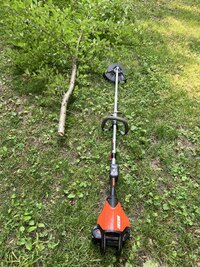
I removed a ton of flowering pear, barberry, burning bush, Japanese honeysuckle & multiflora rose from a 4.5 acre park. For the bigger stuff I cut stumps to knee level and came back later to cut at ground level and sprayed 41% glyphosate with a small hand sprayer mixed 50/50 with water with a blue dye within 5 minutes of making the final cut. For the smaller stuff 1" diameter and under, I found the flat side of a pick axe was the best tool to chop and pry out the roots. If I get more into this stuff I will buy a weed wrench. Many examples of the pears creeping into the understory from the edges and outgrowing sugar maples, hickories, blackhaw, eastern wahoo, beech, hophornbeam and other natives.
I poked a bunch of pawpaw and spicebush seeds in the soil but would really like to learn more about helping disturbed woodlots get a healthy understory established by spreading seeds.
Thanks for the help with this project!
Sounds like great work.
In "Tree Pruning", Shigo used this quote from "The Little Prince":
"And the fox said to the little prince: 'Men have forgotten this truth. But you must not forget it. You become responsible, forever, for what you have tamed.'"
While he implied this for street trees, I feel it applies to the broader environments of forests, and even entire regions.
It's not that any species is inherently bad, yet we have intended to tame many environments, and in our current day, many of them have changed in use and upkeep that lead to undesirable results.
Early examples when I was learning about "invasives":
Seeing huge stands of bright yellow Gorse shouting "CAUTION" and making impenetrable the edges of cattle fields in Oregon which had been suffering from Erosion due to the hoof action and stunted root base.
Impressive stands of Japanese Knotweed (a hyper-accumulator of metals) growing in little islands of toxic soil at the foot of large abandoned brick mill buildings in the northeast.
Bittersweet vines dragging trees to the ground throughout Southern New England, in dense, even-aged stands of overgrown pasture, to create spacing for the remaining trees to flourish.
More recently, I was exploring a nearby forest in an area here that were shockingly defoliated by an intense wave of gypsy moths, they appeared to go after Oaks predominately. Now that these are falling down, four years later, I am seeing Pines and other species with room to breathe, and overall the forest is appearing more balanced. The Oaks that survived have breathing room at their current height.
Anyway, the conversation of Invasives has always fascinated me.
I learned about it at the same time I discovered Japanese Knotweed as one of my prime medicines for dealing with Lyme Disease. I noticed an ad in the local paper that said "Know your Knotweed" and after my excitement I realized that it promoted calling your local Oregon dept. of something and they would come spray it dead on the spot.
I understand the reasons for this but it always threw a big suspicion of:
Who Makes the List of species that are deemed okay or OUTLAW in our land.
Yet one day, I discovered Knotweed in my local tide marsh, an area maybe 8 feet square... and I made no delay, dug it up within three days, searching for every piece of root I could find. I made medicine from the roots in alcohol. The following spring I picked up a tick within a few dozen yards of that Knotweed patch. got Lyme again.. d'oh! They say where there's poison, the antidote remedy is near at hand...
What poison have we wrought, and what messages are coming from nature's plants?
I believe Nature works in a language we may not always understand.