Invasive Species Removal?

Another way to frame these kinds of environments is ‘climax’ forests, which can be helpful because the definition of old growth excludes much more forests. Climax forests may have been logged 2-300 years ago but have basically returned to the largest amount of biomass possible for that site.

...…
I'm going to counter point a few paragraphs one per reply...for discussion sake. No huge disagreement just other ways to think about it.

First, climax and old growth are not the same. Especially among hardwoods in Eastern US. The simplest way to define a "climax" forest is "what's up there and what's down here are the same".

The conversion from pioneer species to intermediate species to climax species is "complete". When the canopy trees die one by one, they'll be replaced by more of the same species.

Most of what we call old growth is oak-hickory dominated. There is almost no oak in the understory, but rather a lot of Maple, beech, maybe some Basswood, yes... hickory. Maple-beech would generally be considered a climax forest.

To take it a step further...in a forest whose understory is dominated by pear or honeysuckle, you will see few native species regenerating. There will, however be more of the same. So you could say a honeysuckle woods is a "climax" forest, but it would not be very old or have the characteristics of old growth.
 
...
But the argument in Orions book would suggest we should be hesitant to try to maintain any site exactly the way it is, because conditions change and climate is changing. In North America, many of these old growth or climax forests are missing one of their keystone species, the American chestnut. So to think we can ever go back to an America before the introduction of invasive species/pests/pathogens is impossible.

.…
I'll agree we're never going "back". I'd always ask "back to what?" to anyone who suggests we can or should. .the forest (and climate) has always been changing. If you look at "old growth" much of it is 400-500 years old. Not much older. Why? Oaks will live longer than that. What happened 500 years ago that caused this? Maybe too much influence from the book 1491 here, but just a thought.

Also...who says we can't go back to American chestnuts? I heard last week that the decision about permissibility of the GMO chestnut trees (from Syracuse) is supposed to come down by the end of the year.
 
.... across the globe is indicative of a site change and in some cases the invasive species is filling a niche that a native species is unable to fill as effectively. But more often than not it’s indicative of some stupid shit we did near the site. Built a dam, drained a swamp, built a development, etc.

If they are there in the woods, the argument holds some truth that the non-natives are filling that gap "better" than a native. They were able to out compete. But which gap? And are you OK with that gap being filled, but another being wide open. For example birds and honeysuckle. Yes...they fill the "gap" of an understory in the woods very well. We've found heavy infestations in even mildly disturbed woods (no woods is "undisturbed"). There is a plant there...great. However we do know that such areas provide less valuable nutrition (resulting in lower bone density), more nest predation, and undesirable habit for some of the more sensitive bird species while providing more than adequate nesting for "generalist" who will nest about anywhere.

So it is really about identifying which gaps are more important to the whole picture.
 
Last edited:
Ecological philosopher Edward Abbey once declared “growth for the sake of growth is the ideology of the cancer cell.” He was referring to the ever-diminishing wild places of his beloved Arizona, replaced by sprawling subdivisions that housed a ballooning population of retirees, alongside massive mining and oil leaaes

Above…not my words, but I agree

Yes, humans have chosen to destroy. The ‘Why’ has generated discussions for eons.
 
Ecological philosopher Edward Abbey once declared “growth for the sake of growth is the ideology of the cancer cell.” He was referring to the ever-diminishing wild places of his beloved Arizona, replaced by sprawling subdivisions that housed a ballooning population of retirees, alongside massive mining and oil leaaes

Above…not my words, but I agree

Yes, humans have chosen to destroy. The ‘Why’ has generated discussions for eons.
I’ve listened to a lot of Charles Eisenstein podcasts and books where he talks about how we are in the space between stories. Where many people no longer believe that infinite growth and technology is leading us to live better lives anymore ( what he calls “the old story”), but we don’t know where to go with that understanding with all the old story momentum in place.

An article in the Arborist news a couple months ago reminded me of this. It was written by a field arborist that talked about how he got in the profession because of the love of trees, but spends every day as an arborist cutting them down.
 
Ecological philosopher Edward Abbey once declared “growth for the sake of growth is the ideology of the cancer cell.”

That quote is actually quite appropriate because you could turn it around and point to the biomass generated by a Bradford pear and other such invasives!

@ATH I owe you a reply but I’m waiting to finish the book first!
 
That quote is actually quite appropriate because you could turn it around and point to the biomass generated by a Bradford pear and other such invasives!

@ATH I owe you a reply but I’m waiting to finish the book first!
Look forward to hearing your thoughts once you've processed them...
 
Just a follow up on this post.

I removed a ton of flowering pear, barberry, burning bush, Japanese honeysuckle & multiflora rose from a 4.5 acre park. For the bigger stuff I cut stumps to knee level and came back later to cut at ground level and sprayed 41% glyphosate with a small hand sprayer mixed 50/50 with water with a blue dye within 5 minutes of making the final cut. For the smaller stuff 1" diameter and under, I found the flat side of a pick axe was the best tool to chop and pry out the roots. If I get more into this stuff I will buy a weed wrench. Many examples of the pears creeping into the understory from the edges and outgrowing sugar maples, hickories, blackhaw, eastern wahoo, beech, hophornbeam and other natives.

I poked a bunch of pawpaw and spicebush seeds in the soil but would really like to learn more about helping disturbed woodlots get a healthy understory established by spreading seeds.

Thanks for the help with this project!
 
Just a follow up on this post.

I removed a ton of flowering pear, barberry, burning bush, Japanese honeysuckle & multiflora rose from a 4.5 acre park. For the bigger stuff I cut stumps to knee level and came back later to cut at ground level and sprayed 41% glyphosate with a small hand sprayer mixed 50/50 with water with a blue dye within 5 minutes of making the final cut. For the smaller stuff 1" diameter and under, I found the flat side of a pick axe was the best tool to chop and pry out the roots. If I get more into this stuff I will buy a weed wrench. Many examples of the pears creeping into the understory from the edges and outgrowing sugar maples, hickories, blackhaw, eastern wahoo, beech, hophornbeam and other natives.

I poked a bunch of pawpaw and spicebush seeds in the soil but would really like to learn more about helping disturbed woodlots get a healthy understory established by spreading seeds.

Thanks for the help with this project!
Sounds like great work.

In "Tree Pruning", Shigo used this quote from "The Little Prince":
"And the fox said to the little prince: 'Men have forgotten this truth. But you must not forget it. You become responsible, forever, for what you have tamed.'"

While he implied this for street trees, I feel it applies to the broader environments of forests, and even entire regions.

It's not that any species is inherently bad, yet we have intended to tame many environments, and in our current day, many of them have changed in use and upkeep that lead to undesirable results.

Early examples when I was learning about "invasives":

Seeing huge stands of bright yellow Gorse shouting "CAUTION" and making impenetrable the edges of cattle fields in Oregon which had been suffering from Erosion due to the hoof action and stunted root base.

Impressive stands of Japanese Knotweed (a hyper-accumulator of metals) growing in little islands of toxic soil at the foot of large abandoned brick mill buildings in the northeast.

Bittersweet vines dragging trees to the ground throughout Southern New England, in dense, even-aged stands of overgrown pasture, to create spacing for the remaining trees to flourish.

More recently, I was exploring a nearby forest in an area here that were shockingly defoliated by an intense wave of gypsy moths, they appeared to go after Oaks predominately. Now that these are falling down, four years later, I am seeing Pines and other species with room to breathe, and overall the forest is appearing more balanced. The Oaks that survived have breathing room at their current height.

Anyway, the conversation of Invasives has always fascinated me.
I learned about it at the same time I discovered Japanese Knotweed as one of my prime medicines for dealing with Lyme Disease. I noticed an ad in the local paper that said "Know your Knotweed" and after my excitement I realized that it promoted calling your local Oregon dept. of something and they would come spray it dead on the spot.
I understand the reasons for this but it always threw a big suspicion of:
Who Makes the List of species that are deemed okay or OUTLAW in our land.

Yet one day, I discovered Knotweed in my local tide marsh, an area maybe 8 feet square... and I made no delay, dug it up within three days, searching for every piece of root I could find. I made medicine from the roots in alcohol. The following spring I picked up a tick within a few dozen yards of that Knotweed patch. got Lyme again.. d'oh! They say where there's poison, the antidote remedy is near at hand...
What poison have we wrought, and what messages are coming from nature's plants?
I believe Nature works in a language we may not always understand.

 
gypsy moths,
FYI the language has changed on these; they're referred to as spongy moth/LDD moth now due to the previous name containing a slur.

I know one thing we struggled with in Southern Ontario was trying to wrap our heads around if we're just fighting the inevitability of climate change. Plants moving up from warmer environments into hardiness zones they "shouldn't" be able to survive in, but winters aren't as harsh as they used to be and the natural environment itself is changing. Things like black locust migrating up waterways into warmer and warmer areas that it may have once existed in hundreds of years ago. Now up here in Northern Alberta we're trying to increase our biodiversity since our canopy is all elm/ash/poplar, and warming plant hardiness zones are certainly helping us establish a more varied urban canopy. But the flip side of that is we'll open up to more invasives, pests, diseases...I can't think about it too much or my head will hurt
 
I'm going to counter point a few paragraphs one per reply...for discussion sake. No huge disagreement just other ways to think about it.

First, climax and old growth are not the same. Especially among hardwoods in Eastern US. The simplest way to define a "climax" forest is "what's up there and what's down here are the same".

The conversion from pioneer species to intermediate species to climax species is "complete". When the canopy trees die one by one, they'll be replaced by more of the same species.

Most of what we call old growth is oak-hickory dominated. There is almost no oak in the understory, but rather a lot of Maple, beech, maybe some Basswood, yes... hickory. Maple-beech would generally be considered a climax forest.

To take it a step further...in a forest whose understory is dominated by pear or honeysuckle, you will see few native species regenerating. There will, however be more of the same. So you could say a honeysuckle woods is a "climax" forest, but it would not be very old or have the characteristics of old growth.
I kept writing replies and having to do something else and losing it all. Anyway.

Do you see forests with pear in the understory? I haven’t yet.

I'll agree we're never going "back". I'd always ask "back to what?" to anyone who suggests we can or should. .the forest (and climate) has always been changing. If you look at "old growth" much of it is 400-500 years old. Not much older. Why? Oaks will live longer than that. What happened 500 years ago that caused this? Maybe too much influence from the book 1491 here, but just a thought.

Also...who says we can't go back to American chestnuts? I heard last week that the decision about permissibility of the GMO chestnut trees (from Syracuse) is supposed to come down by the end of the year.
Can you speak more to what you think may have happened to the oaks 400-500 years ago? I have often wondered the same thing.

The 15/16ths chestnut has limited availability but you can get a handful of nuts if you give the ACF $300. I might just do that this year, but I honestly would be more inclined to plant the GMO as it will be virtually identical to the original. Or both. They will likely interbreed anyway in the next generation.

But even if we were to plant the shit out of some chestnuts, 200 years from now it won’t be the forest we had 200 years ago, because now we are missing hemlock, ash, maybe beech, and who knows what else. And temperatures are chasing species north of their range.

So we really are jumping into an uncertain future.

If they are there in the woods, the argument holds some truth that the non-natives are filling that gap "better" than a native. They were able to out compete. But which gap? And are you OK with that gap being filled, but another being wide open. For example birds and honeysuckle. Yes...they fill the "gap" of an understory in the woods very well. We've found heavy infestations in even mildly disturbed woods (no woods is "undisturbed"). There is a plant there...great. However we do know that such areas provide less valuable nutrition (resulting in lower bone density), more nest predation, and undesirable habit for some of the more sensitive bird species while providing more than adequate nesting for "generalist" who will nest about anywhere.

Yes. Like, is biomass for the sake of biomass inherently good? Probably not.

One section of this book deals with the management of the environment from an American indigenous perspective. Everything was extremely managed for specific purposes that benefited humans, but also benefited the health of the entire ecosystem. There was no such concept of ‘wilderness’ or ‘conservation’. There were numerous interventions. A lot of times it was to maintain an ‘oak savannah’ which is an ecosystem that is incredibly productive. My philosophy has always been driven by a very hands off approach so this has been something that’s really changed my perspective. Like, a climax forest or old growth forest may not have been the ideal ecosystem those land managers were trying to create and maybe it shouldn’t be our goal either.

I’ve been listening to a lot of podcasts as well and there’s just a lot of conflicting methodologies when approaching invasives. Some folks say it really is our duty to remove them or limit their spread. Others say use them. Any of you who have chipped a bradford know how a 12” tree can fill a chip truck the same as a 36” white oak. It’s insanely good at making biomass. It’s good enough firewood. That said, I cut all the Bradfords down where I live. I think the author of the book lost me a little bit in some of the pie in the sky ideas about how to turn shit plants into gold. She also blamed EAB on persistent drought in the northeast… I don’t buy that. I’m going to dig up all my miscanthus, keep cutting down my Bradfords and privet. I won’t be adding chemicals but I understand we can only do so much.

One point I did think the book made well is that these lands would ideally be managed by the people who have vested interests in them, for hunting and foraging. Here we are getting paid to keep invasives out of a park of an HOA... Well really, if folks were required to live off the land and knew that a certain management would give them x amount of acorn meal and game versus a much lower yield, darn tootin they’d get off their couch and create the ecosystem that would support their caloric needs. They might dig up all the kudzu, or find that it has some uses. That may be how things had been done on this continent. But that is a huge, huge huge leap from where we are now ;)
 
More recently, I was exploring a nearby forest in an area here that were shockingly defoliated by an intense wave of gypsy moths, they appeared to go after Oaks predominately. Now that these are falling down, four years later, I am seeing Pines and other species with room to breathe, and overall the forest is appearing more balanced. The Oaks that survived have breathing room at their current height.
What’s shocking to me about that oak massacre is what a missed opportunity the municipals had. Hundreds of prime oak stems that would have made amazing lumber were left as habitat spars. We hem and haw at the price of a 2x4 but those towns couldn’t get it together to coordinate a massive influx of responsibly acquired oak lumber. Not to mention the crews that got the canopies down were from Texas (we are talking about MA / RI.)

I really appreciate the knowledge you shared about knotweed. I hadn’t heard any of that!
 
What’s shocking to me about that oak massacre is what a missed opportunity the municipals had. Hundreds of prime oak stems that would have made amazing lumber were left as habitat spars. We hem and haw at the price of a 2x4 but those towns couldn’t get it together to coordinate a massive influx of responsibly acquired oak lumber. Not to mention the crews that got the canopies down were from Texas (we are talking about MA / RI.)
I hope we see more coordination between tree industry and lumber industry. It requires a tight link, but I know we've all had moments see a massive tree full of lumber getting pulverized into chips, thinking... Wha???
The occasional massive old farm tree etc can include 1000s of dollars of potential lumber vale, and create work for a sawmill guy, etc. Yet the buzz of efficiency rattles on..

I really appreciate the knowledge you shared about knotweed. I hadn’t heard any of that!
"The Book" is by Stephen Harold Buhner, "Healing Lyme". It has a whole chapter about knotweed. It's one of my top 5 herbs, just don't use it in a daily regimen as it can mess with the kidneys somhow.
It's function of slightly thinning the blood and improving circulation could be very potent in this time right now in regard to new concerns of heart disease.

Tying those two threads together, how amazing if the same crews that remove invasive stands also harvest for medicine. I have a specific site in mind for this (like I did here in the marsh), and maybe with some documentation the idea could get a bit of traction.

I am of the belief that everything needed for life and survival is readily available from the Earth, it's just a matter of organizing, processing, and knowing where it's needed.

Nation is facing concerns about home heating through the winter, yet the chipper grinds and grinds...
 
.....

Do you see forests with pear in the understory? I haven’t yet.
We have seen it in areas. Certainly more in old fields than in the woods, but it is showing up.
Can you speak more to what you think may have happened to the oaks 400-500 years ago? I have often wondered the same thing.
I don't think anybody knows for sure. And I don't think it happened "do the oaks", but more "for the oaks". We know oak needs significant disturbance to regenerate successfully. The book 1491 argues that the native populations were much higher than often reported. The theory goes that huge numbers died from introduced disease before Europeans ever had a chance to see who was here. IF that is the case, they certainly would have had influence on the land. There are quite a few discussions that native peoples used fire quite a bit...again, a lot of people using a lot of fire = a lot of disturbance. (as you point out below - maintaining oak savanna) I just wonder what the Appalachian hardwood region looked like in 1491? Was it less forested??? Then by the time Europeans moved west, it looked like mature forest.
The 15/16ths chestnut has limited availability but you can get a handful of nuts if you give the ACF $300. I might just do that this year, but I honestly would be more inclined to plant the GMO as it will be virtually identical to the original. Or both. They will likely interbreed anyway in the next generation.

But even if we were to plant the shit out of some chestnuts, 200 years from now it won’t be the forest we had 200 years ago, because now we are missing hemlock, ash, maybe beech, and who knows what else. And temperatures are chasing species north of their range.
Agreed on all points!
....

One point I did think the book made well is that these lands would ideally be managed by the people who have vested interests in them, for hunting and foraging. Here we are getting paid to keep invasives out of a park of an HOA... Well really, if folks were required to live off the land and knew that a certain management would give them x amount of acorn meal and game versus a much lower yield, darn tootin they’d get off their couch and create the ecosystem that would support their caloric needs. They might dig up all the kudzu, or find that it has some uses. That may be how things had been done on this continent. But that is a huge, huge huge leap from where we are now ;)
I get where you are coming from with "they’d get off their couch and create the ecosystem that would support their caloric needs" - but I'd argue society addresses that. We planted a 40-50' patch of wheat last year just for kicks. One of my helpers likes the idea of small scale agriculture (not the work though). I told him if I got enough to make a batch of cookies I'd be happy. Anyhow to the point: after harvesting, thrashing, and winnowing the wheat I said "I sure hope whoever invented the combine that does this all at once made a lot of money off of that invention!" So in the case of the HOA, at least they are willing to address the invasives even if it is by hiring you.
 
Didn't read all of the longer post, but feel compelled to clarify what old growth forest is by my understanding-

An old growth forest is a comprised of trees that grew their entire lives in woods composed of mature trees. There is effectively no old growth on the east coast. Lots of mature woods made up of old trees, but basically nowhere where those trees came up under canopies of trees that were how big they are now.

Old growth ain't just big ol trees, it is a long time scale biome (for humans anyways)
 
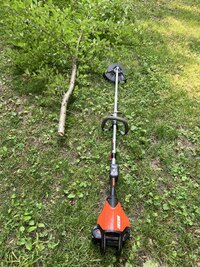
I bought the brush cutter attachment for my echo battery dpas2600 powerhead and it works great for small pear, honeysuckle, barberry, multiflora rose and grasses. I dig up and uproot everything I can, but if it’s too big for that I zap it with this and stump treat. Basically just a circular saw on a stick. It’s nice to not have to be on my knees with a chainsaw as much.
 

Attachments

  • IMG_1523.jpeg
    IMG_1523.jpeg
    1.4 MB · Views: 5
  • IMG_1526.jpeg
    IMG_1526.jpeg
    65.2 KB · Views: 5
  • IMG_1527.jpeg
    IMG_1527.jpeg
    67.2 KB · Views: 5
  • Like
Reactions: ATH
Those are great for the right sized stuff! The biggest challenge I've found is treating after cutting. Do you have a good system for that?
 
That is a good method. Years ago, we treated thistles in pachysandra by wearing a cotton glove over a rubber glove; dipped the glove in a pot of roundup, and then just grabbed each thistle. Killed the all off nicely with no off-target application.
Around here we call that The Glove of Death technique.
 
  • Like
Reactions: ATH
When doing invasive species removal like flowering pear, honeysuckle, multiflora rose - I assume chipping on site risks spreading seeds?

Also, what would be the best time of year for treating the freshly cut stumps with herbicide? Any suggestions for the best herbicide for this method? Mostly dealing with flowering pear.

Thanks!
misc comments...

The 7 or so groups I've worked with around here, some NGOs and others government bodies, all use burn piles to dispose of their debris.

Some treat stumps with Garlon, others use glyphosate. I don't know their mixes but on my property 20% - 40% glyphosate, water-based, works well.

Application methods vary -- squirt bottles, sponge rubber-banded to the end of a stick (herbicider carries the solution in something like a cut-open milk carton to dip the sponge into for refills), or a mini paint roller (3-4") again with a dip container. The roller also makes it easy to apply herbicide to leaves or the stem of stuff that's too small to cut.

On smaller stems or for super-precise application I've used a sponge-top bottle (like the dabbers used by bingo afficionados, or a Buckthorn Blaster) and it's worked well.

Some groups cut and treat year round. Others say it's not effective enough during the growing season.

Stumps are usually treated less than an hour after cutting. For the few species that tend to exude a lot of fluid after being cut, we'll wait a few hours or the herbicide doesn't get absorbed. If stumps can't be treated same day they'll be cut higher (12+"), then within a few days cut lower and treated.

Some groups try to cut 4-5" high so stumps are easier to find for treatment. One (government / lawyer'ed-up) insists on cutting to ground level to avoid "trip hazards".

I've once seen a sawyer followed by a flagger that sticks a metal wire flag by each cut stump / stem. The herbicider than pulls the flags as they treat.

When there are tons of small cut stems to treat, some will be missed. We often accept that knowing that whatever gets missed, or needs retreatment, will become obvious soon enough. It's never a one-and-done job anyway so one or more return visits will be needed.
 

New threads New posts

Kask Stihl NORTHEASTERN Arborists Wesspur TreeStuff.com Teufelberger Westminster X-Rigging Teufelberger
Back
Top Bottom