
Navigation
Install the app
How to install the app on iOS
Follow along with the video below to see how to install our site as a web app on your home screen.
Note: This feature may not be available in some browsers.
More options
You are using an out of date browser. It may not display this or other websites correctly.
You should upgrade or use an alternative browser.
You should upgrade or use an alternative browser.
Invaders!!
- Thread starter Leroy
- Start date


- Location
- Retired in Minneapolis
I think the walk would have to be in circles
There are places on the East Coast of US that have the beginnings of being old growth. After 200+ years the trees are large and the understory thick
The Native Tree Society might be a good resource
There are places on the East Coast of US that have the beginnings of being old growth. After 200+ years the trees are large and the understory thick
The Native Tree Society might be a good resource

Cereal_Killer
Branched out member
- Location
- Ohio
We have some great National Forests in SE Ohio.
Yes definitely, western PA has some that fit the bill too (in fact I'm taking a trip there this spring to climb one specific tree)!
hseII
Participating member
- Location
- United States
Anybody here want any kudzu? I have plenty of it in my neck of the woods. Take a nap in the woods and it can cover you before you know it. That plant is fast.
I’ll be glad to send enough to start a few Kudzu farms.
C.O.D. Of course.

Evo
Been here much more than a while
- Location
- My Island, WA
The Olympic National Forest... The last of the last, everything from coastal to alpine.Where would one go to find a large undisturbed deciduous forest? Does it exist? Large as in you could walk for many days and not find the end... Off topic I know, just curious....

ATH
Been here much more than a while
- Location
- Findlay, Ohio
Yeah, it is nice, but almost all of that has been clearcut......twice.We have some great National Forests in SE Ohio.
Here is a good read about Ohio's Iron furnaces and their impacts on the forests written by a very well-respected Ohio forester. Correction...that is an article about the furnaces, but not much about impact on forests. This one from USFS has more about forests 300-350 acres per furnace per year and from the Conway article there were 46!!! furnaces. (almost 14,000 acres per year cleared).
Shawnee State Forest is another big parcel in Ohio. Also cut over twice. Then the 2003 ice storm leveled almost half of it again.
The Washington-Jefferson National Forest is pretty nice. Also has been cut over. Also lost a high percentage of total canopy cover to Chestnut Blight.
You could hike the Appalachian trail. A lot of heavily disturbed and commercialized portions...but some pretty remote areas too. I haven't done any measure portion of it, but enjoyed some long day hikes in SW VA and some backpacking trips in NC.
Adirondacks in Upstate New York may be one of the better bets. Some of that was protected before it was cut too hard.
PNW is the best bet, but not as much vast expanses of just deciduous forest.
Last edited:
ATH
Been here much more than a while
- Location
- Findlay, Ohio
Yes!The Olympic National Forest... The last of the last, everything from coastal to alpine.
Back in college, I spent a few days hiking from the beach where we needed to watch tide tables to avoid being pinched off, through the Hoh rain forest, up an 8000 ft mountain, and came out somewhere on the opposite side of the park. Wish I took better notes (or any notes, for that matter) about where we went. It was spectacular!
Evo
Been here much more than a while
- Location
- My Island, WA
You were likely in the La Push area. The Hoh rainforest river trail will dump you into the Sol Duct ranger station. If this is the case you started in the center west edge and wound up in the Northern center edge. There are other routes but this one is pretty popular.Yes!
Back in college, I spent a few days hiking from the beach where we needed to watch tide tables to avoid being pinched off, through the Hoh rain forest, up an 8000 ft mountain, and came out somewhere on the opposite side of the park. Wish I took better notes (or any notes, for that matter) about where we went. It was spectacular!
ATH
Been here much more than a while
- Location
- Findlay, Ohio
That may have been. We were there in early May. Not many people there at that time. Maybe to La Push looking at Google Earth now? - this was probably 22 years ago...but I think perhaps on the north side of that river just north of La Push, then several miles on the Pacific NW Trail I see on the map and then inland somewhere south of that bay??? There were only a few parking spaces where we parked - come to think of it...I don't remember going back there to pick up the rental car, but we must have??? I just remember hitch hiking and riding on the ferry with the guy who picked us up. Bits of memory aren't fitting together. I do remember finishing our hike at a more popular area with a bigger parking lot, more buildings, more people.
I also remember seeing my 2 favorite road signs on that trip. I got a picture of one. The other isn't funny out of context...we drove for probably an hour on a narrow dirt road leading no where (where ever we started). There was a sign that said "congested area ahead". Probably not the same thing that sign means in LA...
here is a picture of the other sign from that trip:
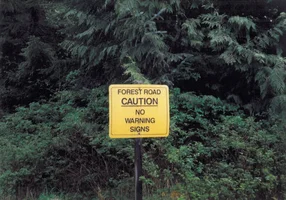
I also remember seeing my 2 favorite road signs on that trip. I got a picture of one. The other isn't funny out of context...we drove for probably an hour on a narrow dirt road leading no where (where ever we started). There was a sign that said "congested area ahead". Probably not the same thing that sign means in LA...
here is a picture of the other sign from that trip:
Evo
Been here much more than a while
- Location
- My Island, WA
It's changed quite a bit... Pretty much logged off right to the park boundary, we were there mid March, didn't hike very far as we were strapped for time, but by mid afternoon it was nearly crawling with people (at least from how I remember it being). It's sad to admit that I'm a boat ride and a few short hours, but have rarely made it back in the past 10 years. Summer time it's impossible!

As professionals we have to walk the line and educate on the difference between exotic and invasive.
Japanese maple is exotic vs European buckthorn which is invasive.
A significant portion of exotics are invasive but not all. That’s the problem, eab exotic and horrible vs mpb native and horrible.
I was taught native good exotic bad but narrow views empty your toolbox in a hurry and if we go with native from 100 years ago in today’s urban settings that idea is often crap.
I do NOT support invasive trees or bugs they’re a pita.
However if site conditions deem an exotic tree be the best fit to grow to the highest potential it should be heavily considered. If you limit yourself out of the gate to anything other than physical site conditions and a trees potential you could be offering a second rate opinion, where the sites beat potential can never be reached.
That way of planning often happens but seems crazy to me, but hey I go where I’m sent.
Japanese maple is exotic vs European buckthorn which is invasive.
A significant portion of exotics are invasive but not all. That’s the problem, eab exotic and horrible vs mpb native and horrible.
I was taught native good exotic bad but narrow views empty your toolbox in a hurry and if we go with native from 100 years ago in today’s urban settings that idea is often crap.
I do NOT support invasive trees or bugs they’re a pita.
However if site conditions deem an exotic tree be the best fit to grow to the highest potential it should be heavily considered. If you limit yourself out of the gate to anything other than physical site conditions and a trees potential you could be offering a second rate opinion, where the sites beat potential can never be reached.
That way of planning often happens but seems crazy to me, but hey I go where I’m sent.
Evo
Been here much more than a while
- Location
- My Island, WA
Location and scale.. 200' Doug firs don't make the best street trees. I don't work in the urban setting, so I do lean towards natives in the outer boundary of the managed landscape.As professionals we have to walk the line and educate on the difference between exotic and invasive.
Japanese maple is exotic vs European buckthorn which is invasive.
A significant portion of exotics are invasive but not all. That’s the problem, eab exotic and horrible vs mpb native and horrible.
I was taught native good exotic bad but narrow views empty your toolbox in a hurry and if we go with native from 100 years ago in today’s urban settings that idea is often crap.
I do NOT support invasive trees or bugs they’re a pita.
However if site conditions deem an exotic tree be the best fit to grow to the highest potential it should be heavily considered. If you limit yourself out of the gate to anything other than physical site conditions and a trees potential you could be offering a second rate opinion, where the sites beat potential can never be reached.
That way of planning often happens but seems crazy to me, but hey I go where I’m sent.
- Location
- Retired in Minneapolis
Well put @KevinS
The native limiter has been written into project specs by well-intentioned designers who need a bit better understanding. This was a topic at a past STSCthers a huge difference between the two
The native limiter has been written into project specs by well-intentioned designers who need a bit better understanding. This was a topic at a past STSCthers a huge difference between the two
Absolutely if that’s the right spot for native I so go for it. Also the thing I left out of my post is if all your sites are similar sometimes you may sacrifice potential to keep some diversity. Diversity in an urban setting is kind of an overall shared dilemma/goal for everyone while still striving for potentialLocation and scale.. 200' Doug firs don't make the best street trees. I don't work in the urban setting, so I do lean towards natives in the outer boundary of the managed landscape.
Finding enough diverse genera and families is the problem.
We have a strong grower industry here but finding significant amounts of more rare plants is the challenge. Contracting a grower years in advance is the way to go if you want more urban diversity
We have a strong grower industry here but finding significant amounts of more rare plants is the challenge. Contracting a grower years in advance is the way to go if you want more urban diversity
ATH
Been here much more than a while
- Location
- Findlay, Ohio
Maybe as they move away from pear, we'll see more options? (I know, wishful thinking...more likely just more A. freemanii). the growers are responding to demand - growing what sells. Were you at the Ohio Tree Care Conference last time it was at Kalahari? Landscape architect with a laundry list of awards for landscape design recommending honey locust, pear, and Norway maple...
I hope that’s there heads against the wallMaybe as they move away from pear, we'll see more options? (I know, wishful thinking...more likely just more A. freemanii). the growers are responding to demand - growing what sells. Were you at the Ohio Tree Care Conference last time it was at Kalahari? Landscape architect with a laundry list of awards for landscape design recommending honey locust, pear, and Norway maple...
New threads New posts
-
test
-
-

-
 Alternatives to standard asphalt around roots
- Started by southsoundtree
- Replies: 20
-
-

-


