Insect & Disease ID Trivia

Re: Insect & Disease ID Trivia

Whoa! Slow down! Those last three posts got way too exciting for me to handle!

I propose that we throw an add on to this game. Instead of just naming the pest or disease, let's also suggest the best course of control. We're all trying to learn here right?

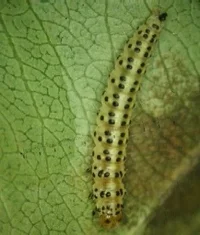
And...was that european pine sawfly? Or some other sawfly.

Our current control is foliar spray of carbaryl. Ontario is super limited for registered pesticides.

Please feel free to dispute or recommend a better treatment option. I'm all ears.
 
Re: Insect & Disease ID Trivia

I'd like to know more too. What are the host species for the insect? Geographic area and time of year when the specimen was spotted? If it's not too much trouble to share some information that will help me to visualize the critter doing its thing in a tree, it would be a great learning opportunity for me!

Thanks for some very interesting posts!
 
Re: Insect & Disease ID Trivia

http://www.extension.umn.edu/distribution/horticulture/DG6703.html

1.Mechanical Control -Examples here include methods such as hand picking larvae from plants, physically dislodging them by using forceful water sprays, or other means of nonchemical control. Population size and distribution will determine the effectiveness or suitability of the chosen method.
2.Biorational Insecticides -Insecticidal soap-best for low populations of young larvae. A note here -Bacillus thuringiensis(BT)will notcontrol sawflies. Strains of this biological insecticide are effective against various caterpillar pests (larvae of butterflies and moths), but will not control sawfly larvae.
3.Conventional Insecticides -Any of the insecticides listed in Table 1 will provide good control of sawflies. These products should be considered only after all other management tactics have been explored.

acephate (Orthene)
bifenthrin
carbaryl (Sevin)
insecticidal soap (M-Pede)
malathion (Malathion)
permethrin

Anyone ever used acephate as a soil drench? results?

http://www.treecarescience.com/arborceuticals/insecticides-miticides/lepitect
 
Re: Insect & Disease ID Trivia

I'm told acephate binds with organics in the soil and is not translocated into the tree. Not to say that it doesn't work but i would stay away from trying it.

Macro: the list is helpful but in practice what do you use for sawfly damage?

I'd love to find an alternative to sprays but haven't yet found an effective one. I have used ace caps (orthene implants) but the damage to the trunk is prohibitive. (although we used them at a hospital where YHSS was bad and they weren't cool with spray of any kind. Incidentally another contractor had tried soaps to no effect the year before i was called.
 
Re: Insect & Disease ID Trivia

I usually release several chameleons on the infested specimen to achieve mechanicle control.

No, honestly I haven't yet had a saw fly outbreak bad enough to treat yet. But keep in mind, I just started my PHC program 2 years ago. I have mostly been doing HWA treatments, organic fert, oil sprays for scale, mites etc, borer treatments with various insecticides.

Excellent idea to list treatments for the ID pics!

Let me ask you, what pesticides do you commonly use as a spray? (trunk or foliar) What type of PPE do you wear and what sprays do you feel comfortable working with? Maybe we should private message to avoid a borrage of anti treatment attacks.

I really wish soil applications and lower trunk sprays with pentra bark were more effective for more difficult to control pests, simply for the applicators sake.
 
Re: Insect & Disease ID Trivia

In the interest of keeping to the theme of the thread, why don't we leave treatment options for response to posting insect of disease id photos. It'll all come out if people jump on board as they have with the super boring and never challenging tree id game. (kidding).

I don't have another image to post right now, they're on my other computer.

I'd love to talk more about treatment options.

Anyone got a pic to post?
 
Re: Insect & Disease ID Trivia

oyster scale. they are so easy to find i handpick, with vinyl gloves cuz they are messy.

had a client call cuz they saw white things on their hemlocks and feared adelgids since those suckers are now in the piedmont. all i saw was oyster scale but i sold them on a preventive for adelgids.

oyster scale has wide host range but have seldom seen dieback result
 
Re: Insect & Disease ID Trivia

Is oyster scale the same thing as barnicle scale?

I have been doing 1-2/year oil sprays for all customers with hemlock hedges and have found adelgid, spider mites, barnicle scale and elonagate scale on almost all hedges (pre-treatment).

Do you guys feel comfortable with 1 oil spray/year for hemlock hedges? (No soil treamtment?)

One customer was having a lawn service do annual imidacloprid soil injections for his hedge, the spider mite damage was insane. Been having me do oil for the past year, you can see about 2 inches of lush green new growth since and faded out spider mite damage on all old growth on one side of the headge (facing southwest).
 
Re: Insect & Disease ID Trivia

Not oysershell scale in that picture. Definitely a scale. We don't have hemlock up here so i can't comment with certainty but 2 sprays of oil per year should control spider mites and scale very well. We have oyster scale on cotoneaster here where it will kill hedges entirely. 1 oil spray is very effective against it.

Even if i could use imidacloprid legally, i certainly would avoid it at all costs. There are far better alternatives. For hedges that are accessible by sprays, oils would be the way to go, for HWA too. Imi only for the large trees.
 
Re: Insect & Disease ID Trivia

I concur, not oysterscale. Looks like one of the wax scales (subfamily Coccinae). It would be helpful if we knew the host.
 
Re: Insect & Disease ID Trivia

i stand corrected on common name--it is indian wax scale, per the cornell text p 356, ceroplastes ceriferus. very waxy and squishy and deep red inside. been a long time since i ate an oyster i guess...

barnacle is c. cirripediformis
 
Re: Insect & Disease ID Trivia

I have been seeing it a lot on hemlock hedges. It is indian wax scale but I am a little confused because the source I found on the net says indian wax and barnacle are the same? But evidently not.

As for treatment, I'm already oil spraying all hedges for HWA, spider mites, and scale.

Off topic: we had major winds yesterday and after 2 hard years of drought, massive oak went down (uprooted), and the typical white pine, bradfords, lombardy, silvers, included bark trees, etc. I had a lady tell me I am responsible to remove her split pear at no charge because I pruned it a couple years ago. hahahaha! I told her "I wish I could, but I can't control motha natcha"
 
Re: Insect & Disease ID Trivia

[ QUOTE ]
...the source I found on the net says indian wax and barnacle are the same? But evidently not...

[/ QUOTE ]evidently the net is not all that reliable. if you want to manage insects and diseases in treeses, you kinda need those 2 books.

wink.gif
 
Re: Insect & Disease ID Trivia

Diseases of Trees and Shrubs By Wayne A. Sinclair, Howard H. Lyon, and Warren T. Johnson

The second edition of this standard reference for plant health specialists, diagnosticians, horticulturists, arborists, foresters, and students is fully updated and amended. More than 2,200 color images in 261 full-color plates illustrate this resource in addition to 350 black and white photographs and drawings. Both a diagnostic tool for most diseases and a reference guide, a searchable CD-ROM is included containing a bibliography with more than 4,500 entries. (©2005, hardcover, 676 pp., glossary, index, 300 pp.) CD is PC and MAC compatible.

Insects that Feed on Trees and Shrubs By Warren T. Johnson and Howard H. Lyon

For diagnosing insect problems, this publication from Cornell University Press is one of the most comprehensive and functional manuals available. Essential facts for identifying more than 900 insects, mites, and other organisms are provided with 241 full-color plates to visually recognize insects and their damage potential to trees and shrubs. (©1991, hardcover, 560 pp., glossary, index, full color photos)

o and...it's a caterpillar!
 
Re: Insect & Disease ID Trivia

Nope. This may be unique to my region, i dunno. It affects apple trees and hawthornes. The reason that i've posted it is because here we get lots of aesthetic damage to apples and lots of calls and attention. But, all the research i find about it says that it's totally harmless and treatment is not warranted. This is mostly true but i have seen it defoliate apples to the point where fruit is aborted early.

Insect ID is the easy part, treatment plans are the hard part.
 

New threads New posts

Back
Top Bottom