Ingrown Girdling Nylon Ropes

Bart_

Carpal tunnel level member
Location
GTA
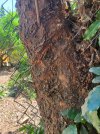
Someone hung a treehouse using big fat 1" or so 3 strand nylon about 10 years ago. Maples. New owner neglected it for 8 years of growth. In one place the rope is nearly encased by trunk growth. Tree is still healthy. I figure any aggressive cutting to get the rope out and stop the girdling is likely to also damage the tree bark. Chemically melt the nylon out - would poison the tree? Try to melt it out - would cook the cambium? Sawing/serraded knife although effective so far would damage the bark layer unseen as you worked (?) Fein oscillating cutter?

Is there a magic bullet to get the rope out? What would you recommend?
 
My thought would be to find the place the rope is most exposed, and carefully cut it with a knife, or a hammer and a razor sharp chisel, and then pull it out. Any minor injury you cause to the tree will be minimal compared to the future damage that rope will cause.
 
Do you have pictures to share

I’d get out as much oh the old rope as possible. Using an oscillating cutter is an excellent idea. I think that once you get going the trickle of cut/removed fibers will turn into a flood. Getting the first ones out will take work
 
  • Like
Reactions: ATH
I agree that you want to get as much out as possible. If there is an area where it is encased, you'll just leave that there. But like @Tom Dunlap said, I bet you'll be able to pull it out fiber by fiber from that area if you cut on either side of that area.

A sharp chisel is probably your best bet for this. Oscillating tool me melt some fibers making them harder to pull out? I would also bring some needle nose pliers to try to talk on those fibers.

Overall, when I find ropes or wires in trees, the goal is to get as much out as possible without damaging any bark. If the tree grows over it and reconnects on the other side, that means it won't actually girdle the tree. Just be a weak spot.
 
And then always be aware that will be a forever weakened section of the tree/limb.

Will it?

Trees are amazingly good at absorbing and growing around objects. If those objects are stationary and not abrading tree tissue, cambium remains intact and strong without inner decay or disfunction.

That said, poison is in the dose. I have seen an entire wrought-iron stair railing halfway embedded into the trunk of a Norway maple that showed no outward signs of stress for having done so. I have also seen a simple string tied around a small branch, kill all that was beyond it. I believe each situation should be assessed individually before strong statements are made.
 
I learned a lot about how trees coped with wounds by using my bandsaw for dissection

It was really interesting slicing through a limb that had grown around a chain. I used my abrasive chop saw to cut it

Since the cambium was affected intermittently there was very little discoloration. The growth increments were compressed though.

Some things get left in place. Not all would get removed
 
In one spot the tree almost encapsulated the rope, on a vertical stem. I was working my way towards it, prying out 1 of 3 strands till it got so tight I was starting to see wood chips flake off on extraction, so I stopped. I might achieve 1/3 to 1/2 circumference removal on that stem without getting crazy. The other was in a 30 degree main crotch and I'm concerned about the weakness of the massive inclusion if I leave that one in. I've got most of that one out so far except right in the crotch. It also has plenty of bark for sap flow vs the first one should I cause damage. I thought I was crushing cambium already with my prying, another reason I stopped. On the vertical one I'm considering leaving the rope in on the lean-ward side because It's already tighter than heck and contributing to supporting the bending beam compression there.

Thank you for the thoughts. No magic bullet! Doh!
 
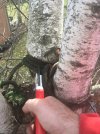
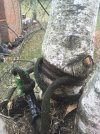
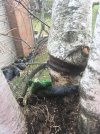
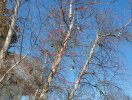
I can’t add much except a few interesting pics of rope girdling a birch that I did a few years ago. Another company did this “bracing” job. Just tied a section of climbing rope around the two leads and even left a snap hook up there. Absurd.
FBAAA005-8B42-4F05-9055-164C7CB5656C.jpeg123030D5-6663-4993-95D0-37841C3DDA2D.jpeg1DD991A6-04BD-4FCF-ABEB-E1C12699C93B.jpeg

Interesting how the tree shows the actual weave of the rope fibers. Lucky to get it out before totally embedded.
 
Have not. Customer moved. I could do a drive by, but I suspect it is doing well. Showed no signs of dieback even with the rope in it.
 
Post mortem. There were two big ropes and another minitreehouse had two more smaller ropes. The buzz cutter on lowest speed didn't melt the fibers but if they were loose grabbed them and just shook them around. Similar to how your hand saw will pull a loose rope sideways but cut a taut rope. I ended up using the buzz cutter judiciously to trim a bit of tree to get a bit more rope out, but the tree growth won the day. I left 1/3 circumference buried on the vertical stem ( 1/4" visible!) and the crotch actually had two layers deep. Lower layer was long gone and for half the crotch the upper layer was completely encapsulated too! There was about 7 wraps of 5/16 rope in the mini rig and I gave up there too, but did open 3/4 of the circumference.

They're not high value trees and not aimed at targets so my conscience isn't suffering.
 
Not a rope but here's a pretty good ingrown item from a removal/cleanup job we did a couple months ago.
 

Attachments

  • 20220725_115803.jpg
    20220725_115803.jpg
    998.8 KB · Views: 19
Along these lines I have installed Cobra and Notch Dryad, and Allgear Branch Saver for others. Over time, they grow into trees just like the classic aircraft cable inside garden hose. I don't sell any of this to people.
 
Along these lines I have installed Cobra and Notch Dryad, and Allgear Branch Saver for others. Over time, they grow into trees just like the classic aircraft cable inside garden hose. I don't sell any of this to people.
That would be caught (and adusted) on prescribed regular inspections
 

New threads New posts

Back
Top Bottom