I Need Crane Pics

[ QUOTE ]
I'm in my own little world , if people are flipping cranes all the time , than do your thing .

[/ QUOTE ]

Thats obvious, and if you keep up on the Awakenings and the Crane threads you would know that they are.

I'm not using scare tactics although its a good idea like Mark said to show people who don't know any better that cranes can very easily be turned wrong side up.

I am designing a crane course for a 30 person municipal arborist crew, I think only about half or less are climbers meaning that the other half wont care about whats being said and they still have to be entertained.
 
[ QUOTE ]
[ QUOTE ]
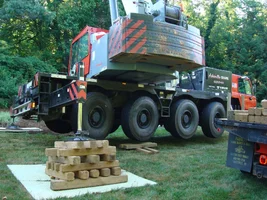
Some one may recognize this photo. It is an awesome example of what can be done with cribbing. I personally would be too skeerd to attempt or suggest my crane guy do this... But, it was pulled off without incident.

[/ QUOTE ]

looks familar......

[/ QUOTE ]

John. You got some nice cribbing going on there. Does that make the customers pucker a little?
bigeyes.gif
 
That cribbing is impressive! i would have liked to have seen a larger footprint, and more a packed configuration if i were to be setting it up. And the plywood makes me mucho nervous! Dig the hill side a bit and run your first course with the grade, then cross ways, no slippage then!

All in all good work, and large cajones!
 
If you dig the hillside wouldn't the first course be flat? For that I agree. I'm also not a fan of the spacing (packing) configuration. If there's an air space then there's room for crushing. At least that's how I look at it.
 
yes the first course would be flat, what i meant was with the grade was run them in a vertical configuration. If the hill wasnt dug they would be faced downhill, not across the hill.

That makes even less sense, huh!?
 
We would start a 6x6 first horizontal on the downhill, then a 4x4, then the ground. On top of that we run( 2ft by 2ft square plywood 6 to 8 pieces thick) blocks until we get the right height. Hope that makes sense. On that hillside we would leave the rear tires on the ground with the brakes locked. I hate hills.
 
[ QUOTE ]
Some one may recognize this photo. It is an awesome example of what can be done with cribbing. I personally would be too skeerd to attempt or suggest my crane guy do this... But, it was pulled off without incident.

[/ QUOTE ]

What I want to know is, what is the procedure to stack it up that high. Do you do it by level, per one side at a time??
 
track mats...not plywood.

folks who live in the flats freak when they see what it takes to get cranes level here...

AT or "boom truck" are no different with cribbing
 

Attachments

  • 193296-campbell003.webp
    193296-campbell003.webp
    446.9 KB · Views: 95
[ QUOTE ]
track mats...not plywood.

folks who live in the flats freak when they see what it takes to get cranes level here...

AT or "boom truck" are no different with cribbing

[/ QUOTE ]

AT=tires off ground
Boom truck=tires on ground

That is what was said earlier, in response to the post about leaving rear tires on ground.
 
I've been in situations where it's so steep when you pick the front up, if you don't leave the rear tires on the ground you will slide the boom truck before you get level. The only plywood we use is the blocks we made out of the plywood. The blocks are made of 8 layers of plywood screwed together. One sheet of plywood is a joke. Once the boom truck gets its nose up to level then we raise the rears off the ground.
 
In the photo in question, the only way for him to have gotten the front tires so far off the ground would have been to have started with all the cribbing he could get under his front pads, jack them up until they reached the stops, and then put cribbing under the front tires, let down the outriggers, and repeat as necessary until level and or out of cribbing! Don't ask how I know this.

Not stated in the ballsy (agree with that, not totally out of line if he knows his rig) photo was what direction was he working, how far etc.

I have not found anything better for my purposes(effective, versatle, and cost effective) then 11 7/8" micro-lam. I carry mine, cut to 30" in length, in racks under the bed on both sides, about 25 per side. I alternate/criss cross/log cabin the direction I lay them in, can "stair step" them, and individually they are easy to handle. The local builders keep me supplied, they are used for headers and girders. I'd use them even if I had to buy them (about 3.50 per running foot). This is for a 22 ton with up and in outriggers.

It sure would be nice to only set up on flat level ground, as all agree is the way to do it, unfortunately out here in the mountainous west that is the exception, so we have to get creative, while staying safe, or else they'll call the next crane service in the yellow pages. One thing I won't do is setup so the rear tires are off the ground (and I'm working on a hillside) as that's where the parking brake is. On the level I prefer to extend the outriggers until they are fully in contact/tight, and of course get the rig level. But I leave the tires still touching the ground. I was taught if you can leave the running gear on the ground, and IF you start to tip, as the running gear comes off the ground you now have extra counterweight AND it is a headsup you are doing something wrong! I have heard "off the ground" is the way to go, I just don't agree from my experience, my rig feels more solid with some rubber on the road.

I don't want to imply I load the crane until my tires pick, and then back off, in fact I've never done that, but I have yet to hear the explanation why all boom truck tires must be off the ground. Inform me.....
 
I was always taught same as you Courier. Boom trucks tires are to stay on the ground, just slightly. put the out riggers down and take some weight off them. Cranes (truck, AT, etc) should have tires off the ground completely.
 
The whole thing with tires having to be off the ground is because the tires normally hold 40,000lbs in the back and 20,000 pounds in the front. What that means is they the tires (suspension, really) are "pushing" up on the crane.

It's easy, especially if you are setting up on a hillside, for the rear tires to be "pushing" 80,000 lbs or more.

Apparently there are certain configurations where supporting the weight of the crane+load on the tires will lead to instability. Basically, I thnk if you do setup with tires touching down, make sure you don't lift stuff off the side of you crane really close to the tipping line on the chart and you should be Okay. You can imagine that making a borderline pick off the side with the tires pushing 80,000 lbs upwards on your rig could lead to the springs "jacking" the crane up. They would jack it up and continue to provide an upward force for a lot of suspension travel distance. By the time the springs weren't pucshing up anymore the crane would be on it's way towards tipping and the load would be accelerating furthur away!

Lifting off the back should be Okay since you will immediately "pickup" Counterweight as you approach the tipping point.
 

New threads New posts

Back
Top Bottom