I fell 35 feet

Location
Washington
About 3 months ago I took a bad fall while rapelling SRT. Why you ask? Because I got lazy. It was the end of a long, hard day removing 2 very large doug firs (each approx 48" DBH). After stripping the limbs, dumping the top, and four or five 12 ft sections of trunk (I said it was big din't I?), I finally had the thing short enough to fall in my customer's back yard. My first mistake was to use my new 5/8" Tree Master rigging line to rappel on. I was comfortable doing this though because it was brand new and had never been used before. I tied the rope to the top of the spar with a clove hitch backed up with one half hitch. Normally I would use two half hitches to back it up, but I was tired and yada yada yada. I did decide to test the knot first though becuase of the missing half hitch. so with my flipline still around the trunk, I jumped and shock loaded the knot a couple times to make sure it would hold, which it did. So thinking everything was good to go, I disconnected my flipline and began to rappel on my figure 8. I was even using a prusik to back up my figure 8 just in case something happened and I had to let go of the tail. I got about half way to the ground when I felt the knot start to slip. Looking up, I saw the rope whipping around the tree like a snake on whip-its. After waiting about 3 more seconds for the knot to finish coming undone, I fell about 35 ft to the ground. I got really lucky in the landing and missed all of the logs littering the LZ, plus the cast iron wood stove lawn art. My helmet saved my life, and the doc said my spurs saved my leg, but my ankle was shattered, plus two broken ribs and 14 stitches in my chin where they found the on/off switch from my chainsaw inside my face. Two reconstructive surgeries, 56 stitches, and 15 weeks later, I am finally able to put weight on my left leg again. It will be another few months before I'm back to 100% again, but I'm gonna get there. Long story, but here's the moral: DON'T GET LAZY! There aren't any little mistakes in this business. Saving 2 minutes to retie my stupid knot is going to cost me almost a year of my life.
 
Thanks for the story.
Good luck with your recovery.
Running bowline is good. Rapelling off a rigging line is something i do all the time. If the rope is in good nick then use it. The forces you apply to the rope on a gentle rappel is minimal.
 
wish you a speedy recovery thanks for sharing. one lapse in judgement can really make you pay. must have been terrifying to see it coming undone.
 
[ QUOTE ]
Long story, but here's the moral: DON'T GET LAZY! There aren't any little mistakes in this business. Saving 2 minutes to retie my stupid knot is going to cost me almost a year of my life.

[/ QUOTE ]


It is tough to share something like that, but it helps us all...thanks. I think it always helps all of us to step back and think a little more about what we are doing. Your line, "There aren't any little mistakes in this business", is well spoken.
 
Thanks for all the well-wishes everybody! I hope my story might shake us all up a little, because the alternative is pretty painful. Since I fell, I have been re-examining the habits I acquired during my first few years in this business. Probably like most people, I didn't get any formal training or education when I became a climber. My boss just threw some rope at me and told me to get my butt up there. I learned to do things the way he and my co-workers did things, not necessarily the best way. For example, many local climbers around here regard my use of two fliplines as redundant. When I tell them that is the point, I get a lot of weird looks. Most folks around here just unclip when going around a branch on spurs simply because that is the way its always been done! How many other similar techniques do we employ? I realize that tradition has a lot to offer us, but there is simply no substitute for thinking for yourself.
 
[ QUOTE ]
Since I fell, I have been re-examining the habits I acquired during my first few years in this business. Probably like most people, I didn't get any formal training or education when I became a climber. My boss just threw some rope at me and told me to get my butt up there. I learned to do things the way he and my co-workers did things, not necessarily the best way. For example, many local climbers around here regard my use of two fliplines as redundant. When I tell them that is the point, I get a lot of weird looks.

[/ QUOTE ]

I first learned to climb from a friend who learned to climb poles in VietNam, stringing commo wire. We bought some basic gear (lineman belt and tree spurs) in the early 70's, took my Goldline rockclimbing rope and made it up as we went.

Then I worked for a "real" tree company and they taught me their way...spike up until you can feel like you need your lanyard. I was about 20 feet up a dead oak, maybe 4 foot diameter, too big for my lanyard for a ways. I was about 3 feet below a big limb and felt like I needed to safety off. Mike, the experienced climber, told me it would be better to lanyard off above that limb, so I figgered he knew better than me. On my next step the spur kicked out and I started sliding. I was doing pretty well holding on and slowing myself down as I skidded down the tree...then I hit a speedbump...a healed over swell that kicked me away from the trunk. It was just me and the air for the last ten feet. My right wrist hurt pretty good but I hoped it was just sprained. Somehow I got back into the tree, safetied off and cut that limb off. I remember that when the limb fell it pinched the saw a little and when I pulled it back how much the wrist hurt. I came down at that point and my coworkers told me I didn't look too good. I spent the rest of the afternoon tucked up under a bush while the job was finished.

I drove my Fiat 124 home that night but couldn't use my right hand at all...shifting and driving with my left only. X-rays told me that, yep, the wrist was broken (navicula, took 6 months in a cast to heal -- but it was a great excuse to drop Economics 101...I was in college at the time).

That was one of my first lessons in learning to listen to ME first. That was also when I started having a safety installed BEFORE my feet leave the ground.

Redundancy takes discipline...it takes a little more time but if it prevents a catastrophe it is worth it.
 
Well, it's OK to hear your OK but damn that was a close call. 35' is a long way to fall and get away with it.

About the only thing I use a Clove hitch for is tying crap down on the truck and trailer. That's a shit knot, and get it out of your tree work, things can roll out of them.

I've seen a climber lose branches when rigging with those clove hitches.

Your way better off with a running bowline, a lot of times I take 2 wraps around the trunk then put a running bowline if I'm going to rappel the rope. Another I'll use is 2 wraps and 2 half hitches, never had one look like coming undone.

Take care and I wish you well in recovery.
 
[ QUOTE ]
About the only thing I use a Clove hitch for is tying crap down on the truck and trailer. That's a shit knot, and get it out of your tree work, things can roll out of them.

I've seen a climber lose branches when rigging with those clove hitches.

[/ QUOTE ]

Once after a tornado went thru a local trailer park, I was helping remove a pine trunk from a kitchen...thru the roof. I used a clove hitch to tie a 4-5 foot piece on...the operator asked if that would hold. I said, "Sure, always has". I had not used it for something that big before and it rolled out, of course...big embarassment for me and made a hellluva racket in that kitchen. I running bowlined things from then on.

The crane operator smiled and winked at me...the bastid /forum/images/graemlins/grin.gif

Now, if I use a clove hitch, I will add 2 half hitches.
 
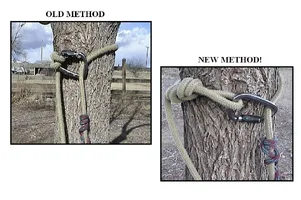
This post hit home with me. Check out my attachment of what I have been doing lately with a clove hitch. While blocking out/chunking out wood I use this to back me up when there is no tie-in point availible.

And of course, I use my lanyard while I do this.

I use this instead of a runnig bowline with an extra long tail. I don't like the running bowline in this situation because it is difficult to pull out after weight is applied to it. So, I use the biner. I only use the clove hitch purely for the sake of speed. When my weight is applied to this it grabs well. And when I need to pull the extra long tail I have no problems at all.

Anyway, this thread has converted me to use a mid-line figure 8 on a bite. It is quick to tie and with the biner it is quick to retrieve.

What do you guys think?
 

Attachments

  • 37407-ChokeMethods.webp
    37407-ChokeMethods.webp
    116.4 KB · Views: 177
The figure 8 is a bullet proof knot, easy to tie and safe.

The only negative is it may be hard to undo when loaded heavily in rigging, but in your application no worries at all as only body weight applied.

I think you have the biner upsidedown in the new way pic though.

Clove hitches suck, just do 2 rounds and 2 half hitches, I am talking about on the timber though not on biners etc.

I have had a few people in the stunt industry tell me they use the figure 8 knot all the time, once again, safe, easy to tie, bullet proof and actually has better rope strength than the bowline ... in other words you lose less rope strength with that knot as the bends in the rope are less acute and friction better dispersed.
 
notahacker-

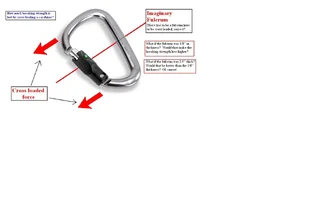
I would seriously recommend not using carabiners to choke your climbing line as you show in both of your pictures. That kind of setup can reduce the carabiners breaking strength by as much as 95% to the point where even a small shock load could break them. Carabiners in general are only designed to bear weight when tension is applied along the long axis. Sideloading and edgeloading result in drastically lower strengths. A shackle or clevis though is capable of being side or edge-loaded without a problem (although they certainly aren't as easy to open & close).

I have also discovered since I fell that some knots are stronger than others. The % of rope strength that a particular knot will maintain is related to the diameter of the bend radii it forces the rope around. The smaller the radius, the more breaking strength you lose. While most of the sources I found were not in exact agreement, most did seem to agree that the figure 8 on a bight maintains more rope strength than any other - around 85%. The bowline though, which I was taught to use to connect my climbing line to my saddle with, can cause a 50% reduction in the rope's breaking strength! The fig 8 on a bight is a little bulky, but I guess nothing is free, huh?
 
Ditto on the clove and its rollout tendencies. I recall, nearly 30 yrs ago, when my crew leader tied off a 100-150 pound short section that was over a roof, holding the line and helplessly watching the hitch roll out. Luckily, the piece held just long enough to swing clear of the roof as it was unrolling and free falling.
 
[ QUOTE ]

That kind of setup can reduce the carabiners breaking strength by as much as 95% to the point where even a small shock load could break them.

[/ QUOTE ]

I respect a person who has fallen 35 feet and lived to tell the story. Please don't take this wrong. I am just doubting the claim. (Need to back up claims like that with documentation)

There are too many variables with this set up and the cross loading to say that there is a 95% loss. Using the facts from the carabiner in the photo (Petzl William) which is 25kN on the long axis and 7kn on the short axis. (In pounds that is 5,625 long axis and 1,575 short axis.)

If what you said was correct, then on the longer axis 95% loss is equal to 281.25 lbs. And the shorter axis 95% loss is equal to only 78.75 lbs. I doubt that is correct!

I agree the is situation should be avoided with large loads, however I don't see a problem with this usage. Besides, I can change to a steal carabiner in that situation to makee it sure proof.

***Don't forget, Sherrill Arborist Supply put this in a magazine as a "quick tip" type of thing. Hopefully they did not over look this cross loading issue. /forum/images/graemlins/wink.gif
 

Attachments

  • 37492-CrossLoadBiner.webp
    37492-CrossLoadBiner.webp
    46.1 KB · Views: 68
The clove hitch IS a crap knot, under test situations apparently. Ontario is in a state of great change with the Ministry of Labour severely scrutinizing our practices. Apparently a commitee of industry reps had some testing done of 2 knot categories, friction hitches and endline/attatchment hitches. The only FH that passed were the TL, BH, Swabbish and the gripping hitch (never heard or seen this one b4)Prussik, Kleimheist passed as FL knots as well. For attatchment knots the clove failed the worst, the one's that passed for open systems were Fig 8 on a bight, cow hitch (picture looks very similar to a girth hitch) 3pl Fisherman's. The ones that passed for a closed system were bowline (why even bother?) 3pl Fisherman's, 2bl Fisherman's, an Anchor hitch, and a Becket Bend????(ever heard of a Becket Bend?)

For the most part I've tried to do a lot of digging to get more info, but the people in charge don't like the people who are up to date with the latest and greatest (I got called a 'gearhead' in a very condescending manner)so I haven't found out alot of test parameters. It is governmental so I will eventually find out. But ultimately their testing conviced them to pull the clove.
 
Good on ya Mangoes (gearhead ha ha)

I climb DRT and the terminal end of my lifeline is always a figure 8. Fast to tie and idiot proof (not that I'm an idiot just piece of mind). And the terminal end of my split tail is a double fishermans with the friction hitch being a Blakes.

You do have to watch the tail of those fishermans knots as they do creep over time, tail is supposed to be 4 x dia of rope or something like that, could be 5x .

Becket bend, well all my research tells me it's like a sheet bend, another name for it, but I dont know how that would be used in the climbing system as it's used to join ropes together. I prefer the Zepplin bend for that anyway.

Regarding that biner set up for coming down a spar I've seen that illustrated in a Petzl indutrial access book too, they used a figure eight where the biner was attached.

The problem is when the spar is small dia and the loading on the biner is like a curved vector as it tries to bend it around the spar ... but I use 50KN steel biners so I dont care when I do it. My whole climbing system is steel all the way, I'm not much for alloy biners, as if that few onces of weight makes a difference but the benefit of piece of mind is far better.

For short decents to the next blocking section etc I just do a running bowline with a long tail.
 

New threads New posts

Back
Top Bottom