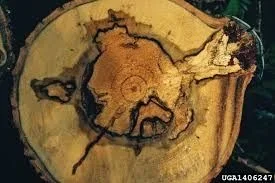
Hypoxylon canker

Location
Shawnee
What are the best practices when dealing with newly infected trees aside from fertilization and watering? I have heard that hypoxylon should be pruned out when discovered and use wound dressing to prevent oak wilt. And I have been told to wait until winter. How fast does hypoxylon move through a trunk and is it worth waiting and risking internal rotting making it to the trunk?
 
I am a little lost as to what you are asking. Hypoxolon (inc. Kretzschmaria) is seen on trunks and limbs of large trees and as such there is no possibility of pruning it out. Black crud on branches may or may not be Hypoxolon, things such as Excidia grandulosa and Daldinia come to mind, you can also add in some of the lichens such as Collema, Leptogium and even Tuckermanella and Tuckemanopsis as species that may be misidentified as Hypoxolon.

As for treatment you can try to strengten the tree through biologically oriented interventions such as fertilizing and soil remediation.
 
Hypoxylon infects heartwood and rots the interior of a branch before the appearance of its signature black fungal spore mats beneath splitting bark. If hypoxylon reaches the truck of the tree there is no cure, just the possibility of improving vigor to prolong the life of the tree before it's inevitable demise. My question is when hypoxylon is discovered in a scaffold branch should it be immediately removed back to solid clean wood or should I wait until winter?
 
The answer to my question depends on the speed at which hypoxylon moves through heartwood. If it moves at a foot a year then I should wait to remove the branch because the risk of infecting the trunk is low. If it moves at ten feet a year I should remove the limb immediately or as soon as fertilization is applied to reduce the risk of the trunk becoming infected.
 
This is interesting. I've never known the Hypoxylon canker fungus (indeed Kretzschmaria deusta for most hardwoods) to occur or move through heartwood, at least not heartwood in the sense of that dark colored core of oak and walnut (and many other species). Maybe it does, but I haven't seen it. It does move through sapwood of Tilia, Acer, Betula, and more at a pretty good clip. Meaning...maybe a meter in a growing season. Your results may vary. Francis Schwarze described it as going through reaction zones/column boundary layers (walls 1,2, and 3 of the CODIT model). I'm open to it going through barrier zones (wall 4 of CODIT), but I don't think I've seen that. As a canker fungus, it kills the vascular cambium so under good conditions (for the fungus), a barrier zone doesn't form because the new cell generator is dead. Although a fast moving, true decay fungus, much of the damage is through erosion and pitting of the S2 secondary wall, although the mycelium itself can grow through the cell lumina (those open pore spaces) of xylem.
I definitely agree with Buckmaster that the growth is extensive prior to mat formation and sporulation, I just think it is growing through sapwood, frequently of species that don't produce heartwood as Shigo defined it.
 
Kevin describes it pretty well, see Schwarze's books (primarily Fungal Strategies of Wood Decay in Trees) and Weber and Mattheck's Manual of Wood Decay in Trees for more info.

I suppose my only point of contention is with Kretzschmaria, I have found it extensively maples in particular with some occurrence in true heartwood developers, it certainly moves into heartwood, whether it travels vertically I am not sure. Kretz is much more extensive than anybody realizes.

Yes S2 degradation, 10% decline in weight 90% loss of strength. A very dangerous fungi that has been implicated in quite a number of tree collapses.
 
I very much doubt you are seeing Hypoxolon as the primary (Most common) decay agent of heartwood decay of oaks. I think you need to do a little more investigation.
 
No that is not likely to be Hypoxolon. The black lines are demarcation lines of individual decay columns as individual strains of the fungus are incompatible.

You photo shows white rot, and a decay patter not expected with Hypoxolon. Even if you consider Kretzschmaria to be Hypoxolon we would expect to see next to nothing or perhaps some indication of soft rot.
 
Last edited:
Buckmaster's photo is definitely showing zone lines, but I'm not convinced it is Hypoxylon decay. I wrote a little section for the Encylopedia of Plant Pathology on zone lines: http://www.nrs.fs.fed.us/pubs/41405.
As for genus vs. disease names: I'm quite at peace with calling the disease "hypoxylon canker" out of respect for years of tradition in forest pathology. I do use the name of the causal agent as "Kretzschmaria deusta". I was not an early adopter of that nomenclatural transfer, but I was won over. No, I do not claim to be an expert on this specific disease, although I've seen it on maple (which does not form heartwood) quite a bit. I'll defer to MrTree on that.
 
Whether you call Kretz a Hypoxolon or not I think that people should know that Kretz was called Hypoxolon deusta, then Ustuiina deusta. and then reclassified as Kretzschmaria deusta (and a few other synonyms as well). As Kevin can attest to keeping up with nomenclature and taxonomy is not an easy task.

Identification to species is not particularly easy without a little more knowledge than black equals hypoxolon. A good starting point is "
Keys to the xylariaceae (excluding anthostomella) of the British Isles"

Kretzschmaria is a serious problem in trees and every single arborist, consultant, tree worker, and climber needs to be farmiliar with it.

That said I think you have a photo of a piece of wood decayed by a white rot decay organism and the black is zone lines or demarcation lines (depending on who you have learnt from)
 
To address the op of what to do, the first step is a positive Identification

If it is truly Kretz, it depends. What is the age and size of the conk, size and location of branch, tree species, good compartmentalizer or not, tree vigor, pruning cycle, etc.

It is a tough pest to fight.
 
I'm a couple of months late to this thread, but I really think some pictures would help. I think Buckmaster and mrtree are talking about two different things.

Oklahoma faced its worst drought since the Dust Bowl about five or six years ago. We had over seventy straight days of 100+ degree temperatures and hardly any rain one summer. Needless to say, a huge number of trees were stressed and became susceptible to various pathogens. Oaks were particularly bad off. Black, gray, and white spore pads appeared on branches all across town and would eventually move to the trunk. In most cases, if it reached the trunk, it was pretty much considered a lost cause.

There are still quite a few lovely specimens standing in people's yards like the ones below. What do you think mrtree? Hypoxylon? It looks nothing like the pictures of Kretz that I found on google. I had never heard of Kretzschmaria before reading some of your post. Then again, you've probably forgotten more info on pest management than I'll ever learn. hypoxylon4.webp IMG_20161018_115345832.webp
 
Well the simple answer is I cannot tell without closer examination, but it is certainly not Kretz or a hypoxolon.

That said I would need far better pictures and preferably samples to examine. To even suggest it is a resupinate fungi is being generous.

I think what these trees show is a species (or more) that are coming in to clean up dead tissues and start the process of decaying wood. There is some benefit to knowing if they are saprotrophs or parasites but not a lot in the trees you show, perhaps in other healthier trees.
 
Agreed, that top pic isnt Hypox or Kretz, perhaps Irpex or something similiar in appearance.
Thats not to say that they are not in your area. In the meantime, do what you can for your customer's trees to avoid or alleviate stressors.
 
Last edited:
Absolutely not Kretzsch, hypoxylon, or other xylaria (in a broad sense)
I agree with Mrtree, not Irpex.
In the interest of being generous, the key characteristics that I'd want to see to "ballpark" it are:
1. Sizes and shapes of the pores: too small to see, tiny but visible, large, angular, sinuous, round.
2. Degree of reflex: (turned up away from the branch on the margins, turned away from the branch in the middle of the mat, imbricate masses?)
3. Mat thickness and texture: thin like paper, thick like a cookie, crisp, brittle, leathery

Fool that I am, I'll say I would start with Antrodia or one of the recent segregates and spiral out from there. If I'm halfway on the right track here, that would be a "cleanup crew" decomposer and not a primary pathogen. Although perhaps not relevant to arboricultural prescription, this is a tough group for experts to ID based on macro- or even micro-characters. what is relevant is that strength loss moves right along with development of the mat. The big kids would want the genetic sequence. I know, that's not much help.

 

New threads New posts

Back
Top Bottom