How to Get Power from a Pulley

Now find the post with those lines in it... :)

Rope stretch plays an interesting role in queing up the pulleys.

Log with a pulley (#2) on top ala double whip, rope anchored above comes down (thru pulley #2) and back up to/thru top pulley (#1) and back down to the guy. Using typical arborist rope and pulleys the tension ratios would be 1.2.

Guy starts tugging to lift the log. The tension at his hand is 1.2x higher than the tension between the two puleys - as long as the log is going up. The tension between the pullleys is in turn 1.2x higher than the rope from pulley #2 up to the anchor. Three different rope tensions and three different amounts of rope stretch.

So the guy stops. And starts to lower. His rope segment starts to lower tension - and unstretch- but the pulley #1 doesn't start to move until his hand tension drops to 1/1.2 x the middle rope segment tension. In getting there it briefly passes through an "equal" moment. Now that pulley #1 is moving its allowing the middle rope segment to begin to unstretch (remember it was the second tightest segment) and the whole process is repeated at pulley #2 until the middle rope tension has fallen so far that pulley #2 starts to rotate - with the 1/1.2 x tension situation. Now the log is lowering and the double whip pulleys are acting as sucky bollards. The lowest tension is now at the guy. The rope stretch(ing) and unstretching sort of sequences the order of pulleys starting/stopping rotating.

You can substitute eg big biner with higher associated tension ratio for pulley #2. It still analyzes the same but different proportiioning.
 
I guess the Spanish Burton would be a bit more efficient than the Handy Billy, due to fact that the first uses only two pulleys, whereas the Billy uses three?
 
Here is, I believe ? , a progress capture Spanish Burton

 
Last edited:
The Burtons/floating pulley(s) have a distance problem;
whereby the floater(s) 'bottom out' before rest of system, ending full system travel.
Best many times, ratchetting into sequential bollard holds as re-extend rig for next 'rope purchase'(Dr. ABoK term) from loaded to unloaded side .
.
i favor for final tightenings the dual input pulley system positions i try to show of the standard end, then the next most powerful position in rig to work in opposing direction. Can go normal end grip for speed to start and dual to tweak/top off. Input force into either, and the other takes a hit too as equal and opposite of that EFFORT (not bodyweight) input. The lesser input position does not get as many friction%. In fact if just 1 overhead pulley and free-hang on opposite end than load (so bodyweight is ballast against target load)and reach to load side pull up on load, that effort direct to load has zero friction+just made self heavier on the other end so total is 1xEffort + (1xEffort+bodyweight xFriction inefficiency).
.
Then if can lock arm to load and leg lift thru cam on the controlling/opposing rope side get leg input 1x direct to load/no friction tax , if arm rigid, + (1xEffort+bodyweight xFriction inefficiency) only are doubling leg, not arm force. Found this while working in DdRT, and is fantastic for climber (helping) preset tension. if purchase can be held, can the try sweat/swig more purchase out. Becomes pre=tighten linearly as setup to swig across now with less rubbery lever...
.
Get super tight and can lay load into some more softly to pre-tighten more before tearoff especially horizontals, especially if hitch is out near CoG for longer lever and more support. Less shock of transfer to rope, the more is pre-transferred to rope before tearoff. Can also get immense side force from slanted rig line to fhold(Netherland betwixt fall and hold!) more gracefully sideways as it goes...
.
Friction is a buffer for rigging, can be foe that buffers your input against load in raising, but friend that buffers load against you in hold and lowering. So 5x rig expect need more than 20# effort against 100# lift; but then less than 20# hold or lower.
 
In the TreeSpyder's picture of the Spanish Burton, a prussic can be added from the anchor to the load side, serving as the progress capture there. Then the second pulley can be prussic to the tail of the purple rope (rather than terminated there as the picture shows), then when you run out of travel, the second pulley can be slid up the tail for another purchase, and begin a new pull from the new purchase..
 
3 typical pulley/pulley set positions: input, output and machine/pivot.
.
In simplest 1 pulley setup can use the 3 positions to show 3 lever classes like w/rigid levers.
class_1 lever: pulley on pivot, redirection of input, same speed
>>the ONLY lever class that can reverse direction between input & output
>>because is the only lever class where the pivot is between input and output
class_2 lever: pulley on output, 2x output against load, at 1/2 input speed and distance;
>>'compresses' distance into smaller, but 'denser'(forcewise) footprint
>>output closest to end pivot.
class_3 lever: pulley on input , 1/2x output against load, at 2x input speed, distance
>>'dilutes' force over longer distance of less 'dense' force per unit travelled.
>>output farthest from end pivot.
.
These also may be seen as like a transmission, 1x reverse and 3 forward speeds: 1/2x, 1x, 2x
>>all just a swap of distance and force to the same distance x force volume
>>previously looked at force output this is outer side of coin of distance output.
No free rides of power or speed or reverse must be able to cover cost$, in fact conversion(friction) lo$$ w/each.
.
Lever_classes_in_standard_rigid_levers%2C_as_applied_to_rope_%27rolling_levers%27.png

(oldy, no gradient inner shadow on rope)
pulleys give flexible/rolling leverage.
.
You start with finite input of a volume, as now 'inherited' into the domain of the scenario
= force x distance as a volume =output - conversion loss.
>>all must balance, conversion loss making up difference etc.
.
arc180 is amazing here as it is in concrete bridge support etc.; same maths.
 
Last edited:
Yup, and there you have it. If you can understand the principles and 3 classes of the lever, then you can understand how a pulley/block can generate MA or simply act as a redirect. That is where I was headed when I posted this thread.

I don't want to get involved with the advantages/disadvantages of friction in this thread, as that deserves a post all of its own.
 
I have been chatting and sharing with Kenny for over 22 years now here on TreeBuzz and I always enjoy his input and diagrams, but even though I have a degree in engineering and physics, I still need to usually read through his content more than once!
 
TYSM guys; always and all ways enjoyed your contributions as well.
.
i know i say stuff differently, am kinda self taught to my views, of a mix of math as i have FELT thru own body(as it's own education, some beyond words) and other things.
As a kid, always jealous younger brother(i wore many of his hand me downs) could draw and i couldn't, so totally L-earned to draw to show what was trying to say about rigging etc.
i work in vectorized graphics to draw, that even the math vectors match the cos:sin subject material to even more re-confirmations many times!
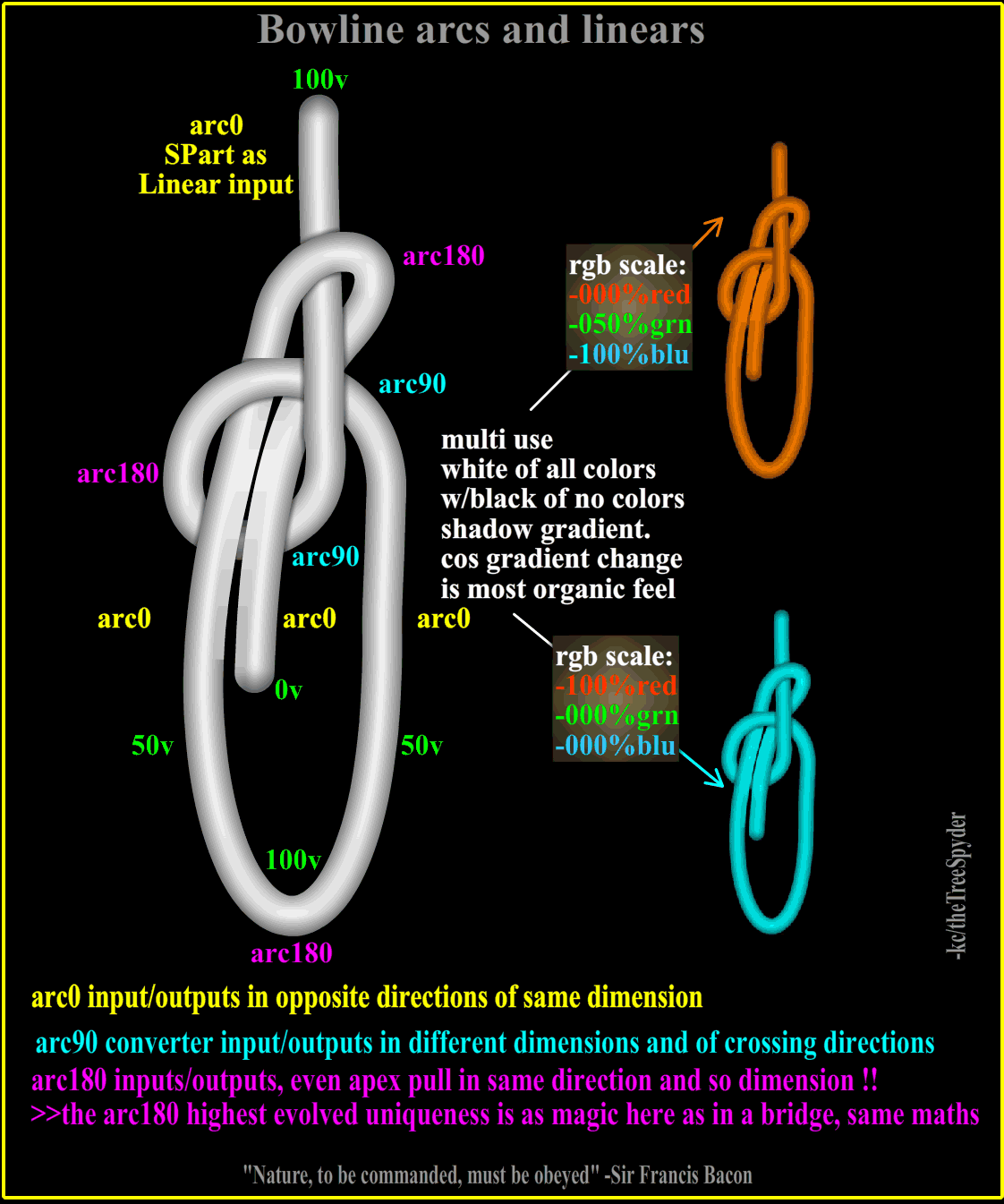
bowline-arcs-and-linears.png

(from other discussion)
All the newer(like this) drawing ropes have evolved to be started/saved as white. Then shadow gradients, inner and outer, save over white; to make any color, even reuse sometimes many times....different colors w/same gradient shadow fades
>>pic shadow gradients are as a sin:cos:sin pendulum swing of dark:light:dark for gradient shadowing. Looks most natural/organic(even flat white looks rounded) as is the organic full to null fade of everything, then back to complete pendulum 'stroke' across of sin:cos:sin waveform. (if add color changes black gradients, but if subtract to leave same color : black - anycolor rgb still = black, affects only white in subtraction!)
.
The whole clock breakdown i throw sometimes to decode cos:sin in 6 degree increments is part of the feel, from doing iron crosses staring across gym at clock now 2(crosseyed in strain), 1 for each arm. Then how Babylonians presented circle with clock.. For decades of free education have read many daily and work things would not have seen without my clock decoder ring; let alone to such depths. The comparative impacts of change per minute from clock decodes even more of what seems have actually felt at high strains of climbing, exercising, work etc.
Not trying to wander, just showing various ways have L-earned and re-affirmed cos:sin(as breathlessly try to explain self/views/expressions/redundancies!); and how then everything found relates to cos:sin of cycle/circle in all these, and then folds back to then so works in greater even expression volumes then in ALL rigging, hinging etc. especially at out level of play!
.
Peace!
PS
To the thread name: "How to Get Power from a Pulley"
Rolling Lever(s) same as for Rigid Lever(s).
Start with a Volume of Power as work input = Force x Distance
And funnel that Volume of Power into a smaller Distance
>>of now more denser Force (now in that smaller footprint).
No free rides, all must be paid for, and tax at every turn of conversions in fact.
 
Last edited:

New threads New posts

Kask Stihl NORTHEASTERN Arborists Wesspur TreeStuff.com Teufelberger Westminster X-Rigging Teufelberger
Back
Top Bottom