
Navigation
Install the app
How to install the app on iOS
Follow along with the video below to see how to install our site as a web app on your home screen.
Note: This feature may not be available in some browsers.
More options
You are using an out of date browser. It may not display this or other websites correctly.
You should upgrade or use an alternative browser.
You should upgrade or use an alternative browser.
How not to tie in
- Thread starter allmark
- Start date

allmark
Participating member
I also was taught that way and did so for alot of years. I was also taught to free climb with 3 points of contact. I dont do that for better ways that are safer.


- Location
- Phila. Pa.
I have a Johnson ball and hook with a much more substantial sprung closure than the hooks you attached. I have a stick crane, I take the climber up with his rope in the hook, he sets the strap and comes down to the ground or gets into position to cut. At this time he has the eye of the strap between his climbing line and the sprung closure of the hook. I don't see how his climbing line is coming out of that hook. It may be "possible" for the rope to come out but treework is inherently filled with alot of "possible" unsafe things. I personally don't think it's safe to be attached to a crane and be controlling that same crane with a remote control that is on the climber. It seems to me their is a chance to accidently hit an undesired function. I guess the remote has a lockout but still, with branches, twigs, losing your balance, etc. From what I have seen on this site that is practiced and accepted. What would the OSHA stance be on that practice? May'be I'm wrong.


- Location
- Linden, New Jersey
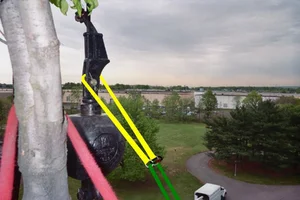
- Location
- Phila. Pa.
Even with this set-up isn't it possible for the friction saver to somehow work its way down between the two adjoining metal pieces and get pinched and possibly cut or sheared. Probably highly unlikely but still "possible".

- Location
- Bloomington, Indiana
[ QUOTE ]
I couldn't find the picture I wanted, so I improvised with paintshop. This is one method I've used most of the time. I've worked with smaller cranes where the friction saver rings don't fit through that spot.
[/ QUOTE ]
That's not a good option. Not only is that a pinch point (as brushbandit noted), but, because of the moving parts, that part of the ball has grease, which collects dirt, and the grease and dirt are then loaded to the FS. The attachment shows an example.
The following quote is from the Z. Note the last part of the sentence:
[ QUOTE ]
5.7.9.3 The arborist climbing line shall be secured to the crane in such a way that it
does not interfere with the function of any damage-prevention or warning
device on the crane and so that no part of the crane compromises the climbing
line or any component of the climbing system.
[/ QUOTE ]
I couldn't find the picture I wanted, so I improvised with paintshop. This is one method I've used most of the time. I've worked with smaller cranes where the friction saver rings don't fit through that spot.
[/ QUOTE ]
That's not a good option. Not only is that a pinch point (as brushbandit noted), but, because of the moving parts, that part of the ball has grease, which collects dirt, and the grease and dirt are then loaded to the FS. The attachment shows an example.
The following quote is from the Z. Note the last part of the sentence:
[ QUOTE ]
5.7.9.3 The arborist climbing line shall be secured to the crane in such a way that it
does not interfere with the function of any damage-prevention or warning
device on the crane and so that no part of the crane compromises the climbing
line or any component of the climbing system.
[/ QUOTE ]
Attachments

climbhightree
Branched out member
- Location
- Lebanon, Pa USA
Here is TCIA article write up about it...
http://www.tcia.org/PDFs/TCI_MAG_March_07.pdf
go to page 44
I use a shackle on the main line, above the ball. And I use zip ties and/or cotter pin to make sure shackle can't unscrew/ Plus a zip on fs rings.
http://www.tcia.org/PDFs/TCI_MAG_March_07.pdf
go to page 44
I use a shackle on the main line, above the ball. And I use zip ties and/or cotter pin to make sure shackle can't unscrew/ Plus a zip on fs rings.
- Location
- Linden, New Jersey
"Even with this set-up isn't it possible for the friction saver to somehow work its way down between the two adjoining metal pieces and get pinched and possibly cut or sheared. Probably highly unlikely but still "possible"."
"That's not a good option. Not only is that a pinch point (as brushbandit noted), but, because of the moving parts, that part of the ball has grease, which collects dirt, and the grease and dirt are then loaded to the FS. The attachment shows an example."
----------------------
I see your point, and agree. Not trying to start an argument, just stating why I felt safe with this setup when I used it. That's one reason why we're here, "constructive criticism".
On this particular crane block, there wasn't really any space between the adjoining pieces of metal for the thickness of the fs to get wedged into or pinched. There wasn't any grease contact either. This was a new crane and maybe it wasn't greased at that point. I know the swivel is greased, but due to the angle at which the fs hangs, there wasn't contact. I wouldn't have put it there if it would get greasy, I like to keep my equipment as clean as possible. I get pi**ed off when someone steps on my rope. My fs was (lost it since then) in far better condition than the one in your attachment, I would retire that one. The carabiner was just to keep the fs in place when not in use.
Crane blocks do vary in construction and condition though. I can see the possibility of pinching and grease/dirt on other cranes. Also, there could be sharp edges on an older block.
I've used the shackle method also and agree that's a better option. I used another method also, but I'll get back to that later. By the way that was a Link-Belt RTC-8040 crane.
"That's not a good option. Not only is that a pinch point (as brushbandit noted), but, because of the moving parts, that part of the ball has grease, which collects dirt, and the grease and dirt are then loaded to the FS. The attachment shows an example."
----------------------
I see your point, and agree. Not trying to start an argument, just stating why I felt safe with this setup when I used it. That's one reason why we're here, "constructive criticism".
On this particular crane block, there wasn't really any space between the adjoining pieces of metal for the thickness of the fs to get wedged into or pinched. There wasn't any grease contact either. This was a new crane and maybe it wasn't greased at that point. I know the swivel is greased, but due to the angle at which the fs hangs, there wasn't contact. I wouldn't have put it there if it would get greasy, I like to keep my equipment as clean as possible. I get pi**ed off when someone steps on my rope. My fs was (lost it since then) in far better condition than the one in your attachment, I would retire that one. The carabiner was just to keep the fs in place when not in use.
Crane blocks do vary in construction and condition though. I can see the possibility of pinching and grease/dirt on other cranes. Also, there could be sharp edges on an older block.
I've used the shackle method also and agree that's a better option. I used another method also, but I'll get back to that later. By the way that was a Link-Belt RTC-8040 crane.
Attachments
- Location
- Linden, New Jersey
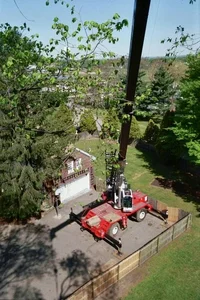
Alright, I'll throw this one in for discussion. Using a eye&eye or a webbing sling, make a prusik on the upper part of the hook. Then attach a carabiner & pulley for the rope. It keeps everything away from the grease/dirt problem. It also stays in place above any slings on the hook. Any comments for dangers/benefits?
I had a little more fun with paintshop for this one.
I had a little more fun with paintshop for this one.
Attachments

- Location
- St. Paul, MN
Nice art! You need to be tied in with a seperate and dedicated TIP attached to the load line above the ball/hook. Times are bad enough with enforcement; just tie in as ANSI/Industry Best Practices recommend and we'll all be happier for it.
I personally will not tie in to the hook because... it's dirty; it doesn't auto-lock; even if it did auto-lock I have to open the gate to install slings; it can get crowded in the hook and I don't want my friction saver getting pinched, especially with multiple slings; it's just plain better to tie in above the ball!
I personally will not tie in to the hook because... it's dirty; it doesn't auto-lock; even if it did auto-lock I have to open the gate to install slings; it can get crowded in the hook and I don't want my friction saver getting pinched, especially with multiple slings; it's just plain better to tie in above the ball!

- Location
- Northern California
I do like the use of a pulley instead of the friction saver. That is just my own opinion. The bend ratio in a pulley is by far greater then with either a shackle or two rings.
Reasons why not to use a pulley?
Reasons why not to use a pulley?
- Location
- Linden, New Jersey
Thanks for the art comment. I don't use this setup. I might have used it a couple times a few years ago while experimenting. Just posting because it might be a good example of "How not to tie in".
I'll attach the crane block artwork for anyone else who wants to use it in paintshop to show different setups.
I'll attach the crane block artwork for anyone else who wants to use it in paintshop to show different setups.
Attachments
New threads New posts
-
test
-

-
-

-
First time rope and harness tree climber shows the best attitude
- Started by moss
- Replies: 7
-

-


