How do you attach lines?

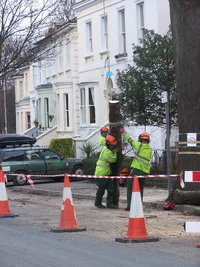
I was doing a fell with a couple of fellas the other day... it was a well knarly lombardy poplar, not easy, let me tell you. Backyard, no access... the works.

The job was with Alan, a friend from Ireland we do a lot of work with and Kai Busemann, for those of you who know him. Kai is very experienced arborist, has been around a long time and done his bit for the climbers' scene, so it was fun doing this job together.

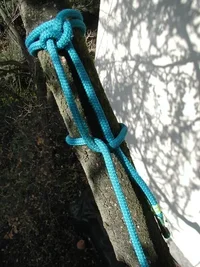
During a break Kai quizzed me on the reason for not using running bowlines to attach pieces. When I thought about it, I realised he was right, it's actually really rare that I'll use one. I prefer a backed-up clove hitch. Why? Well, I like the way it cinches up tight against the limb. A Buntline'll do the same for you, but it's harder to undo when it's been loaded.

Then I wondered, do you also do this (see attached pic)? By leaving the end slighty longer, you can tuck it under the half hitch in front of the clove hitch. So, you have a half hitch backing up the clove hitch, the tail tucked under the half hitch to prevent roll-out of the clove hitch - a double back-up! I feel pretty safe with that, and there's very little risk of it slipping on a low diameter limb.
 

Attachments

  • 21058-P3110157.webp
    21058-P3110157.webp
    68.2 KB · Views: 278
I prefer the running bowline cause i can tie very quickly and easily, and because it was the primary knot I "learned" to use, and it releases easily after being loaded. Ill use the timber hitch on larger pieces,(usually blocking) where i know the hitch will seat evenly across the piece.
I dont use the clove hitch because of the need for a back-up, a properly tied bowline ive found to be sufficient most of the time.
 
I also learned to rig with a runnin bowline. On heavy or slippery loads a marl of half hitch to spread the load and add security. I never understod the benefit to a clove. I do see it used alot and it seems to take longer to tie and uses more rope plus it seems harder to tie, dress, and set? Why not use it(a bowline) Bend ratio? Open minds want to know.
 
Hiya Tod,

yes, I agree, the standard set-up we teach would be half-hitch first, followed by bowline or timber hitch.

My question is why is this? I'm not sure I'd agree with the difficulty of tying, dressing and setting. Don't you think that the timber hitch - one of the knots taught as standard - is a knot that's greatly misjudged in terms of ease of tying? Looks easy, can't go wrong. Well, I've seen that knot tied sloppily so many times... all wraps bunched up around the bight for instance. No, I don't think that's such a strong reason against the clove.

Takes more line, yes. I do switch to timber hitch on high dia lumps of wood.

Bend radius? Well, there my feeling would be the clove wins hands down over the bowline. Mind you, if you start the knot off with a half hitch, I don't know if bend radius really comes into this, that'd be more on a straight pull.
 
For light loads I tend to use slings. I take four up the tree and use as many as I need for each drop. Attaching them to the line via a rigging plate. I was taught to tie a timber hitch and half hitch and keep it simple, i.e. less karabiners etc in the system. I agree with this thought, but with smaller loads and lots of them in a day, it seems to me that a chockered sling with half hitch is quicker as you don't need to estimate how much rope to use and you can tie the next section while the end of the rope is on the ground with the last section. Multiple branches can easily be attached this way.

In the picture is one section tied with just a chockered sling as it was to big for a half hitch. Much bigger than this and I would use two slings chockered in opposite directions. For the really big stuff I would go back to timber hitch and half hitch. There was no shock loading in this particular situation and in most cases lines are pre tensioned using GRCS. Only when there is significant shock loading possibilities or really big stuff would I use knots. Am I wrong in doing this? I guess the weakest point here is the bowline on the end of the line but by either pre tensioning or having ground crew that let it run we still remain within SWL.
 

Attachments

  • 21066-6.webp
    21066-6.webp
    540.1 KB · Views: 233
Hey Rupe,

love the Proclimber sticker on the car in the background, ye crafty bugger! Caroline'll love ya! /forum/images/graemlins/wink.gif

Off the top of my head, one thing I'd mention looking at the picture - besides the sticker - is there seem to me to be many points where you might get cross-loading, don't you think? Krab in large eye of bowline, krab in rigging plate... I agree, there is a place for hard-ware in rigging, but you do have to consider it carefully! (Which I'm not saying you haven't)

Personally I tend to do some jobs purely with knots and others with copious amounts of bits of metal based on... mood, I suppose (and the situation on site, naturellement!).
 
Good points and good eyes!! (I'm sure Caroline loves me, she has my credit card number tatooed on her arm!!) Yes cross loading was the reason I was taught not to use hardware, but, if like I said, loads are pre tensioned then you can check all is well before cutting. I do use knots with all types of freefalling objects unless really small tops, so hopefully all is well. In answer to your original question then, timber hitch and half hitch but running bowline if I'm having trouble reaching the desired tie point, and then would usually have half hitch also. Used clove hitch a few times in the past but had complaints from groundies and we need to keep them happy!
 
i think force direction and axis in consideration to the load is always imprtant in rigging. For pulls perpendicular to the spar, running bowline, i don't see how a clove would tighen down better than that. For pulls inline/paralell with the spar as a direction, precede with half hitch. Same with any eye; when pulling in line/ parralell always precede with half hitch. i think the preceding half or other coils is the proper way to pull along the length of an item, and also buffers loading to the weakest point, the joint of the knot. Our friction hitches are pulls inline/parallel to the host of lifeline, and ar the coil/ half hitch type described for pulls along a spar/ paralell. as the diameter of the spar increased a running bowline taking less line for perpendicular pulls)

i think the strength of the Clove Hitch as determined by primary loaded bend would logically be dependant on the size of the host spar. A bowline around strength would be set by the bend in the knot as primary to the bend to the wrap around load, until the attatchment to load was a rib of metal/ almost sharp. Being as that is loaded the same as to knot; and nothing is constant, all gives way to another consideration at some point; the sharpness of the hitchpoint causing sharper bend than the knot, being that other consideration here i think. A running bowline's strength i think would be limited by the angle of bend that the eye placed on the standing part as the standing part reeved thru the eye.

i think of a Timber Hitch as a form of Backhand Hitch; and as such you you should seat and maintan pressure with the bitterend making it back around to trap at point 5 o'clock (and perhaps beyond) on a firm convex points, beggining with a 12o'clock pull, first turning clockwise on wrap.
 
Wow! Very enlightening gentlemen. As I have mentioned in other posts I get the pleasure of teaching arborist apprentices in the winter months. First year students are not taught rigging, we focus on climbing and pruning. Second year apprentices are taught ALOT of rigging. As a teacher we have a standard list of generally appropriate knots.
1. Light Rigging Tie Off- Running Bowline
2. Heavy Rigging Tie Off- Marl or Marling 1/2 Hitch w/clove & 2 halves or Running Bowline
3. Rigging Sling Aloft- ONLY a Cow Hitch
4. Rigging Sling @ Ground- Cow Hitch or Timber Hitch

We are very hesitant to use a timber hitch in any rigging scenario where a load may experience dynamic characteristics that cause the timber hitch to be loaded towards the wraps. We teach that one can only really trust a timber hitch in the 180 degrees from the bight....90 up and 90 down. But thats in an environment where everything needs to be black and white. When I'm out in the field I'm a real big fan of the Halter Hitch. Great for light rigging, and groundies love the ease by which its undone. I'll even use it when rigging bigger wood, just have to ensure that its preceded with a marl.
 
We mostly use tenex spliced into endless loops. we girth hitch them (sometimes with a marl too). This works really well with a ladder hook spliced onto the rope.
Got the idea from Norm. I've been using it for coupple years now and love it. It's low on extra hardware, very efficient, and strong. On large wood I use a running bowlone often backed with a half-hitch or a marl.
 
The ones from sherril are rated at or above 5000 lbs. So don't get too overly aggressive. I found a similar hook used on cranes thats rated over 10,000. it's not too heavy either. I'm now thinking about using a doubble locking snapshackle from layline. it looks like it might work very well.
 
180 degrees(6 oclock form 12 o'clock pull) around from the standing part pull (and bight in timber hitch, cow etc.) is good rule of thumb for making sure the bitter end of the line gets 'nipped'. Actually picturing as a box of 4 sides of pull; the whole knot as a system is pulling the same diretion as the standing part's pull, so 180 pulls tight(bottom of box of pulls, trapping into the spar. The sides of the spar (3 and 9 o'clock) would be pulling towards the standing parts pull too, but this is not a trapping direction against spar. 5 and 7 o'clock are about the same trap against spar as 6 in this 'box' imagery of pulls.

i think a 2nd directional pull influnce can free the bitterend from being pinched that should be considered. In addition to the standing part's load pull direction, there is also the directional pulls of the line around the host spar. Also, a consideration of 6o'clock /180 on a convex (which this must be to work, at least at main trap point) to be a key point in the way the line tracked around and was secured, as it is the most pinch direction

But 180 (6 o'clock from a 12 o'clock standing part pull), is on the top of the hill/curve, and the pull direction of line around the spar (assumimng a clockwise initial turn), can unseat that hitchpoint, from the top of the hill, 'travelleing' the line down the hill in the direction of the line lacing around spar. i think that the 5 & 7 o'clock positions have about the same pressure trapping into the spar by the forward pull of the standing part(above paragraph). But, are more advantageous a pinch/nip to sieze/hitch the final bitterend, in that the pull direction of the line around the spar, in that the 5, 7 o'clock positions can trap into the hill at 6 as the pinch forward into the spar.

In general for turn, roundturn and crossed turn based lacings, i think the 7o'clock position traps into the spar from a forwrad pull of the standing part, and traps into the 'hill' at 6 o'clock as the loaded line pulls around slightly, tracking the bitter end. If that trap was at 6, i think it is easier to pull free/ falling off the hill in the direction of the line slippage/ stretching as being worked. The direction from a clockwise turn, would pull towards 5 o'clock, so even though 5o'clock has about the same tension trapping forward; this choice is poorerer from the force direction of the line pulling around spar.

Conversely, in examples where the clockwise turn is reveresed with a backhand hitch as a base (still as many turns/grips as a round turn as a base, only positioned different), i think 5 oclock is correct to 'nip' the bitterend. On a turn that started clockwise, then reversed (timber, cow etc.) to counterclockwise, trapping a would give as much forward pressure as 7, but if the standing part 'drew' the bitterend along, it would actually tighten the 'eye' /bight the standing part reeves thru. a Backhand hitch base, complicates things some, for it reverses and thereby has 2 diretcions of line lacing pull round the spar. The Standing Part's and the Eye/Bight's reversed pull. Making 7o'clock a much worse choice to pinch/sieze/nip the bitterend of the line, to secure the knot of a backhand hitch base.
 

Attachments

  • 21121-TimberTensionBest.GIF
    21121-TimberTensionBest.GIF
    58.2 KB · Views: 108
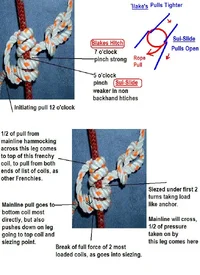
Same theories of 2 different directional forces in line, the load pull, and the line pull; to explain differance between Blake's and Sui-Slide / last mistake knots!
 

Attachments

  • 21122-Blakes Look.webp
    21122-Blakes Look.webp
    117.1 KB · Views: 99
[ QUOTE ]
During a break Kai quizzed me on the reason for not using running bowlines to attach pieces. When I thought about it, I realised he was right, it's actually really rare that I'll use one. I prefer a backed-up clove hitch. Why? Well, I like the way it cinches up tight against the limb. A Buntline'll do the same for you, but it's harder to undo when it's been loaded.

[/ QUOTE ]
You might also try the Timber Hitch with the rope making a full round turn of the
loaded end before being tucked back under/around itself ("dogging" the end).
This round turn will give you a sort of friction nip such that you can set the
hitch snug to the object (within reason of how much jostling it might endure).
(It's rather dismaying how badly this simple knot (Timber H., i.e.) has been
presented in some knots books--all wraps of the end up by the loaded side of
the object, e.g.!).

FYI, although it consumes more rope, one can tie a marline hitch in the bight
(and thus, after the end knot).

*knudeNoggin*
 
Hey Mark,
I use the marline hitch, then a running bowline. Have been using the yosemite tie off lately(Yosemite bowline). I have never had a running bowline capsize or become untied when I've 1st tied either a half hitch or marline hitch.
On small stuff, we use loops and a lowering line with a locking ladder snap spliced on it.
 

New threads New posts

Back
Top Bottom