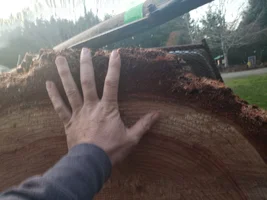
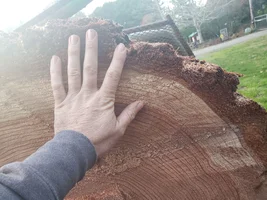
How do you “ethically” ascend redwoods with weak anchor branches?

Love it, is that you up on the trunk? These trees are absolutely doable for line setting, the most challenging for sure. When you get new tubing on your big shot try shooting with a 10 or 12' pole, use a full 8' pole (no sections) then put a 4 section on top. You can set up a "pull and hold" with a Klemheist hitch tied with accessory cord on the lower pole, tie a strong non-locking biner to the hold down, put a quick release on the loop of your slingshot pouch. Wichard snap release is the rock on, rock solid snap release despite everyone wanting to cheap out on shitty dog snaps from the hardware store etc. The Wichard snap release is a lifetime tool, will never fail or piss you off. I put a small/strong pear shaped quick link on the bottom eye of the Wichard snap release. Slide the hold down up the 8' section, pull the tubing down grabbing tubing just above the pouch, clip the pear link on the sanp into the Klemheist/carabiner hold down. Pull down and keep going push it down, you can go 6x the slack length of latex tubing. Get comfortable, sight up the pole, keep you upper hand on the back of the pole unless you like getting your knuckles smacked and fire accurately exactly where you want th bag to go. On a good day you can get accuracy within a 1 and 1/2 to 2' circle at 100+ feet with a small amount of practice. Air temperature effects latex tubing performance, above 50f all good, below 30f you need to prewarm in your truck cab to get the high shot, and be quick about it, I wrap the sling head in a hoodie or whatever and don't take it off the sling head until I'm about to fire.

All of you might already know all that, spelling it out to be clear because each detail makes a difference getting an accurate high shot. Using a pull and hold w/snap release improves your accuracy exponentially on a max 6x sling pull, I don't care how much of a rock star you are ;-)

I take the stock tubing off a big shot, use a slightly lighter tubing spec and tune the slack tube length so I can put it to the very bottom of a ten foot pole close enough to 6x length tubing extension ratio. If anyone's interested I'll post the tubing spec.

In this video one shot into a 145' woods white pine with an extensive deadwood zone guarding the first live limbs. You can see the quality of the anchor when I get to it. Doesn't always go that well, (you can hear the hit on a limb, got the good deflection that time) but you can get it in no more than 3 throws most of the time. Feel free to laugh at my ascent system, video is dated on Vimeo 2013 but was shot earlier before I was climbing rop wrench. Microcender with short tether and long foot loop, and hitch below it is the ascent system. Used a bungee HUT to move the Microcender up as I climbed. Same climbing system/slingshot setup was used to access and climb off the grid big PNW old-growth 2010, worked great.


-AJ
No this is the owner of the company. My line had 3 nicks in it and was cut into 3 ropes upon inspection yesterday morning , no climbing fo me. Ok I will def get a longer stick then, and either get a trigger or mod one like you suggest. But my biggest unknown is navigation of 60-80ft of shades out deadwood with a line. Period . Also the redwoods don’t seem as secure as a pine or doug fur they pop out easy , I wouldnt trust very many single redwood branches (unless the were substantial or very obviously attached strong. These 2/3rd gen seem to have small , spindlely , and weakly attached branches.
I would say if I could come up with a way to cinch the trunk (and fast )somehow, I’d be golden .
 
Dude your suggested setup for shooting lines in Reds is a recipe for disaster. If SRT in 2nd growth Reds is what you seek an APTA and a pair of binoculars is a must. It will take hours and hours of practice with an APTA, a throw line, and a 14-16 oz throw ball before you will be able to consistently hit your mark, and hours after that before you will come to understand when you can, and more importantly when you can't employ SRT on a given climb... If you get ahead of yourself you are setting yourself op for serious injury or worse. 2nd growth Reds are a completely different animal than a Fir, Pine, or even an old growth Red, and as such take a very specific skillset to work with in a safe and efficient manner.

I have been wreaking Reds for over 40 yrs and only started using an SRT setup in the last 2-3 yrs. It can be a game changer for sure, but you MUST understand that SRT cannot and should not be used in Reds 100% of the time....


If you don't already know how to properly roll a flip-line I would highly recommend that you do so. Once you can do this efficiently you can employ the technique along with a rope walker setup to ascent SRT without worrying about a fall should your TIP fail....

Thank u and I appreciate it . I was in the field today going over the dynamics with a coworker and we def came to the same conclusion, not all of these trees can be climbed SRS ( or at least not in a timely fashion) and base it on a judgment call of specific trees that a line can be placed, customer needs, and tree condition. As much as I’d like to say they can all be done SRS. I don’t believe they all can be on a reasonable time frame in a job site setting while staying competitive. This of a huge interest to me because my partner and I are starting a small specialty service , removing hazard limbs and other small jobs, we want to be able to deploy a fast and accurate climb line , ropewalk up (zero spikes) and remove said hazardous limb. But to build a company we need to stay up on current tech , and follow good practices while competing to do 3-4 jobs a day
 
I was not commenting on your post nor your skill set Moss. Your skill as a climber speaks for itself (in a good way). My comment was pointed towards Ptstreeguys idea of shooting a line over some dead limbs, then taking that same line and shooting back over the tree.. A fucking disaster in the making......Trust me....
No over again around the other side so that the line would go completely around the actual tree
 
Love it, is that you up on the trunk? These trees are absolutely doable for line setting, the most challenging for sure. When you get new tubing on your big shot try shooting with a 10 or 12' pole, use a full 8' pole (no sections) then put a 4 section on top. You can set up a "pull and hold" with a Klemheist hitch tied with accessory cord on the lower pole, tie a strong non-locking biner to the hold down, put a quick release on the loop of your slingshot pouch. Wichard snap release is the rock on, rock solid snap release despite everyone wanting to cheap out on shitty dog snaps from the hardware store etc. The Wichard snap release is a lifetime tool, will never fail or piss you off. I put a small/strong pear shaped quick link on the bottom eye of the Wichard snap release. Slide the hold down up the 8' section, pull the tubing down grabbing tubing just above the pouch, clip the pear link on the sanp into the Klemheist/carabiner hold down. Pull down and keep going push it down, you can go 6x the slack length of latex tubing. Get comfortable, sight up the pole, keep you upper hand on the back of the pole unless you like getting your knuckles smacked and fire accurately exactly where you want th bag to go. On a good day you can get accuracy within a 1 and 1/2 to 2' circle at 100+ feet with a small amount of practice. Air temperature effects latex tubing performance, above 50f all good, below 30f you need to prewarm in your truck cab to get the high shot, and be quick about it, I wrap the sling head in a hoodie or whatever and don't take it off the sling head until I'm about to fire.

All of you might already know all that, spelling it out to be clear because each detail makes a difference getting an accurate high shot. Using a pull and hold w/snap release improves your accuracy exponentially on a max 6x sling pull, I don't care how much of a rock star you are ;-)

I take the stock tubing off a big shot, use a slightly lighter tubing spec and tune the slack tube length so I can put it to the very bottom of a ten foot pole close enough to 6x length tubing extension ratio. If anyone's interested I'll post the tubing spec.

In this video one shot into a 145' woods white pine with an extensive deadwood zone guarding the first live limbs. You can see the quality of the anchor when I get to it. Doesn't always go that well, (you can hear the hit on a limb, got the good deflection that time) but you can get it in no more than 3 throws most of the time. Feel free to laugh at my ascent system, video is dated on Vimeo 2013 but was shot earlier before I was climbing rop wrench. Microcender with short tether and long foot loop, and hitch below it is the ascent system. Used a bungee HUT to move the Microcender up as I climbed. Same climbing system/slingshot setup was used to access and climb off the grid big PNW old-growth 2010, worked great.


-AJ
I fully respect your “leave no trace” style of rec climbing moss.
 
Dude your suggested setup for shooting lines in Reds is a recipe for disaster. If SRT in 2nd growth Reds is what you seek an APTA and a pair of binoculars is a must. It will take hours and hours of practice with an APTA, a throw line, and a 14-16 oz throw ball before you will be able to consistently hit your mark, and hours after that before you will come to understand when you can, and more importantly when you can't employ SRT on a given climb... If you get ahead of yourself you are setting yourself op for serious injury or worse. 2nd growth Reds are a completely different animal than a Fir, Pine, or even an old growth Red, and as such take a very specific skillset to work with in a safe and efficient manner.

I have been wreaking Reds for over 40 yrs and only started using an SRT setup in the last 2-3 yrs. It can be a game changer for sure, but you MUST understand that SRT cannot and should not be used in Reds 100% of the time....


If you don't already know how to properly roll a flip-line I would highly recommend that you do so. Once you can do this efficiently you can employ the technique along with a rope walker setup to ascent SRT without worrying about a fall should your TIP fail....

Answer me this... can most redwoods be climbed without spikes. I'm not talking production, as we all know there are many who can be at the 90' mark gaffing up a tree by the time someone has a throw line set raising a climbing line (if they make their first shot). I'm also assuming a fairly practiced person at setting a line, via slingshot, air cannon, or even bow and fishing line.
Say give it an hour to set a line, could 90% of second/third gen reds be climbed via rope and flip only? Give it two hours set up time could 95% of them be climbed?
I know the ones where your looking at 100' to the first green shaded out spindly limb would take more time, and certainly more if in a thick stand.
 
Answer me this... can most redwoods be climbed without spikes. I'm not talking production, as we all know there are many who can be at the 90' mark gaffing up a tree by the time someone has a throw line set raising a climbing line (if they make their first shot). I'm also assuming a fairly practiced person at setting a line, via slingshot, air cannon, or even bow and fishing line.
Say give it an hour to set a line, could 90% of second/third gen reds be climbed via rope and flip only? Give it two hours set up time could 95% of them be climbed?
I know the ones where your looking at 100' to the first green shaded out spindly limb would take more time, and certainly more if in a thick stand.
I would say that with enough time to set up and the right gear I’m sure 90% of the reds could be climbed spikeless but 1 hour in any of the situations I have seen would be nigh impossible and probably lucky to do it in 2. That labyrinth of dead wood and that throw line will cause serious issues , snags , exc as u know and the angle of the shot combined with the proximity to other trees. I’d say within a few hours I could get a line cinched around the trunk to ascend spikeless. Possibly faster with a crossbow but I don’t know enough bout em to speak on thst.
 
I would say that with enough time to set up and the right gear I’m sure 90% of the reds could be climbed spikeless but 1 hour in any of the situations I have seen would be nigh impossible and probably lucky to do it in 2. That labyrinth of dead wood and that throw line will cause serious issues , snags , exc as u know and the angle of the shot combined with the proximity to other trees. I’d say within a few hours I could get a line cinched around the trunk to ascend spikeless. Possibly faster with a crossbow but I don’t know enough bout em to speak on thst.
I’m not talking about isolating the trunk.
However, if you are wanting to knock out 3-4 jobs per day, and you think your are looking at a two hour line set time you’re dreamin. At best with little travel time, little bs client time you will be super lucky to get two jobs done in a day.
 
Contemplating using a technique you are unfamiliar with, that would result in risking your life to "ethically" remove a tree limb is insane on many levels.

Spending two hours setting a climbing line, is something you do on weekends for practice, or maybe an expedition climb, not on a work site.

People here can only give you histories of what has worked for them...tools and techniques, to those specific trees and locations.

I don't see any shortcuts to your question. Only with practice and progressive experience will you get the answer. At that point, you will know, with your first walk around, what can and cannot be done with that particular tree. If you are interested in SRS, maybe think of learning on something other than one of the tallest trees in the world.
 
Answer me this... can most redwoods be climbed without spikes. I'm not talking production, as we all know there are many who can be at the 90' mark gaffing up a tree by the time someone has a throw line set raising a climbing line (if they make their first shot). I'm also assuming a fairly practiced person at setting a line, via slingshot, air cannon, or even bow and fishing line.
Say give it an hour to set a line, could 90% of second/third gen reds be climbed via rope and flip only? Give it two hours set up time could 95% of them be climbed?
I know the ones where your looking at 100' to the first green shaded out spindly limb would take more time, and certainly more if in a thick stand.
Firstly, I can't overstate just how truly untrustworthy the limbs on a 2nd growth Red are. Their downward growing nature can make it virtually impossible to get your line in near the trunk, and combined with their utter lack of any strength they are a SRT disaster waiting to happen. I also can't overstate just how much a Redwood is utterly unaffected by spurs. Put all you pre-conceived Arb notions aside, because these trees simply DO NOT care.

To answer your question Evo, I would say one would be having a very good day if they could do 50% of their 2nd growth Reds spurless, and 1/2 of those trees would probably need to be climbed employing Richard's "rope walking with a flip-line technique". In the end what the OP is envisioning is taking a simple little 15-20 minute deadwooding climb and turning it into a 3+ hour sketchy, die if you fuck up, shit show. All in the spirit of ethics? Thanks but I think I'll pass....
 
Contemplating using a technique you are unfamiliar with, that would result in risking your life to "ethically" remove a tree limb is insane on many levels.

Spending two hours setting a climbing line, is something you do on weekends for practice, or maybe an expedition climb, not on a work site.

People here can only give you histories of what has worked for them...tools and techniques, to those specific trees and locations.

I don't see any shortcuts to your question. Only with practice and progressive experience will you get the answer. At that point, you will know, with your first walk around, what can and cannot be done with that particular tree. If you are interested in SRS, maybe think of learning on something other than one of the tallest trees in the world.
Leave it to DSMc to get right to the bone!!! I suggest that in the future all silly ideas and suggestions are run through DSMc first, so he can thoughtfully discard them. Might save this forum pages and pages of inane and downright misinformed dangerous conversations?
 
Last edited:
An extremely fast growing Red with some seriously thin bark..The habits of a planted tree or one that is out of its natural environment? If you don't mind me asking Megavit, where u at?
Crescent city California. I have seen some really thin barked ones too. They are usually alot smaller. This one was 140 feet tall. Had 2 tops that started about 54 feet and 1 side ripped off down to 12 feet from the ground.
Redwoods are tricky to work for sure.
 
Reds are generally an extremely fun and forgiving tree to work with, but they are definitely not conducive to setting lines and SRT ascents...One must developed a very specific skillset and proceed with caution if SRT rope walking is something they want to do on a daily basis while working with Redwoods....
 
For pruning on super tall skinny poles the SRT win can be for the situation where you put some effort in setting a good high anchor and then are able to redirect through and work multiple trees in a group. After the “slowness” of the first setting the work efficiency can be excellent. It’s surprising how well you can reach other trees that you at first think are too far away, with a grapple or throwing hook.
-AJ
 
Obviously a completely different game but when I see that I have a tall pine near a sketchy takedown or a super hard to access prune situation it is game on, start shooting the bag high up into the pine, it’s more than worth the time it takes to get the right setting. And sometimes it’s one shot, a little fiddling and you’re ready to work.
-AJ
 
I see lots of insightful comments on this thread and I believe we've answered the initial question regarding various ways to set climbing lines as needed to access younger redwoods, using BigShots with extended poles, air cannons, etc., as well as, ways to set basal anchors when unable to get a direct unobstructed line into a canopy. Of course, there's also the general rule of "thigh", regarding the safe size of limbs worthy of supporting a loaded climber's weight being the same or larger than the diameter of the climber's thigh, but that's not 100% safe either and of course, one should always thoroughly bounce test a climbing line, since any limb has the potential to be unsafe, especially downward facing ones. We can probably all agree on the fact that every tree poses unique challenges when it comes to just removing deadwood, positioning and not felling a tree, more so for newer climbers, but when it comes to climbing trees, whether for recreation or for production, tree climbing is still tree climbing, no matter who is doing it.
 
Last edited:
The OP had a very specific question concerning SRT climbing on a very specific species of tree.
A whole lot of answers from folks with no experience concerning the specific matter in question. Good way to get this fella fucked up or worse...

News flash folks. 2nd growth Reds do not have thigh sized limbs!!!!! The best one can generally hope for is 3"-4", and that WILL NOT support a climber. WTF we gonna do now? Sounds like a new game plan is in order?
 

New threads New posts

Kask Stihl NORTHEASTERN Arborists Wesspur TreeStuff.com Teufelberger Westminster X-Rigging Teufelberger
Back
Top Bottom