How did you go about learning to limb walk?

Winchman

Carpal tunnel level member
I'm comfortable climbing close to the trunk and working my way around limbs, and I'm comfortable climbing in the open, but I just can't get comfortable with the idea limb walking. I've tried working my way out alongside a limb using my lanyard, but it takes a lot of effort to go very far out. I'm worried I'll slip or lose my grip, and swing into the trunk with a lot of force.

I've thought about anchoring some limbs to the ground (with tent stakes) away from the trunk with my climbing rig attached to a limb above. I could lean on the rope while walking along the limbs in different directions to get a feel for the forces involved and how to keep my balance. This would be easy with minimal risk.

Do you think that would be helpful? Any other suggestions?
 
Sometimes the easiest way to complete a limb walk is to climb higher than you need to be and set a redirect over your workzone, then rappel back down. Rope angles make all the difference.

Also, if your comfortable doing small swings, I often find it physically easier to swing out (at least part way) than to walk the entire limb.
 
Swinging around in the open doesn't bother me, but I don't want to swing hard into something hard.

I gathered two limbs with curves and one with a Y from the tree we recently cut. They're light enough to move around, but heavy enough to stay in place on the ground without stakes. I'm going to work with them as Greg suggested before doing anything in the trees...the ultimate low and slow approach. I want to learn how to use my ZZ and my arms to control my leaning position first.

I understand having to want it. There are some things you just can't do without doing them.
 
Last edited:
Swinging around in the open doesn't bother me, but I don't want to swing hard into something hard.

I gathered two limbs with curves and one with a Y from the tree we recently cut. They're light enough to move around, but heavy enough to stay in place on the ground without stakes. I'm going to work with them as Greg suggested before doing anything in the trees...the ultimate low and slow approach. I want to learn how to use my ZZ and my arms to control my leaning position first.

I understand having to want it. There are some things you just can't do without doing them.
I can understand the swinging concerns, you definitely don’t want to bash into the trunk and break yourself!

You may find that a pruner pole with a hook or a hook on a rope could be used to help pull yourself out on a limb, guaranteeing that you do not swing back.

Don’t push yourself too far outside your comfort zone. If you feel like it’s too far, it probably is. Just tell the homeowner to call a professional and do what you feel comfortable doing.
 
Redirecting SRT seems pretty simple. I'll have to think a bit about redirecting both lines of my MRS, though.
A couple of options on this,

•There are MRS redirects

•leave your false crotch low enough from the limb that it's over, to perform an SRS redirect with your basal rope

•carry a second shorter MRS system and set the second system over your work zone.


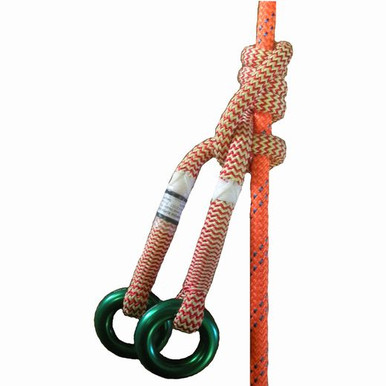
Expanding on the second option and adding an option to your post the other day about tying directly to a pulley, you could use a secret weapon instead of a pulley. In your case preset the friction hitch and backup knot, pull to the desired tie in and ascend doubled rope. The advantage is the easily adjustable tie in point allowing you to easily set SRS redirects while still climbing MRS. On initial setup, if going this route, I would leave a 20' tail on your basal line below the rings. This would allow up to a 20' redirect without having to untie your basal tie.

 
Walked out on a limb... ...until the use of swing throwing mah long lanyard, out to the nearest branch off, then catching the snap lock, to attach it to one of the opposite D-rings, seemed the only way to advance, to the supporting fringes of the branch.

But, yes, seriously, using a 15ft, smooth, stiff, rope, lanyard, is a great simple way to get way-out on a limb.
 
Last edited:
I had a drill sergeant like boss, so do or die was how I learned.

"Get out there farther! I want that rigging line tip tied! We'd be done by now if I were climbing! #@☠️!!!

Probably would have done well in the military.
 
The limbs on the ground are working well for getting a feel for this. It's pretty easy to control my lean angle with the ZZ. The important thing is foot placement and making sure the tension on the rope can't spin you around. That happens very quickly, and I'm really glad I'm learning about foot placement at ground level. All seems fine until suddenly it's not.
 
It's a subtle angle but you want to oppose the direction of the anchor as you work your way out. That way the limb is between you and the direction of force from your anchor. You can walk but "crawling' is awesome. Place footholds with girthed sling runners if you can't find natural footholds on the limb. Attach your lanyard ahead of you as you go, zero swingback potential. Crawl before you walk, walk before you run. The further out a good climber goes the more horizontal their body becomes as their rope angle becomes more shallow.
-AJ
 
Like moss said. I’ll add practice, practice practice. Get the clearest/highest tip you can, and it helps if the angle is off to one side or the other of the limb, scuttle out on the opposite side of the limb from your rope.
Keep your ass level or just below the limb is some of the best advice I’ve heard.
Many times I will use a long laynard and throw it out to the tips of the limb, walk out and snap in. This also allows me to use the lanyard while walking back in, not unlike two climbing lines.
Low and slow (but not too low!), and practice
 
After another session with the limbs on the ground, I found a yard tree with low limbs and a TIP in the right place for more. I had a limb to put my lanyard over, and a clear space to swing into if I messed up. I could move several feet in both directions and practice changing my lean angle. I even let myself get turned around and spun off the limb with and without the lanyard to see what it feels like.

Practicing in a safe place off the ground is a lot more fun, so I'm going to look for places with different limb arrangements to try.
 

New threads New posts

Back
Top Bottom