Hot wires

[ QUOTE ]
No requirements for tools to be tested nor do we in the states have to wear FR.

For one to be "Certified" they have to work for the utility or be a contractor for them with a one million dollar insurance policy and completed the EHAP course.

[/ QUOTE ]

Where's that info from Hammer? I'm not familiar with it.

And 'Certified' as what and by whom?
 
Maybe Tim Walsh can help us with this one. We are hired by the utility via the company that holds the contract for the line clearance. We do the work that they do not have the training or the equipment to perform the work safely. Documentation of our training was required beside that I do not know. I would have to talk to the sales rep.
 
[ QUOTE ]
All arborists must be trained to recognize and avoid electrical hazards. Qualified line-clearance arborists must have additional knowledge about electrical hazards and the special techniques used to work safely near electrical conductors.

[/ QUOTE ]

What are the special techniques?
 
[ QUOTE ]
[ QUOTE ]
All arborists must be trained to recognize and avoid electrical hazards. Qualified line-clearance arborists must have additional knowledge about electrical hazards and the special techniques used to work safely near electrical conductors.

[/ QUOTE ]

What are the special techniques?

[/ QUOTE ]

Kind of fishing here huh? Cant compare apples to watermelons. Canada has drastically different codes/laws/regs. for line clearance than the US. Not even in the same realm.
 
Not fishing but curious as to what special techniques would be used for power related removals than any other tree removal.
If the organization is stating special techiniques then I would think it is unrelated to any other tree removal?
Anyone doing this work would be familiar with these special techniques.
Electrocution is the number one killer of arborists so it warrants discussion.
I've had the training but use it to stay clear of the lines not get closer to them.
There's no good reason for not shutting them down when a life is at stake.
 
One tech would be using a crane. The LCTT are not allowed to use cranes. Alot of the removals we do for them can not be done with out one. The utilites consern is that the LCTT does not have the training or equipment to safely do the work and some one may get injured. Another consern is damage to there wires and poles. They are just being proactive. Both companies are good at measuring risk and are willing to bring in people with a larger skill set.
 
Kevin

I've had the pleasure to visit with Kramer Tree Service and see some of their operation.

Their professionalism and aptitude puts ALL of Ontario's big, private sector, utility tree service providers to shame.
 
Their professionalism and aptitude was never a question.
If the tree or anything else makes contact for any reason and there isn't any insulation between the climber and contact then the outcome is grim.
They don't all come off without a hitch, sooner or later something will happen, it's tree work.

1910.333(c)(3)

"Overhead lines." if work is to be performed near overhead lines, the lines shall be deenergized and grounded, or other protective measures shall be provided before work is started. If the lines are to be deenergized, arrangements shall be made with the person or organization that operates or controls the electric circuits involved to deenergize and ground them. If protective measures, such as guarding, isolating, or insulating, are provided, these precautions shall prevent employees from contacting such lines directly with any part of their body or indirectly through conductive materials, tools, or equipment.

http://www2.tbo.com/content/2008/may/07/.../?news-breaking
 
All of the work we do around live wires is very planned, starting at the sale and through completion. The mandatory requirment is that we must not expose ourselves to the hazard. Directly or indirectly.
 
[ QUOTE ]

Electrocution is the number one killer of arborists so it warrants discussion.
.

[/ QUOTE ]

I Thought "struck by(s)" was the number one cause?

Very nice Jason, Thanks for posting TK.
 
From TCIA...
[ QUOTE ]
Electricity is a serious and widespread hazard to the arborist. Electricity causes about 30 percent of the fatalities in the tree care industry, making it the leading cause of worker fatality. Furthermore, almost all arborists in the field have at least some exposure to this hazard. A street lamp circuit, a cable TV wire, even a phone line can be energized with enough voltage to kill. Indirect contact through a green tree branch or other conductive object is an ever-present threat. One doesn't have to touch a wire to be electrocuted, and about half of all electrocution fatalities are the result of indirect contact.


[/ QUOTE ]
 
Sorry I didn't get a chance to jump in sooner, I have been busy with my qualifying exams (one down one to go).

I'll try to cover as many comments as I can remember:

-Electricity is not the biggest killer. It is a large percentage 17%, but is usually 4th (after transportation 28%, falls 27% and struck-by's 23%)[data courtesy of Dr. John Ball). TCIA uses old OSHA data which is not accurate

-“Certification” to work around energized conductor’s comes from the company, in the United States. You do not have to work for the utility to be a Qualified Line Clearance Arborist QLCA (our designation in the US)

-In tree work in the US we use non-conductive tools, not live-line/hot sticks. We are not required to wear FR clothing and are not to rely on the dielectric capacity of rubber gloves/boots. We work near the lines, not on them

-The minimum approach distance(MAD) for that voltage (listed as 7kV) would be 2 feet 5 inches (and it sounds like you were 5-7 feet away)

-Completing EHAP does not make you qualified or certified

-Special techniques include maintaining MAD/LOA, climbing and rigging techniques, etc.

-In Tod’s case, 1910.269 applies, that is to say that they are working as Qualified Line Clearance Arborists. 1910.333 covers non-QLCA’s

-If the work cannot be completed safely while maintaining MAD, the utility must make it safe; DIG-De-energize, Isolate and Ground.

Sorry if it is a bit disjointed but I am at the tail end of studying for the last few months and my brain is a bit overloaded.

I’ll check this post to see if there are more questions.

TMW

 
[ QUOTE ]
The minimum approach distance(MAD) for that voltage (listed as 7kV) would be 2 feet 5 inches (and it sounds like you were 5-7 feet away)

[/ QUOTE ]

I'm sure the safe limits are very close between the U.S and Canada.
Two to five feet would be acceptable for someone that is authorized, cranes would be ten feet for 7kv.
Being authorized would mean having knowledge,being trained <u>and</u> equipped with the required nonconductive tools to do the work including rubber gloves(here).
All distances for safe limits of approach are measured from the point of planned <u>or</u> unplanned movement which inlcudes tools and trees.

[ QUOTE ]
Completing EHAP does not make you qualified or certified

[/ QUOTE ]

This is one issue that has been answered another would be the safe limits including trees and tools.
Are trees and conductive tools included in approach distances? They are here.

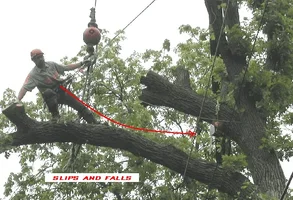
130917-slipsandfalls.PNG


Do these distances include slips and falls which could bring the climber within two feet or allow them to make contact?
Are the power companies asking if the work can be done safely without shutting down the power and leaving the onus on the tree company?
 

Attachments

  • 130917-slipsandfalls.webp
    130917-slipsandfalls.webp
    70.4 KB · Views: 65

New threads New posts

Back
Top Bottom